
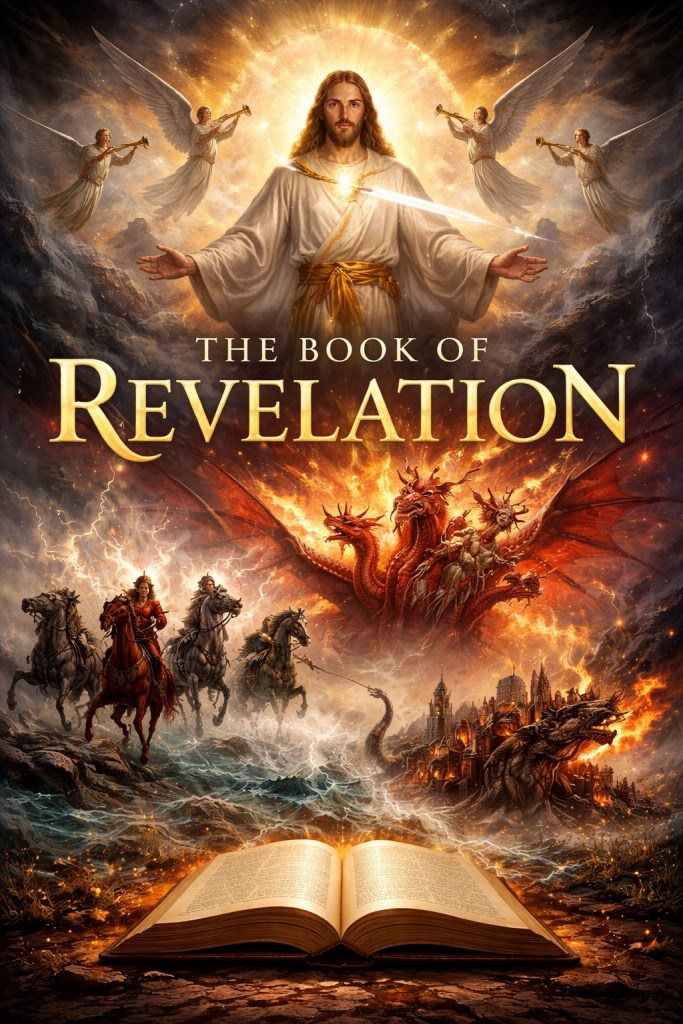
The Book of Revelation (also known as the Apocalypse) is the final book of the New Testament and perhaps the most misunderstood text in the Christian canon. For Catholics, it is not a cryptic timeline of the “end of the world” to be decoded like a newspaper; rather, it is a profound liturgical vision of the victory of Jesus Christ, the Lamb of God, over the powers of sin and death.
To understand Revelation from a Catholic perspective, one must look past the popular “rapture” theology of modern cinema and instead look toward the Holy Sacrifice of the Mass, the history of the Early Church, and the Old Testament prophets.
1. Authorship, Context, and Purpose
The Author and Setting
The book begins by identifying its author as John, who was in exile on the island of Patmos “because of the word of God and the testimony of Jesus” (Rev 1:9). Catholic tradition generally identifies him as St. John the Apostle, the “Beloved Disciple” and author of the Fourth Gospel.
Written likely during the reign of the Roman Emperor Nero (c. 60s AD) or Domitian (c. 90s AD), the book was addressed to seven specific churches in Asia Minor. These Christians were facing a dual crisis:
- External Persecution: The Roman Empire demanded worship of the Emperor as a god.
- Internal Apathy: Some Christians were compromising their faith to fit into pagan society.
The Literary Genre: “Apocalypse”
The word “Apocalypse” (from the Greek apokalypsis) does not mean “catastrophe.” It means “unveiling” or “revealing.” The book’s purpose is to pull back the curtain of earthly history to show the spiritual reality of Heaven. It uses Apocalyptic Literature, a style full of vivid symbolism, numbers, and cosmic battles, which was familiar to 1st-century Jews through books like Daniel and Ezekiel.
2. The Golden Key: Revelation as Liturgy
The most distinctive Catholic contribution to understanding Revelation is the recognition of its liturgical structure. Dr. Scott Hahn and other Catholic scholars point out that the imagery of Revelation mirrors the structure of the Mass.
- The Liturgy of the Word: The first half of the book (chapters 1–11) features the reading of letters to the churches and the opening of a scroll.
- The Liturgy of the Eucharist: The second half (chapters 12–22) culminates in the “Marriage Supper of the Lamb.”
When St. John sees Heaven, he doesn’t see a cloud-filled void; he sees a Temple. He sees:
- An Altar (Rev 6:9).
- Priests (the 24 elders) in white robes (Rev 4:4).
- Candlesticks or Menorahs (Rev 1:12).
- Incense representing the prayers of the saints (Rev 8:3-4).
- The Gloria and “Holy, Holy, Holy” being sung (Rev 4:8).
For Catholics, this means that every time the Mass is celebrated on earth, the Church is actually participating in the one eternal Liturgy of Heaven described in Revelation.
3. Major Symbols and Figures
To read Revelation, one must speak the language of the Old Testament. The book contains over 500 allusions to the Hebrew Scriptures.
The Lamb (Jesus Christ)
While the world expects a “Lion” to conquer (the Lion of the tribe of Judah), John turns and sees a Lamb standing as though it had been slain (Rev 5:6). This is the central paradox: Christ conquers not through military violence, but through sacrificial love. He is the Paschal Lamb whose blood saves His people.
The Woman Clothed with the Sun
In Chapter 12, John sees a woman “clothed with the sun, with the moon under her feet, and on her head a crown of twelve stars.” She gives birth to a male child who will rule the nations. Catholic tradition identifies this woman in three ways:
- The Church: The New Israel, persecuted by the Dragon (Satan) but protected by God.
- Mary: The literal Mother of the Messiah. The description of her as the “Ark of the Covenant” (the previous verse, Rev 11:19) reinforces this, as Mary carried the Word of God within her.
- Israel: The source from which the Savior came.
The Beast and 666
The “Beast” represents corrupt political power that mimics God and demands worship. In the immediate context of the 1st century, the Beast was often identified with Imperial Rome.
The infamous number 666 is an example of gematria (where letters have numerical values). In Hebrew, the name “Nero Caesar” adds up to 666. However, it also has a symbolic meaning: since 7 is the number of perfection, 666 is “triple imperfection”—a system that tries to be divine but fails miserably.
4. The Four Senses of the Apocalypse
The Catholic Church interprets Scripture through different “senses.” We can apply this to the terrifying visions of the bowls, seals, and trumpets:
| Sense | Interpretation of Revelation |
| Literal/Historical | It describes the fall of the Jerusalem Temple in 70 AD and the Roman persecutions. |
| Allegorical | It describes the ongoing battle between the Church and the “Spirit of the World” in every age. |
| Moral | It is a call for the individual soul to repent and remain faithful under trial. |
| Anagogical | It points toward the final Second Coming (Parousia) and the New Jerusalem. |
5. The “End Times” and the Last Judgment
Catholicism rejects Premillennialism (the idea that Christ will reign on a literal earthly throne for 1,000 years before the end). Instead, the Church teaches Amillennialism: the “1,000 years” is a symbolic number representing the current age of the Church, where Christ reigns through His Word and Sacraments.
The Great Tribulation
The Church teaches that before Christ’s second coming, she must pass through a final trial that will shake the faith of many believers (Catechism of the Catholic Church, 675). Revelation depicts this trial as a period of intense spiritual warfare.
The New Jerusalem
The book ends not with destruction, but with a Wedding. The “New Jerusalem” comes down from heaven as a bride adorned for her husband. There is no longer a need for a sun or a temple, for “the Lamb is its light.” This is the ultimate hope of the Catholic: the “Beatific Vision,” where we see God face-to-face.
6. Practical Takeaways for the Faithful
Why read this book today? It is not meant to cause fear, but to provide encouragement.
- God is in Control: No matter how powerful the “Beasts” of secularism, tyranny, or evil may seem, they have already been defeated by the Lamb.
- The Importance of Witness: The word “Martyr” in Greek means “Witness.” Revelation calls us to be faithful witnesses even unto death.
- A Call to Worship: It reminds us that our earthly worship is a “thin place” where Heaven and Earth meet.
- Hope in Suffering: The promise of Revelation 21:4 is the ultimate Christian consolation: “He will wipe away every tear from their eyes, and death shall be no more.”
Summary Table: Key Elements
| Element | Catholic Interpretation |
| The Seven Seals | God’s judgment on the old order (specifically the fall of the Temple). |
| Babylon the Great | Symbol of the corrupt city/empire (Rome) that persecutes the saints. |
| The 144,000 | Not a literal limit on people in heaven, but a symbol of the “Fullness of Israel” (12×12×1000). |
| The Sea of Glass | The baptismal waters and the peace of God’s presence. |
 Nelson MCBS
Leave a comment