
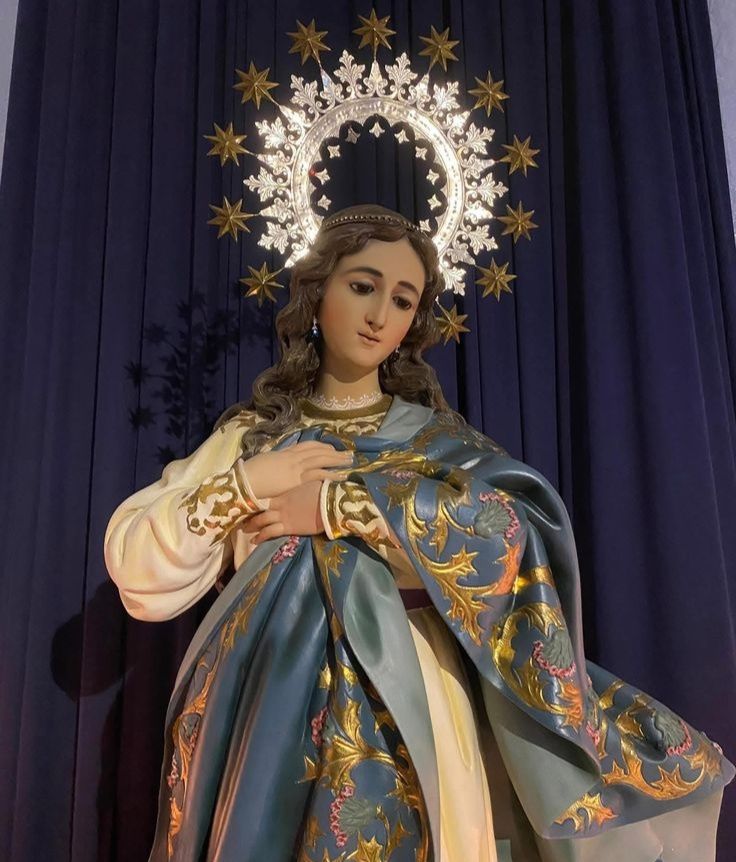
Many people mistakenly believe that the Immaculate Conception refers to the conception of Jesus Christ. Jesus’ conception was most assuredly immaculate—that is, without the stain of sin—but the Immaculate Conception does not refer to Jesus at all. The Immaculate Conception is a doctrine of the Catholic Church in regards to THE CONCEPTION OF MARY.Catholics celebrate the Feast of the Immaculate Conception of the Blessed Virgin Mary on December 8.
THE DOCTRINE
In the Constitution Ineffabilis Deus of 8 December, 1854, Pius IX pronounced and defined that the Blessed Virgin Mary “in the first instance of her conception, by a singular privilege and grace granted by God, in view of the merits of Jesus Christ, the Saviour of the human race, was preserved exempt from all stain of original sin.”
“The Blessed Virgin Mary…”
The subject of this immunity from original sin is the person of Mary at the moment of the creation of her soul and its infusion into her body.
“…in the first instance of her conception…”
The term conception does not mean the active or generative conception by her parents. Her body was formed in the womb of the mother, and the father had the usual share in its formation. The question does not concern the immaculateness of the generative activity of her parents. Neither does it concern the passive conception absolutely and simply (conceptio seminis carnis, inchoata), which, according to the order of nature, precedes the infusion of the rational soul. The person is truly conceived when the soul is created and infused into the body. Mary was preserved exempt from all stain of original sin at the first moment of her animation, and sanctifying grace was given to her before sin could have taken effect in her soul.
“…was preserved exempt from all stain of original sin…”
The formal active essence of original sin was not removed from her soul, as it is removed from others by baptism; it was excluded, it never was in her soul. Simultaneously with the exclusion of sin. The state of original sanctity, innocence, and justice, as opposed to original sin, was conferred upon her, by which gift every stain and fault, all depraved emotions, passions, and debilities, essentially pertaining to original sin, were excluded. But she was not made exempt from the temporal penalties of Adam — from sorrow, bodily infirmities, and death.
“…by a singular privilege and grace granted by God, in view of the merits of Jesus Christ, the Saviour of the human race.”
The immunity from original sin was given to Mary by a singular exemption from a universal law through the same merits of Christ, by which other men are cleansed from sin by baptism. Mary needed the redeeming Saviour to obtain this exemption, and to be delivered from the universal necessity and debt (debitum) of being subject to original sin. The person of Mary, in consequence of her origin from Adam, should have been subject to sin, but, being the new Eve who was to be the mother of the new Adam, she was, by the eternal counsel of God and by the merits of Christ, withdrawn from the general law of original sin. Her redemption was the very masterpiece of Christ’s redeeming wisdom. He is a greater redeemer who pays the debt that it may not be incurred than he who pays after it has fallen on the debtor.
Such is the meaning of the term “Immaculate Conception.”
THE CATECHISM
The Catechism of the Catholic Church states that she was “redeemed in a more exalted fashion, by reason of the merits of her Son” (CCC 492).
She has more reason to call God her Savior than we do, because he saved her in an even more glorious manner!
AN ANALOGY
Suppose a man falls into a deep pit, and someone reaches down to pull him out. The man has been “saved” from the pit. Now imagine a woman walking along, and she too is about to topple into the pit, but at the very moment that she is to fall in, someone holds her back and prevents her. She too has been saved from the pit, but in an even better way: She was not simply taken out of the pit, she was prevented from getting stained by the mud in the first place. This is the illustration Christians have used for a thousand years to explain how Mary was saved by Christ. By receiving Christ’s grace at her conception, she had his grace applied to her before she was able to become mired in original sin and its stain.
WHERE IS THIS IN THE BIBLE?
It’s not explicitly mentioned, but implicitly acknowledged
Jude 24-25
24 To him who is able to keep you from stumbling and to present you before his glorious presence without fault and with great joy— 25 to the only God our Savior be glory, majesty, power and authority, through Jesus Christ our Lord, before all ages, now and forevermore! Amen.
BUT WHAT ABOUT Romans 3 :23 “all have sinned”?
Have all people committed actual sins? Consider a child below the age of reason. By definition he can’t sin, since sinning requires the ability to reason and the ability to intend to sin. {Also a mentally retarded child can’t sin.]} This is indicated by Paul later in the letter to the Romans when he speaks of the time when Jacob and Esau were unborn babies as a time when they “had done nothing either good or bad” (Romans 9:11).
We also know of another very prominent exception to the rule: Jesus (Hebrews 4:15).
So if Paul’s statement in Romans 3 includes an exception for the New Adam (Jesus), one may argue that an exception for the New Eve (Mary) can also be made.
Paul’s comment seems to have one of two meanings. It might be that it refers not to absolutely everyone, but just to the mass of mankind (which means young children and other special cases, like Jesus and Mary, would be excluded without having to be singled out). If not that, then it would mean that everyone, without exception, is subject to original sin, which is true for a young child, for the unborn, even for Mary — but she, though due to be subject to it, was preserved by God from it and its stain.
IF MARY IS WITHOUT SIN, WOULD SHE BE EQUAL TO GOD?
The objection is also raised that if Mary were without sin, she would be equal to God. In the beginning, God created Adam, Eve, and the angels without sin, but none were equal to God. Most of the angels never sinned, and all souls in heaven are without sin. This does not detract from the glory of God, but manifests it by the work he has done in sanctifying his creation. Sinning does not make one human. On the contrary, it is when man is without sin that he is most fully what God intends him to be.
A SIMPLE DEFENSE OF THE IMMACULATE CONCEPTION
Today, however, I want to focus on those four famous words that were used to defend the Immaculate Conception of Mary:
Potuit, decuit, ergo fecit!
“He could; it was fitting; therefore, He did it!”
The Son of God was able to make Mary without original sin.
It was fitting and decent that the Son of God would honor His Mother this way.
Therefore, God did make his Mother without original sin.
The argument is useful for the simple reason that it disarms opponents that deny the Immaculate Conception. It is still useful today in sharing your faith with Protestants.
Simply ask, “Could God make a person without original sin?” (potuit)
Next ask, “Would it have been decent or fitting for the Son of God to have his mother 100% pure and loyal to him?” (decuit)
Then follows the conclusion, “Well then, if He could do it and it was fitting, then He did do it. Mary was conceived immaculately (conceived without stain – macula is Latin for “stain”).
COMMON ERRORS ABOUT THE IMMACULATE CONCEPTION
1) Mary is immaculate because she was conceived by the power of the Holy Spirit. The truth is that Mary was conceived in a natural manner by her parents, Joachim and Anne, but without the stain of the Original Sin.
2) Mary is immaculate because she is a virgin. Indeed, the fact that Mary is immaculate has nothing to do with her virginity, lest we consider the natural intercourse between husband and wife a sin.
3) Mary is immaculate, therefore she did not need a Savior. In truth, all men need to be saved by Jesus; but in the case of Mary, salvation was anticipated to her conception, so that Jesus Christ could be born from a sinless and perfectly pure mother.
CONCLUSION
In 1849, Pius IX asked the bishops throughout the Church what they themselves, their clergy, and the people felt about this belief and whether they would want it defined solemnly. Of 603 bishops, 546 responded favorably without hesitation. Of those opposing, only 5 said the doctrine could not be solemnly defined, 24 did not know whether this was the opportune time, and 10 simply wanted a condemnation of any rejection of the doctrine. On December 8, 1854, Pius IX solemnly defined the dogma of the Immaculate Conception in his bull Ineffabilis Deus.
Finally, it is also interesting that in several apparitions of our Blessed Mother, she herself has attested to her Immaculate Conception: On December 9 (the date for the Solemnity of the Immaculate Conception in the Spanish Empire) in 1531 at Guadalupe, Mary said to Juan Diego, ”I am the perfect and perpetual Virgin Mary, Mother of the true God, through whom everything lives. . . ” In 1830, Mary told St. Catherine Laboure to have the Miraculous Medal struck with the inscription, “Mary conceived free from sin, pray for us who have recourse to thee.”
Lastly, when she appeared to St. Bernadette at Lourdes in 1858, Mary said, “I am the Immaculate Conception.”
Source: Fear Not
 Nelson MCBS
Leave a comment