

Introduction
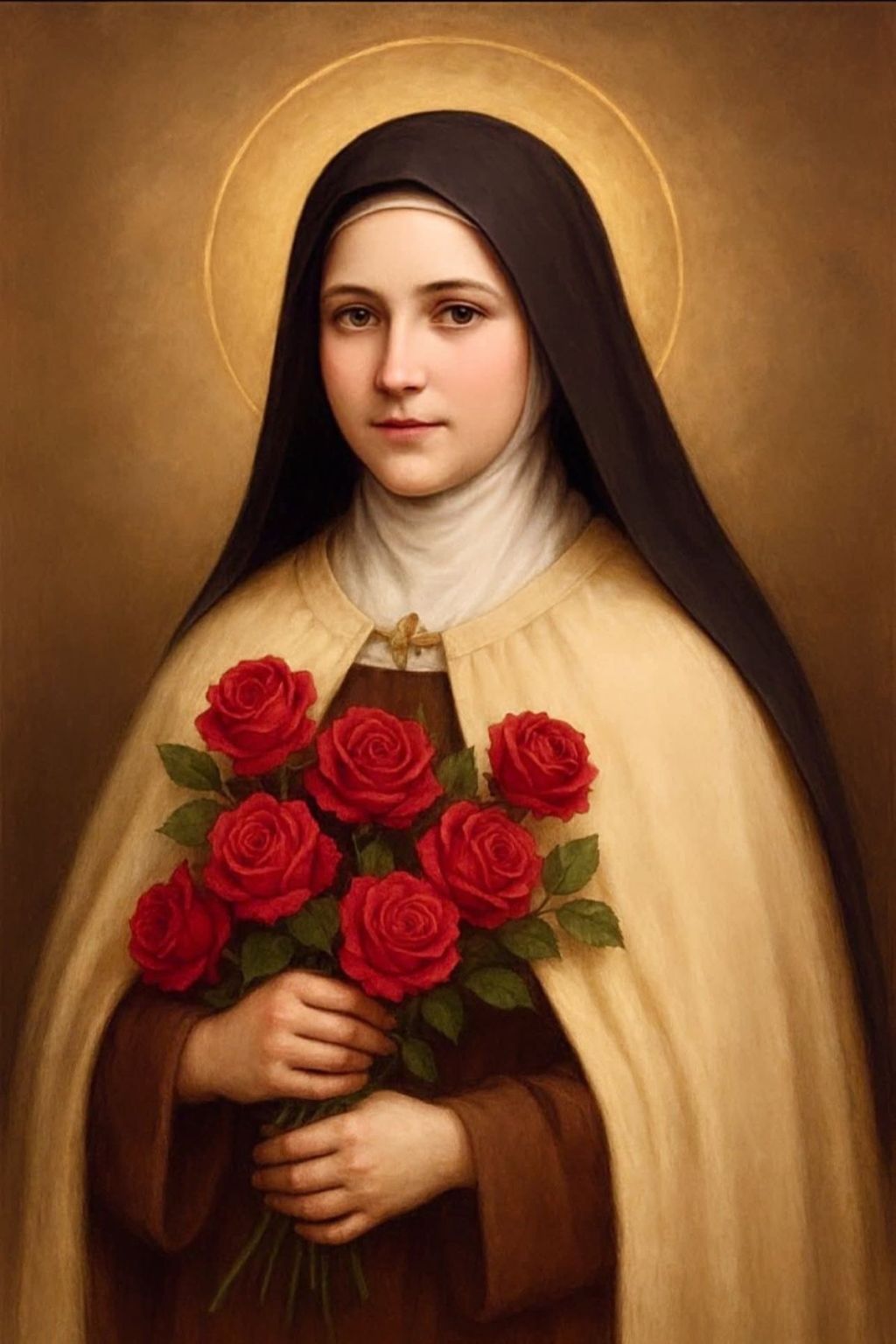
Saint Thérèse of the Child Jesus and of the Holy Face, popularly known as Saint Thérèse of Lisieux or “The Little Flower”, is one of the most beloved saints of the Catholic Church. Though she lived only twenty‑four years and never left the walls of her Carmelite convent, her influence has spread to every corner of the world. Canonized in 1925 and declared a Doctor of the Church in 1997, Thérèse has touched countless hearts through her profound spirituality of simplicity, trust, and love, often summed up in her famous teaching: “the Little Way.”
This document presents a comprehensive account of her life, family background, spiritual journey, writings, theology, miracles, canonization, and enduring relevance for Christians today.
1. Historical and Family Background
1.1 France in the 19th Century
Thérèse was born in a France marked by political upheaval, secularism, and religious revival. The French Revolution had deeply wounded the Church, yet the 19th century also witnessed renewed devotion, missionary zeal, and the flourishing of religious congregations. It was in this context that Thérèse’s simple yet radical holiness emerged as a response to a world torn between faith and modernity.
1.2 The Martin Family
Thérèse was born Marie‑Françoise‑Thérèse Martin on January 2, 1873, in Alençon, Normandy, to Louis Martin and Zélie Guérin. Both parents were deeply devout Catholics, later canonized as saints themselves in 2015.
Zélie, a lace‑maker, was a woman of strong faith and tenderness, while Louis, a watchmaker, was gentle, prayerful, and contemplative. Their marriage was rooted in prayer, charity, and trust in God. Of their nine children, four died in infancy. Five daughters survived, and remarkably, all five became Carmelite nuns.
This family atmosphere of love, discipline, sacrifice, and prayer formed the foundation of Thérèse’s spirituality.
2. Childhood and Early Spiritual Sensitivity
2.1 A Sensitive Child
From her earliest years, Thérèse displayed an extraordinary sensitivity. She was affectionate, deeply emotional, and eager to please. She also possessed a strong sense of justice and moral awareness. Even as a child, she experienced intense joy as well as profound suffering.
2.2 The Death of Her Mother
When Thérèse was only four and a half years old, her mother Zélie died of breast cancer in 1877. This loss deeply wounded Thérèse and marked her personality. She later wrote that her mother’s death was her “first great sorrow.” Afterward, she became more withdrawn and emotionally fragile.
Her older sister Pauline assumed a maternal role, becoming a source of comfort and guidance. Thérèse’s emotional dependence on Pauline would later become a significant spiritual trial.
2.3 Move to Lisieux
Following Zélie’s death, the Martin family moved to Lisieux, where Thérèse would spend the rest of her life. The family home, Les Buissonnets, became a place of spiritual growth, prayer, and education.
3. Awakening of a Vocation
3.1 Desire for Religious Life
From a young age, Thérèse felt called to religious life. Watching her sisters Pauline and Marie enter the Carmel of Lisieux stirred a deep longing in her heart. She desired not simply to become a nun, but to give herself entirely to God.
3.2 Emotional Trials and Healing
In 1886, when Thérèse was thirteen, she experienced what she later described as a profound conversion of heart. After years of emotional hypersensitivity, she received the grace of inner strength. She recalled this moment as her “Christmas Grace,” when she was freed from childish self‑absorption and began to think more of others.
This inner transformation prepared her for the radical path she would soon embrace.
4. The Struggle to Enter Carmel
4.1 Too Young for the Convent
At the age of fourteen, Thérèse sought entrance into the Carmelite convent of Lisieux. Despite her evident piety, she was considered too young. Both the local superior and the bishop initially refused her request.
4.2 Pilgrimage to Rome
In 1887, Thérèse joined a pilgrimage to Rome with her father and sister Céline. During an audience with Pope Leo XIII, she courageously broke protocol and knelt before the Pope, begging permission to enter Carmel at fifteen. Though the Pope did not grant immediate permission, the encounter strengthened her resolve.
4.3 Entrance into Carmel
Finally, on April 9, 1888, at the age of fifteen, Thérèse entered the Carmel of Lisieux. She described this day as the fulfillment of her heart’s deepest desire.
5. Life in the Carmelite Convent
5.1 Hiddenness and Ordinary Duties
Contrary to romantic expectations, Thérèse’s Carmelite life was marked by monotony, obscurity, and small sacrifices. She worked in the laundry, sacristy, and infirmary. Her days were filled with prayer, silence, community life, and simple tasks.
She later wrote that sanctity did not consist in extraordinary deeds, but in doing ordinary things with extraordinary love.
5.2 Community Challenges
Thérèse faced misunderstandings, harsh treatment, and spiritual dryness. Some sisters found her irritating or insignificant. Rather than seeking recognition, Thérèse chose to respond with patience, humility, and silent charity.
These trials became the soil in which her Little Way blossomed.
6. The “Little Way” of Spiritual Childhood
6.1 Essence of the Little Way
Thérèse’s central spiritual insight was her “Little Way”, a path of holiness accessible to everyone. She believed that sanctity did not require heroic feats but total trust in God’s mercy.
The Little Way emphasizes:
- Spiritual childhood
- Confidence in God’s love
- Acceptance of one’s weakness
- Offering small acts with great love
6.2 Trust and Mercy
Thérèse compared herself to a child climbing stairs to reach God, trusting entirely in His arms. She rejected fear‑based spirituality and emphasized God’s tenderness.
Her bold confidence led her to say: “I am not afraid of God who made Himself so small for me.”
6.3 Universal Call to Holiness
Long before the Second Vatican Council, Thérèse articulated the idea that holiness is for everyone, not only priests or mystics. Her message remains deeply relevant today.
7. Writings and Spiritual Legacy
7.1 Story of a Soul
At the request of her superiors, Thérèse wrote her autobiography, “Story of a Soul”, which later became one of the most widely read spiritual books in history.
The book reveals her inner life, struggles, joys, and spiritual discoveries with remarkable honesty and depth.
7.2 Letters and Poems
Thérèse wrote numerous letters, prayers, and poems, expressing her love for Christ and her missionary zeal. Her writings reveal theological depth combined with childlike simplicity.
8. Missionary Zeal and Universal Love
Though cloistered, Thérèse felt a burning desire to be a missionary. She spiritually adopted missionaries, praying and sacrificing for their work.
She famously declared: “In the heart of the Church, my mother, I shall be love.”
This insight defined her vocation and universal mission.
9. Illness, Dark Night, and Death
9.1 Tuberculosis
In 1896, Thérèse fell ill with tuberculosis. Her final months were marked by intense physical suffering and spiritual darkness.
9.2 Trial of Faith
She experienced a profound night of faith, struggling with doubts about heaven. Yet she chose to cling to trust and love, offering her suffering for unbelievers.
9.3 Death
Thérèse died on September 30, 1897, at the age of twenty‑four. Her final words were: “My God, I love You.”
10. After Death: The Shower of Roses
Before her death, Thérèse promised to “spend her heaven doing good on earth.” Soon after, countless people reported favors and miracles attributed to her intercession, often symbolized by roses.
11. Canonization and Doctor of the Church
Thérèse was beatified in 1923 and canonized in 1925 by Pope Pius XI. In 1997, Pope John Paul II declared her a Doctor of the Church, recognizing the profound theological depth of her teaching.
12. Patronages and Global Devotion
Saint Thérèse is the patroness of:
- Missions
- Missionaries
- Florists
- Those suffering from illness
Her shrine in Lisieux attracts millions of pilgrims each year.
13. Relevance for the Modern World
In an age obsessed with achievement and recognition, Thérèse reminds us that love, humility, and trust remain the heart of Christian life. Her message speaks powerfully to those who feel small, weak, or overlooked.
Conclusion
Saint Thérèse of Lisieux proves that holiness is not measured by the size of one’s deeds, but by the depth of one’s love. Her Little Way continues to open paths of hope, healing, and trust for millions. In her hidden life, she became a universal saint, whispering to every soul: “You, too, are called to holiness.”
“After my death, I will let fall a shower of roses.” – Saint Thérèse of Lisieux
 Nelson MCBS
Leave a comment