
From the very dawn of Christianity, persecution has walked hand in hand with faith. The story of the Church is written not only in ink and parchment but in the blood of those who believed, loved, and refused to deny Christ. Across two thousand years, from the dusty roads of Jerusalem to the wartorn plains of Iraq, the faithful have carried the Cross with courage. The early Church Father Tertullian said, “The blood of the martyrs is the seed of the Church.” Those words, spoken nearly eighteen centuries ago, still speak with power today.
Jesus never promised His followers a comfortable life. Instead, He prepared them for struggle. “If they persecuted me, they will persecute you also,” He warned (John 15:20). St. Paul echoed the same truth: “All who desire to live a godly life in Christ Jesus will be persecuted” (2 Timothy 3:12). From the very start, the Church understood that to follow Christ meant to share in His suffering. St. Ignatius of Antioch, on his way to martyrdom in Rome, wrote with burning love: “Let me be food for the wild beasts, through whom I can attain to God.” His words remind us that Christian persecution is not defeat it is the deepest expression of love, the willingness to die rather than deny the One who died for us.
Even today, persecution continues to scar the Body of Christ. According to international reports, more than 360 million Christians face discrimination, harassment, or open violence because of their faith. Yet, wherever the Church bleeds, she also blooms. The faith of the persecuted has become a mirror reflecting Christ’s own Passion silent, forgiving, and unbreakable.
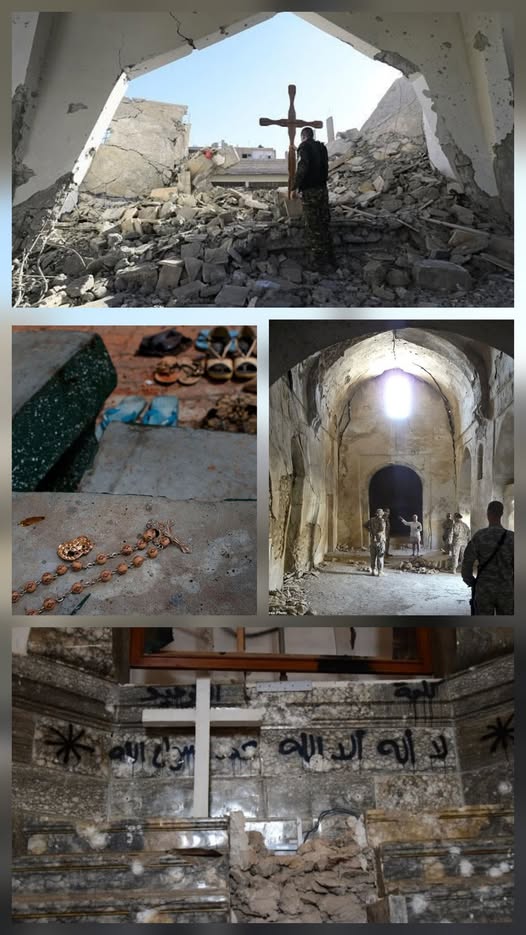
Take Iraq, the ancient cradle of Christianity. Once a land filled with the prayers of Chaldeans, Assyrians, and Armenians, it has seen its Christian population fall from 1.5 million to less than 200,000. When ISIS invaded in 2014, they burned churches, destroyed monasteries, and forced families from their homes. Yet in the ashes, faith refused to die. One priest from Qaraqosh said with quiet strength, “They destroyed our churches, but not our faith.” In that simple statement lives the spirit of Revelation 2:10: “Be faithful unto death, and I will give you the crown of life.”
In Sudan, believers faced years of oppression under a regime that sought to erase the cross from its skyline. Churches were bulldozed, priests imprisoned, and Christians driven into hiding. But even in the desert and the caves, they whispered prayers and broke bread together. St. Cyprian of Carthage once said, “The Church flourishes when it is persecuted.” Sudan’s faithful have proved those words with their lives.
In Nigeria, the soil has become red with martyr’s blood. Boko Haram and Fulani extremists have terrorized entire Christian communities burning churches, kidnapping children, killing worshippers in their pews. Yet the Sunday bells still ring. Families still gather to sing hymns through tears. Their courage reminds us of the Psalmist’s cry: “For your sake we face death all day long; we are considered as sheep to be slaughtered” (Psalm 44:22). The Church in Nigeria stands on Calvary every week, yet she sings alleluia from the cross.
Pakistan, too, bears its own Via Dolorosa. Christians there live with constant fear of blasphemy accusations that can bring imprisonment or death. Yet amid the fear, heroes rise. Shahbaz Bhatti, the Catholic Minister for Minorities, was murdered for defending the faith. Before his death, he said, “I only want a place at the feet of my Lord Jesus.” Like St. Stephen, he prayed forgiveness for his killers (Acts 7:60). The blood of such martyrs waters hope in a land of fear.
In China, persecution wears the face of control. The government surveils churches, imprisons priests, and censors Christian teaching. Yet believers still gather in underground rooms to whisper prayers, share Scripture, and baptize in secret. As St. John Chrysostom said, “The Church is like a great tree: the more it is cut, the more it grows.” The hidden Church in China continues to grow in silence proof that the Spirit cannot be chained.
North Korea remains one of the most hostile places on earth for Christians. Owning a Bible or praying in secret can mean imprisonment or execution. Still, believers meet in forests and caves to worship. They cannot sing aloud, so they hum their hymns through tears. They live the Beatitude: “Blessed are those who are persecuted for righteousness’ sake, for theirs is the kingdom of heaven” (Matthew 5:10). Their silence is a hymn of courage that rises to heaven.
In India, violence against Christians has grown in recent years. Radical groups burn churches, attack pastors, and threaten converts. Yet even in the midst of hostility, believers stand firm. Their faith echoes that of St. Polycarp, who said before his execution: “Eighty six years I have served Him, and He has done me no wrong. How can I blaspheme my King who saved me?” The same courage lives today in the hearts of Indian Christians who choose peace over revenge and forgiveness over fear.
From the first century until now, Christianity has faced every weapon known to man swords, spears, fire, prisons, and guns. Empires rose and fell, tyrants issued decrees, and dictators wrote new laws, yet none could silence the name of Jesus. The Roman Caesars tried to drown it in blood; the Ottoman swords tried to cut it down; communist regimes tried to erase it; modern atheism mocks it but the faith lives on. The Church has survived persecution, exile, ridicule, and war because it was never a human invention. It was born from the heart of God. St. John Paul II once said, “The Church does not die. She carries within her the strength of the Resurrection.” That is why, no matter how dark the night, dawn always returns for the followers of Christ.
The mystery of persecution lies at the very heart of the Gospel. St. Paul, who suffered imprisonment and stoning, wrote, “I complete in my flesh what is lacking in Christ’s afflictions for the sake of His body, the Church” (Colossians 1:24). The persecuted are not victims of fate; they are living icons of Christ’s love. Through them, the world sees that faith cannot be killed because it is rooted not in power, but in love. The Catechism of the Catholic Church reminds us, “Martyrdom is the supreme witness given to the truth of the faith.” The martyrs preach with their wounds what we often hesitate to say with our words.
Yet beyond the suffering, there is hope a quiet, indestructible hope. From the catacombs of Rome to the ruins of Nineveh, from the deserts of Sudan to the mountains of India, the Church still rises. St. Augustine beautifully wrote, “The martyrs’ deaths are the Church’s crowns.” Every act of persecution becomes a new proclamation of faith. The cross that was meant to destroy becomes the banner of victory.
Christian persecution, therefore, is not only a story of pain it is a story of love, faith, and eternal triumph. It reminds us that the message of Jesus cannot be silenced, that the light of Christ will always shine through the cracks of human cruelty. The persecuted Church calls each of us to stand firm in faith, to pray for the suffering, and to never take our freedom for granted. For the Lord Himself has promised, “Be faithful unto death, and I will give you the crown of life” (Revelation 2:10).
 Joseph Thekkedath Puthenkudy
“The blood of the martyrs waters the faith of generations.”
 Nelson MCBS
Leave a comment