

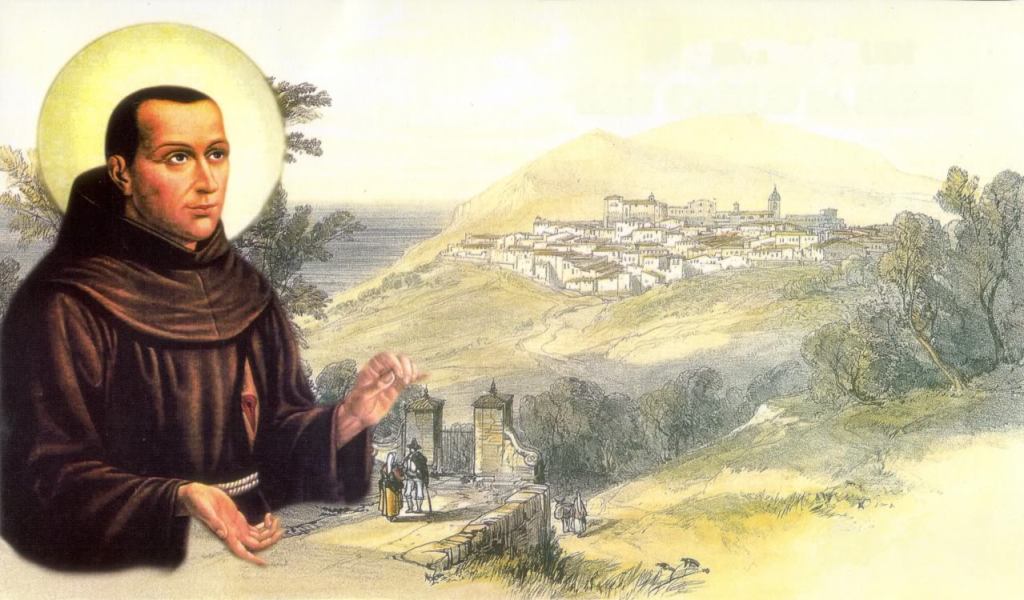
Saints often emerge from dramatic narratives—royal courts, intellectual circles, missionary adventures, or martyrdom. Yet some of the most luminous figures in Christian history appear from unexpected corners, living lives so quiet that their holiness is at first almost imperceptible. Among these hidden gems stands Saint Charles of Sezze (1613–1670), a humble Franciscan lay brother whose deep spiritual life blossomed in the midst of ordinary tasks and silent obedience. Though never ordained and never holding significant office within his order, Charles’s sanctity radiated through his humility, mystical insight, and unwavering charity. Today he is remembered as a model of simple holiness in a world that often overlooks the value of the small and unassuming.
Early Life in Sezze: Roots in Simplicity
Carlo Marchionne—later known as Brother Charles—was born on October 19, 1613, in Sezze, a small town in the Lazio region of Italy. His family lived modestly, and Charles received only basic schooling. What he lacked in formal education, however, he made up for in spiritual sensitivity. From an early age he displayed a quiet, contemplative nature, marked by a longing for closeness to God and a desire to serve others.
His youth was spent working alongside his family as a shepherd and farm laborer. These early experiences among the hills and fields would later influence his spirituality profoundly. The rhythms of nature, the solitude of pastoral life, and the simplicity of rural existence formed in him a mindset attentive to the presence of God in the ordinary. His upbringing also instilled in him a profound humility—he never considered himself gifted, extraordinary, or deserving of admiration.
Answering the Call: The Franciscan Vocation
At the age of 22, drawn by a deep inner stirring, Charles entered the Franciscan Order of the Friars Minor as a lay brother. His decision was guided not by an ambition to become a priest or scholar, but by a desire to imitate the poverty and humility of Saint Francis of Assisi. Throughout his life, Charles remained steadfast in this commitment.
As a lay brother, he was assigned simple duties that others might have found menial—working in the kitchen, cleaning, collecting alms, and tending to the community’s everyday needs. Yet Charles approached each task with devotion, viewing every act as an opportunity to serve God with love. His life echoed the Franciscan conviction that holiness is not limited to preaching or teaching but is accessible through lived humility and generous service.
His superiors quickly recognized his virtues, even if Charles presented himself as unimportant. Though lacking advanced education, he displayed a wisdom that was unmistakably spiritual. Many friars sought his advice, surprised to find deep insight in someone who barely spoke of himself and claimed no authority.
A Hidden Mystic: Visions, Ecstasies, and Spiritual Gifts
Although Charles lived a life marked by obscurity, God chose to grant him extraordinary mystical experiences. These were not the result of intense theological study or intellectual speculation, but were instead gifts given to a soul receptive in its humility.
He experienced moments of ecstasy, visions of Christ and the saints, and profound contemplative states. Despite these mystical encounters, he never boasted about them. In fact, he generally avoided discussing such experiences unless obedience to his superiors required it. His spirituality was not centered on mystical gifts themselves but on the deepening of love, humility, and union with God.
Perhaps the most remarkable incident occurred in 1648, when Charles was praying in a chapel. Overcome with devotion, he placed his hand on his chest, and tradition says that his fingers miraculously penetrated his flesh without causing bleeding. The indentation reportedly remained visible for the rest of his life—a mysterious reminder of his burning love for Christ. Like many mystical wounds recorded in Christian history, this phenomenon served as a symbol rather than a spectacle: a sign of a heart wholly given to God.
The Wounded Healer: Charity in Everyday Life
Charles’s holiness was not confined to mystical experiences; it was rooted in charity. He was known for his kindness, particularly toward the sick, the poor, and the suffering. He served in the convent infirmary for years, tending to the ill with patience and compassion. His gentle presence brought comfort to many who struggled physically or spiritually.
Despite frequent illness and personal suffering, Charles rarely complained. His life was one of self-offering, marked by a quiet acceptance of God’s will in all circumstances. In this way, he embodied one of the core Franciscan virtues: the joyful embrace of poverty, humility, and service.
The Reluctant Author: A Soul’s Journey in Writing
Though he lacked formal education, Charles’s superiors encouraged him to write about his spiritual life. Obediently, he composed several autobiographical and devotional works, the most famous being “The Grandezza e Bontà di Dio” (“The Greatness and Goodness of God”), which recounts the movement of God’s grace throughout his life.
These writings reveal a soul steeped in humility. He constantly referred to himself as unworthy and sinful, even as he described the extraordinary ways in which God had touched his life. His reflections offer valuable insight into a spirituality grounded not in intellectual mastery but in surrender, trust, and inward transformation.
A Reputation of Holiness: Confessor of Popes
In time, Charles’s sanctity became known beyond his monastery. People from across Rome and Lazio sought him out for spiritual guidance. Even prominent figures recognized his wisdom. One remarkable example is Pope Clement IX, who invited Charles to his bedside during a serious illness. The pope trusted the prayers of this humble lay brother more than the counsel of any court prelate.
The respect Charles received from clergy and laypeople alike was a testament to the power of holiness lived authentically. Despite his reputation, Charles remained committed to the foundational Franciscan virtues of simplicity, poverty, and service.
Final Years and Death
By the late 1660s, Charles’s health began to decline. After a life of service marked by physical effort, voluntary penance, and mystical experiences, his body grew frail. Yet even in sickness, he continued to inspire others through his patience and serenity.
Charles died on January 6, 1670, the feast of the Epiphany. Many saw symbolism in the fact that this humble brother—like the Magi who sought Christ—had spent his life seeking the presence of God and revealing that presence to others in the simplest of ways.
Canonization and Legacy
After his death, reports of miracles and answered prayers spread rapidly. His reputation for holiness endured, and the Church recognized his virtues through careful examination of his life and works. Charles was beatified in 1882 and canonized by Pope John XXIII in 1959, nearly 300 years after his death.
Today, Saint Charles of Sezze is remembered not for scholarly achievements or dramatic missionary journeys, but for his sanctity in everyday life. He is a reminder that holiness is accessible to all—not only to theologians, clergy, or those with extraordinary talents. His life teaches that the path to God lies in humility, service, and the willingness to embrace one’s ordinary tasks with extraordinary love.
A Saint for Our Time
In a world that celebrates ambition, visibility, and success, Saint Charles of Sezze offers a powerful counter-witness. His life invites us to rediscover:
- The value of humility in an age of self-promotion
- The sacredness of ordinary work in a culture chasing achievement
- The beauty of silence and contemplation amid constant noise
- The power of charity and service in a society yearning for compassion
Saint Charles reminds us that God’s grace often hides in quiet corners—in small acts of love, in simple routines, in whispered prayers. His example encourages us to find holiness not by reaching upward toward glory but by bending low in humility, where God’s light shines gently but unmistakably.
Prayer to Saint Charles of Sezze
O gentle and humble Saint Charles of Sezze,
faithful servant of God and true son of Saint Francis,
we come before you seeking your intercession.
You who found holiness in simple tasks,
teach us to discover God’s presence in the ordinary moments of our lives.
Help us to cultivate humility, patience, and charity,
that we might imitate your quiet trust in the Lord’s providence.
Saint Charles, mystic of the hidden life,
intercede for us in our struggles—
bring comfort to the suffering, courage to the weary,
and peace to all who carry heavy burdens.
Ask God to fill our hearts with the same burning love
that guided your steps and shaped your every action.
May your example inspire us to serve with joy
and to surrender our lives to God with confidence and hope.
Saint Charles of Sezze, pray for us.
 Nelson MCBS
Leave a comment