
Introduction
Saint Hugh of Lincoln, also known as Hugh of Avalon, stands among the most celebrated saints of medieval England. Renowned for his devotion, justice, humility, and uncompromising defense of Christian values, Saint Hugh’s influence extended far beyond his diocese. His life, filled with service to God and neighbor, provides a shining example of Christian leadership and compassionate holiness relevant to every generation.
Early Life: From Burgundy to the Cloister
Hugh was born around 1140 in Avalon, Burgundy (modern-day France), to William, Lord of Avalon, and Anne. Hugh’s mother died when he was eight. His father, moved by grief and faith, retired with his son to a nearby monastery at Villard-Benoît, where Hugh received a solid religious education. Immersed in prayer, work, and humility from an early age, Hugh’s character was shaped in the monastic mold of discipline, learning, and love for the poor.
At 15, Hugh became a canon regular—beginning the life of discipline, community, and liturgical prayer that would define his sanctity. His path soon led him to the Carthusian Order, one of the most austere and contemplative communities of the medieval church. As a Carthusian at the Grande Chartreuse, Hugh embraced its silence, prayer, and labor—a preparation for the greatness God had in store for him.
The Mission to England: Building Witham Charterhouse
Hugh’s reputation for holy wisdom reached across the English Channel. In penance for the murder of Saint Thomas Becket, King Henry II of England founded the first Carthusian monastery in England, at Witham in Somerset. He called upon Hugh to lead the new priory. Accepting after much hesitation and out of obedience, Hugh arrived in England, where his gentle leadership and commitment to reform quickly turned Witham Charterhouse into a beacon of prayer and renewal.
While at Witham, Hugh earned the respect—even admiration—of Henry II, not by flattery but by courageous truth-telling. He did not shy from rebuking the king for keeping ecclesiastical posts vacant for financial gain. Hugh’s moral courage and integrity marked his dealings with nobles and commoners alike.
Bishop of Lincoln: A Shepherd of the People
In 1186, the vast see of Lincoln had been without a bishop for years. It was the largest diocese in England, encompassing much of the east and central midlands. Hugh was chosen for this Herculean task. Reluctant but obedient, he was consecrated as Bishop of Lincoln.
From the outset, Hugh was a reforming bishop. He restored ecclesiastical discipline, rebuilt the spiritual life of clergy and laity, and undertook the restoration of Lincoln Cathedral, which had been ruined by fire and earthquake. His architectural projects reflected his vision for the diocese: beauty restored, faith renewed.
Defender of Justice and the Poor
Hugh was renowned not only for his holiness but for his unwavering sense of justice. He fearlessly defended the church’s rights against royal interference from both Henry II and his successors, Richard I and John, earning him the title “Hammer of Kings.” Yet, Hugh’s courage extended beyond the defense of church property:
- Protector of the Jews: During the violent persecutions of Jews in 1190-91, Hugh repeatedly risked his own life, intervening with courage and eloquence to disperse mobs and save innocent victims. He issued stern rebukes to persecutors and was one of the few voices denouncing anti-Semitic violence in his day.
- Advocate for the Oppressed: Hugh defended the poor against unjust practices such as the king’s harsh forestry laws. He frequently tended to lepers with his own hands, eating with them and ministering as Christ did.
- Diligence in Pastoral Care: Hugh traveled ceaselessly on horseback, personally visiting parishes, comforting the sick, aiding the poor, and ensuring the administration of justice across his enormous diocese.
Spiritual Depth and Friendship with God’s Creatures
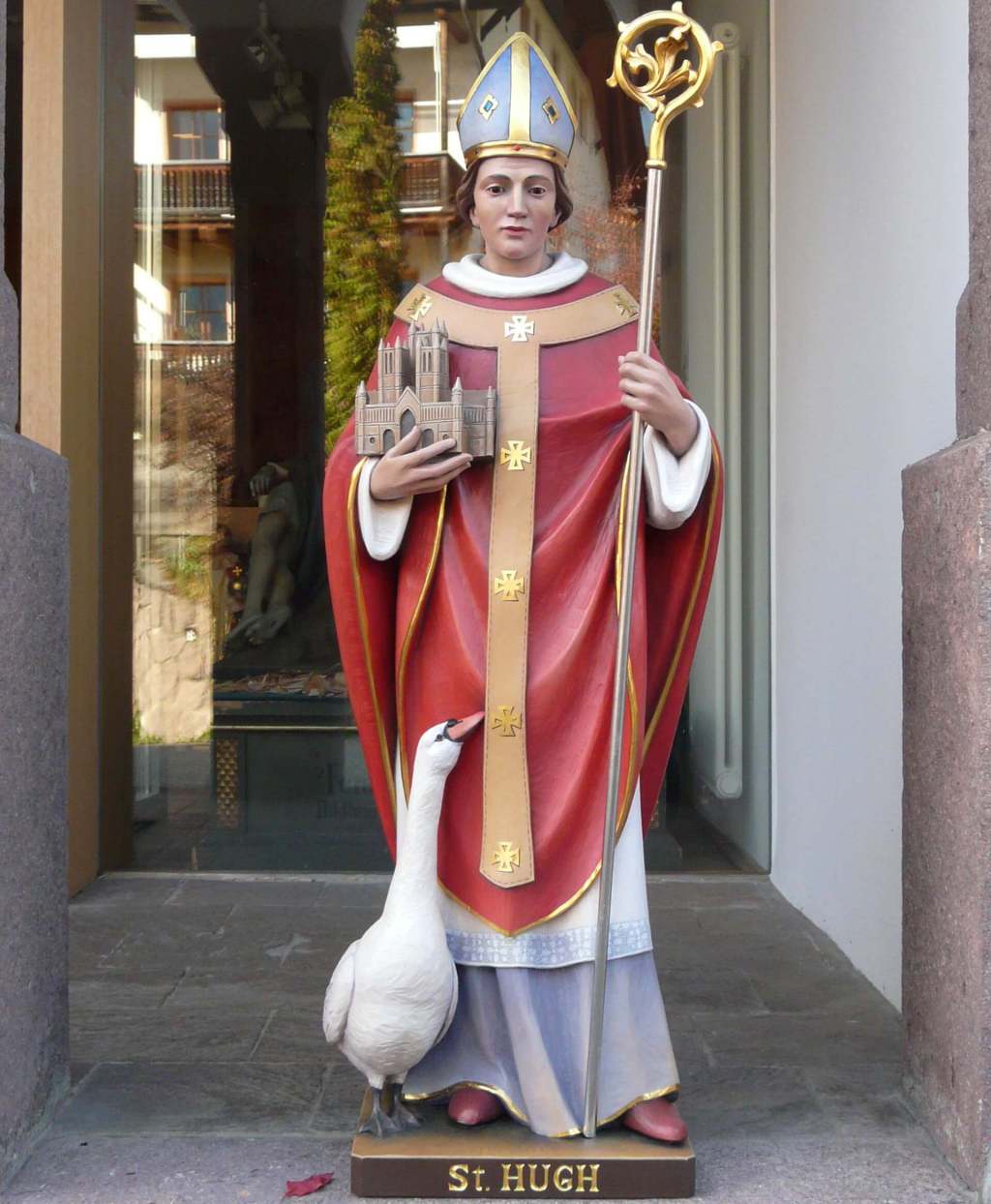
A hallmark of Saint Hugh’s spirituality was his humility and love for all creation. He is famously associated with a swan, known as the “Swan of Stow,” which adopted Hugh at his episcopal manor. The swan would follow him everywhere, even standing guard as he slept, and allowed only Hugh to approach it—a sign of the harmony between sanctity and creation.
Hugh was also known for deep and regular prayer, asceticism even as a bishop, and a special gift of healing. He inspired many by his simplicity and utter trust in God.
Miracles and Canonization
Miracles were reported both during Hugh’s life and at his tomb after his death. The first posthumous miracle attributed to him was the healing of a woman born blind who was restored to sight at his tomb.
After falling ill upon returning from a diplomatic mission to France in 1200, Hugh died in London on November 16th. His body was taken in a solemn procession to Lincoln, accompanied by bishops, barons, and the poor he had championed in life.
He was canonized by Pope Honorius III in 1220. Saint Hugh’s feast is celebrated on November 17th. He is especially remembered as a patron of sick children, the sick, shoemakers, and is often depicted with a white swan.
Legacy
Saint Hugh of Lincoln’s legacy endures as a model of ecclesiastical reformer, a peacemaker, and a loving shepherd. He set an example of fearless advocacy for justice, compassionate care for the afflicted, and authentic devotion. Cathedrals, Churches, and schools still bear his name in England, especially in Lincolnshire, and his story continues to inspire clergy and laity alike.
In a world where power too often corrupts, Saint Hugh stands as a beacon—showing that true authority serves, true leadership uplifts, and true holiness transforms both Church and society.
Prayer to Saint Hugh of Lincoln
O glorious Saint Hugh of Lincoln, faithful shepherd and tireless defender of the poor and oppressed, intercede for us before the throne of God. You who embraced humility and service from your youth, inspire us to follow Christ with unwavering dedication. Teach our hearts the joy of selfless giving, the strength to speak up for justice, and the grace to welcome all with love.
Holy bishop, who loved the sick and fed the hungry, obtain for us the virtues of compassion and courage. Help us to recognize Christ in the suffering, and guide us to bring healing and peace wherever there is strife. As you cherished God’s creatures and found delight in His creation, may we treasure every gift and steward our world with care.
Saint Hugh, you stood firm against the powerful for the sake of truth. Grant us a spirit of wisdom and integrity in our daily lives. Safeguard our Church from error, bless our families with unity, and keep our souls ever close to the Sacred Heart of Jesus.
Through your holy intercession, may we grow in faith and holiness, and one day join you in the eternal joy of God’s kingdom. Amen.
Saint Hugh of Lincoln, pray for us!
 Nelson MCBS
Leave a comment