
𝗧𝗛𝗘 𝗗𝗘𝗩𝗘𝗟𝗢𝗣𝗠𝗘𝗡𝗧 𝗢𝗙 𝗧𝗛𝗘 𝗡𝗔𝗠𝗘 “𝗖𝗔𝗧𝗛𝗢𝗟𝗜𝗖 𝗖𝗛𝗨𝗥𝗖𝗛”
(By: The Catholic Faith Guardian)
One of the most common objections raised against the Catholic Church is the claim that the word “Catholic” does not appear in the Bible and therefore cannot be the true name of Christ’s Church.
This objection rests on a false and historically naïve assumption—that a divinely instituted reality must possess a fully developed, officially registered name from the very moment of its founding.
That assumption collapses once history, Scripture, and reason are taken seriously.
𝘾𝙝𝙧𝙞𝙨𝙩 𝙁𝙤𝙪𝙣𝙙𝙚𝙙 𝙖 𝘾𝙝𝙪𝙧𝙘𝙝 — 𝙉𝙤𝙩 𝙖 𝙍𝙚𝙜𝙞𝙨𝙩𝙚𝙧𝙚𝙙 𝘽𝙧𝙖𝙣𝙙
When Jesus Christ founded His Church, He was not required to assign it a formal institutional name.
There was no civil law requiring registration, no denominational marketplace, and no competing Christian sects needing differentiation.
What we find in Scripture are descriptive identifiers, not official titles:
“my church” (Matthew 16:18)
“the church of God” (1 Corinthians 1:2)
“the church of the living God” (1 Timothy 3:15)
These expressions describe what the Church is, not what she is called, as proper name.
They are theological descriptions, not legal names.
At the time, there was only one Church.
No qualifier was necessary.
𝘾𝙝𝙧𝙞𝙨𝙩𝙞𝙖𝙣 𝙏𝙚𝙧𝙢𝙞𝙣𝙤𝙡𝙤𝙜𝙮 𝘿𝙚𝙫𝙚𝙡𝙤𝙥𝙚𝙙 𝙊𝙫𝙚𝙧 𝙏𝙞𝙢𝙚
A critical fact often ignored by critics is that many foundational Christian terms were developed later, even though the beliefs they express were already held by the earliest Christians.
Examples:
Bible — the word is not found in Scripture. It was invented by Pope Siricius.
Old Testament — not a biblical phrase. It was invented by Latin Theologian Tertullian.
New Testament — not a biblical phrase. It was invented by Latin Theologian Tertullian.
Trinity — never appears in the Bible. It was invented by Latin Theologian Tertullian.
Incarnation — not written explicitly in Scripture. It was used by Latin Fathers St. Ambrose and St. Augustine.
Yet no serious Christian denies these terms.
Why?
Because the concepts are present, even if the terminology came later.
The Church later coined precise terms to defend these truths against heresy.
Terminology developed; belief did not change.
The same principle applies to the name “Catholic Church”.
𝙒𝙝𝙮 𝙉𝙖𝙢𝙚𝙨 𝘿𝙚𝙫𝙚𝙡𝙤𝙥
A person, place, institution, or event can exist before being named, and names often emerge only when necessity demands clarity.
𝐄𝐱𝐚𝐦𝐩𝐥𝐞 𝟏: 𝐂𝐎𝐕𝐈𝐃-𝟏𝟗
The virus existed before it had an official name:
Initially referred to as:
“𝘞𝘶𝘩𝘢𝘯 𝘝𝘪𝘳𝘶𝘴”
“𝘕𝘰𝘷𝘦𝘭 𝘊𝘰𝘳𝘰𝘯𝘢𝘷𝘪𝘳𝘶𝘴”
Later formally designated by the WHO as: COVID-19 (Coronavirus Disease 2019)
The reality preceded the terminology.
𝐄𝐱𝐚𝐦𝐩𝐥𝐞 𝟐: 𝐓𝐡𝐞 𝐏𝐡𝐢𝐥𝐢𝐩𝐩𝐢𝐧𝐞𝐬
The archipelago existed long before a final national designation:
“𝘓𝘢𝘴 𝘐𝘴𝘭𝘢𝘴 𝘍𝘪𝘭𝘪𝘱𝘪𝘯𝘢𝘴” when discovered by Spanish
“𝘗𝘩𝘪𝘭𝘪𝘱𝘱𝘪𝘯𝘦 𝘐𝘴𝘭𝘢𝘯𝘥𝘴” when bought by Americans from Spaniards
“𝘙𝘦𝘱𝘶𝘣𝘭𝘪𝘤 𝘰𝘧 𝘵𝘩𝘦 𝘗𝘩𝘪𝘭𝘪𝘱𝘱𝘪𝘯𝘦𝘴” when freedom was gained from the Americans
The country was real before its official name was standardized.
𝙏𝙝𝙚 𝘾𝙝𝙪𝙧𝙘𝙝 𝙁𝙤𝙡𝙡𝙤𝙬𝙚𝙙 𝙩𝙝𝙚 𝙎𝙖𝙢𝙚 𝙃𝙞𝙨𝙩𝙤𝙧𝙞𝙘𝙖𝙡 𝙋𝙖𝙩𝙩𝙚𝙧𝙣
The Church founded by Christ preceded her formal name.
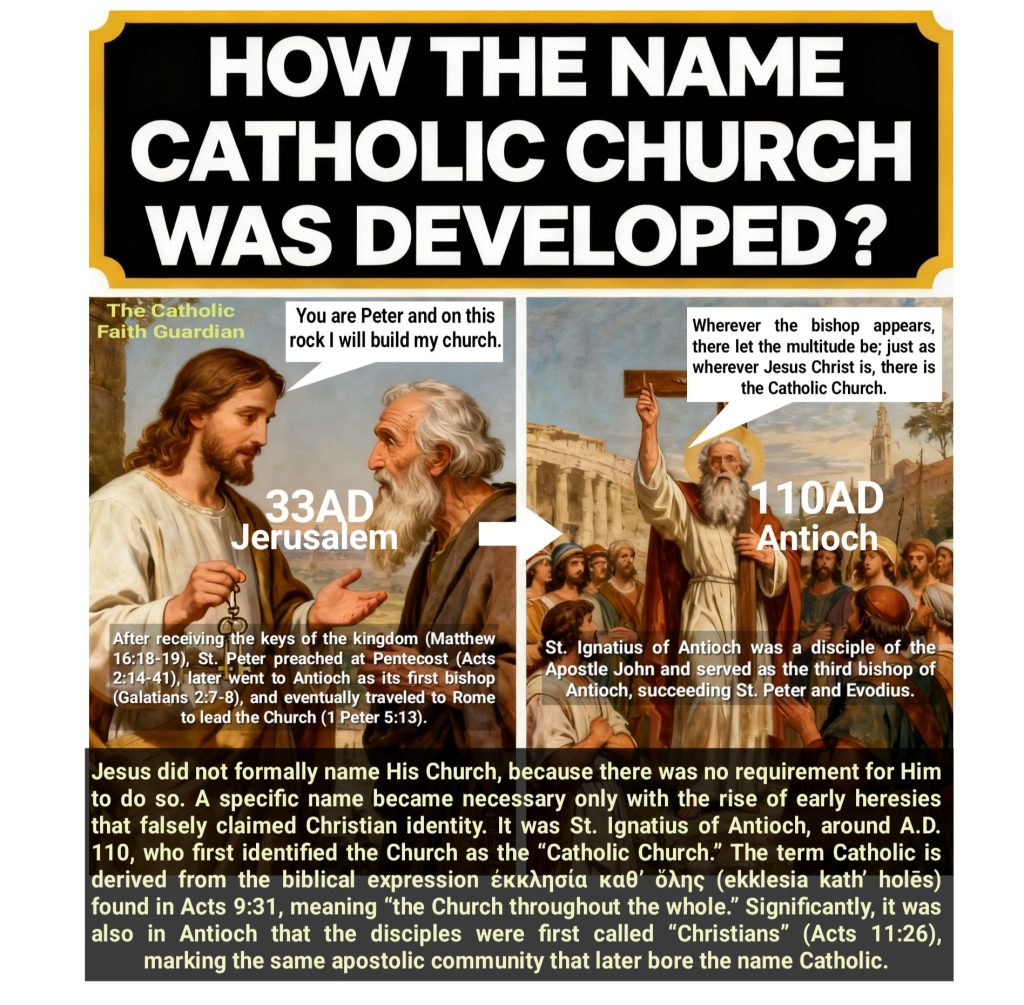
Stage 1: “The Way”
“So that if he found any belonging to the Way, men or women, he might bring them bound to Jerusalem.” — Acts 9:2
This was the earliest identifier used by believers.
Stage 2: “Christians”
“And in Antioch the disciples were first called Christians.” — Acts 11:26
This term identified the followers, not the institutional Church.
Stage 3: The Need for a Universal Identifier
As early heresies emerged—particularly Gnosticism, which claimed secret knowledge and rival authorities—the necessity arose to distinguish:
 the true apostolic Church from
counterfeit groups falsely claiming Christian identity
At this point, the Church required a name that expressed her universality, unity, and doctrinal wholeness.
𝙏𝙝𝙚 𝙀𝙢𝙚𝙧𝙜𝙚𝙣𝙘𝙚 𝙤𝙛 𝙩𝙝𝙚 𝙉𝙖𝙢𝙚 “𝘾𝙖𝙩𝙝𝙤𝙡𝙞𝙘 𝘾𝙝𝙪𝙧𝙘𝙝”
The earliest recorded use of the term “Catholic Church” appears around A.D. 110.
St. Ignatius of Antioch
A bishop of Antioch and a disciple of the Apostle John wrote:
“𝘞𝘩𝘦𝘳𝘦𝘷𝘦𝘳 𝘵𝘩𝘦 𝘣𝘪𝘴𝘩𝘰𝘱 𝘢𝘱𝘱𝘦𝘢𝘳𝘴, 𝘵𝘩𝘦𝘳𝘦 𝘭𝘦𝘵 𝘵𝘩𝘦 𝘮𝘶𝘭𝘵𝘪𝘵𝘶𝘥𝘦 𝘣𝘦; 𝘦𝘷𝘦𝘯 𝘢𝘴 𝘸𝘩𝘦𝘳𝘦𝘷𝘦𝘳 𝘑𝘦𝘴𝘶𝘴 𝘊𝘩𝘳𝘪𝘴𝘵 𝘪𝘴, 𝘵𝘩𝘦𝘳𝘦 𝘪𝘴 𝘵𝘩𝘦 𝘊𝘢𝘵𝘩𝘰𝘭𝘪𝘤 𝘊𝘩𝘶𝘳𝘤𝘩.” (𝘓𝘦𝘵𝘵𝘦𝘳 𝘵𝘰 𝘵𝘩𝘦 𝘚𝘮𝘺𝘳𝘯𝘢𝘦𝘢𝘯𝘴, 𝘤. 𝘈.𝘋. 110)
This testimony is decisive:
 It predates Constantine by over 200 years
It comes from a bishop formed by the apostles themselves
It shows the Church already recognized herself as Catholic
This was not a later Roman invention.
It was an apostolic-era self-designation.
𝙏𝙝𝙚 𝘽𝙞𝙗𝙡𝙞𝙘𝙖𝙡 𝙍𝙤𝙤𝙩𝙨 𝙤𝙛 𝙩𝙝𝙚 𝙒𝙤𝙧𝙙 “𝘾𝙖𝙩𝙝𝙤𝙡𝙞𝙘 𝘾𝙝𝙪𝙧𝙘𝙝”
The word Catholic comes from Greek components:
κατά (kata) — according to / throughout
ὅλης (holēs) — whole / entire
Meaning: “according to the whole”, or “universal.”
𝐀𝐜𝐭𝐬 𝟗:𝟑𝟏 — 𝐆𝐫𝐞𝐞𝐤 𝐓𝐞𝐱𝐭
Ἡ μὲν οὖν ἐκκλησία καθ’ ὅλης τῆς Ἰουδαίας καὶ Γαλιλαίας καὶ Σαμαρείας εἶχεν εἰρήνην…
Transliteration:
𝘏ē 𝘮𝘦𝘯 𝘰𝘶𝘯 𝘦𝘬𝘬𝘭ē𝘴𝘪𝘢 𝘬𝘢𝘵𝘩’ 𝘩𝘰𝘭ē𝘴 𝘵ē𝘴 𝘐𝘰𝘶𝘥𝘢𝘪𝘢𝘴 𝘬𝘢𝘪 𝘎𝘢𝘭𝘪𝘭𝘢𝘪𝘢𝘴 𝘬𝘢𝘪 𝘚𝘢𝘮𝘢𝘳𝘦𝘪𝘢𝘴…
Meaning:
“𝘚𝘰 𝘵𝘩𝘦 𝘊𝘩𝘶𝘳𝘤𝘩 𝘛𝘩𝘳𝘰𝘶𝘨𝘩𝘰𝘶𝘵 𝘵𝘩𝘦 𝘞𝘩𝘰𝘭𝘦 𝘰𝘧 𝘑𝘶𝘥𝘦𝘢, 𝘎𝘢𝘭𝘪𝘭𝘦𝘦, 𝘢𝘯𝘥 𝘚𝘢𝘮𝘢𝘳𝘪𝘢 𝘸𝘢𝘴 𝘢𝘵 𝘱𝘦𝘢𝘤𝘦…”
The phrase ἐκκλησία καθ’ ὅλης (ekklesia kath’ holēs) expresses the very concept later captured in the word Catholic.
The term Catholic is therefore not foreign to Scripture—it is a linguistic distillation of a biblical reality.
𝙏𝙝𝙚 𝘾𝙧𝙚𝙚𝙙𝙨 𝙖𝙣𝙙 𝙩𝙝𝙚 𝙊𝙛𝙛𝙞𝙘𝙞𝙖𝙡 𝙉𝙖𝙢𝙚 𝙤𝙛 𝙩𝙝𝙚 𝘾𝙝𝙪𝙧𝙘𝙝
1. Apostles’ Creed
Core form dates to the 2nd century
Finalized by the 4th century
Explicitly professes:
“I believe in the Holy Catholic Church.”
2. Nicene Creed
First formulated at the Council of Nicaea (A.D. 325)
Completed at the Council of Constantinople (A.D. 381)
It solemnly declares:
“I believe in one, holy, catholic, and apostolic Church.”
This is not symbolic language.
It is the Church formally naming herself in a universal profession of faith.
𝘾𝙤𝙣𝙘𝙡𝙪𝙨𝙞𝙤𝙣
The absence of the word “Catholic” in early biblical texts does not disprove the Catholic Church—just as the absence of the words Trinity or Bible does not disprove those doctrines.
What matters is continuity of belief, not the timing of terminology.
Christ founded one Church.
That Church existed before she required a formal name.
As heresies arose, she identified herself accurately as: Catholic — universal, whole, and apostolic.
To reject the name Catholic Church is not loyalty to Scripture.
It is a rejection of how language, doctrine, and history actually develop.
The Church did not invent herself.
She named herself—because she already existed.
 Nelson MCBS
Leave a comment