

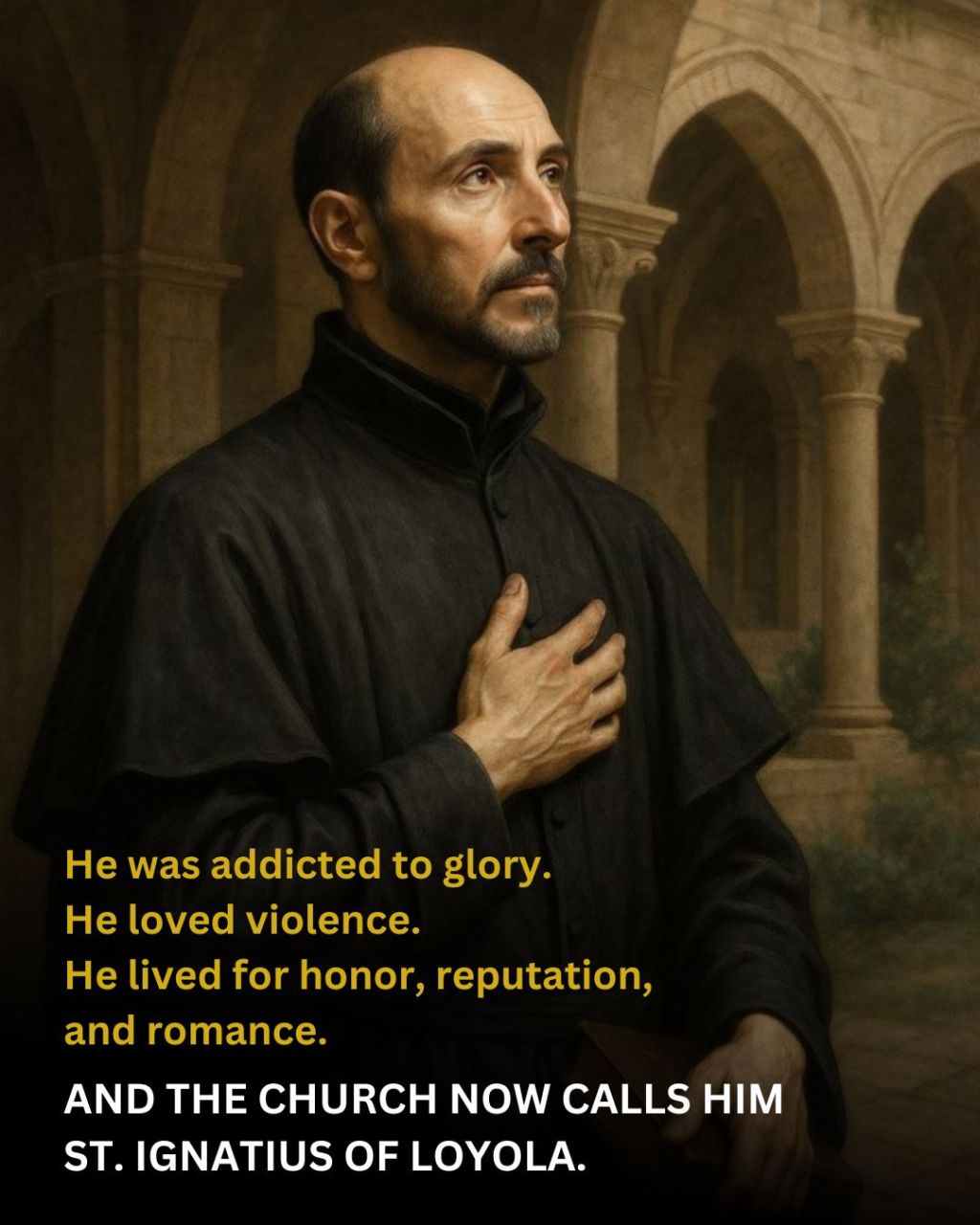
He was addicted to glory.
He loved violence.
He lived for honor, reputation, and romance.
And the Church now calls him a saint.
St. Ignatius was a Basque nobleman and a soldier. He dreamed of fame on the battlefield and admiration in the court. His prayers were shallow. His ambitions were loud. God was a background detail.
Then a cannonball found him.
At the siege of Pamplona, his leg was shattered. One moment he was chasing glory. The next, he was helpless, humiliated, and stuck in bed.
Recovery was brutal. His leg was reset—more than once—without anesthesia. He wanted the bones straight, not for health, but for vanity. A knight had to look the part.
Bored and restless, Ignatius asked for novels of chivalry.
None were available.
Instead, he was handed a life of Christ and stories of the saints.
He read them reluctantly. Then something strange happened.
When he imagined returning to battle, seducing women, winning applause—he felt excited… and then empty.
When he imagined living like the saints—poor, obedient, forgotten—he felt afraid… and then peaceful.
For the first time, he noticed the movements of his own heart.
That quiet awareness changed everything.
Ignatius limped away from his old life and laid his sword before the altar of Mary. He exchanged silk for sackcloth. Pride for silence. Noise for prayer.
In Manresa, he nearly broke.
He fasted too hard. He prayed too long. He was crushed by scruples and despair. He questioned his salvation. He was tempted to give up entirely.
But grace met him there.
Not in fireworks—but in clarity.
God taught him how to listen. How to discern. How to tell the difference between a voice that leads to life and one that only pretends to.
Out of that struggle came a simple method of prayer—notes scribbled for himself—that would later become the Spiritual Exercises, a roadmap for souls seeking God in the real world.
At the age of 33, the former soldier sat in a classroom with young children to learn Latin. He was mocked, imprisoned by the Inquisition, and doubted by many—but he never looked back.
He eventually gathered a group of “friends in the Lord” at the University of Paris. Together, they founded the Society of Jesus (the Jesuits), becoming a spiritual army that would travel to the ends of the earth, not for a king’s gold, but for the “Greater Glory of God.”
St. Ignatius of Loyola teaches us: It is never too late to change the direction of your ambition. Your greatest wound can become the door to your greatest mission.
If you feel your life is aimless…
If you are chasing things that leave you empty…
If you think your pride is an unbreakable wall…
This saint is proof that God can turn a soldier of the world into a soldier of the Light.
St. Ignatius of Loyola, pray for us.
Source: Fear Not
 Nelson MCBS
Leave a comment