

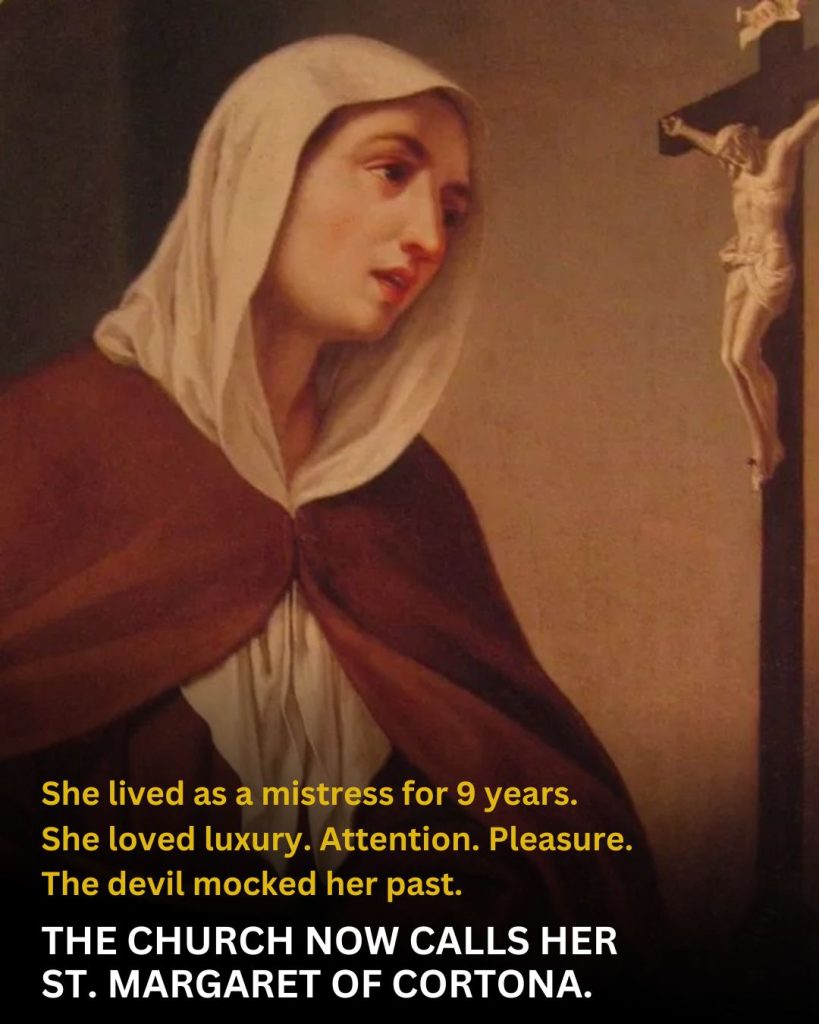
She lived with a man who was not her husband.
She loved luxury. Attention. Pleasure.
And for years, she saw nothing wrong with it.
The Church now calls her St. Margaret of Cortona.
Margaret was born poor, unwanted, and wounded early in life. Her mother died when she was young. Her stepmother made sure Margaret knew she was a burden. Love felt conditional. Home never felt safe.
So when a wealthy nobleman noticed her beauty and desire to be desired, Margaret went with him — and stayed.
For nearly a decade, she lived as his mistress. Fine clothes. Good food. Admiration. A child born out of wedlock. Sin didn’t feel like rebellion — it felt like survival.
Then one day, everything shattered.
Her lover didn’t come home.
Margaret searched for him. When she finally found him, he was dead — murdered and left unburied in the woods.
She stood over his body in horror.
In an instant, pleasure turned to ashes.
The life she had built collapsed under the weight of death. She saw, with terrifying clarity, where her choices had led — not just for him, but for her soul.
Margaret ran.
She returned to Cortona barefoot, carrying her child, publicly confessing her sins and begging God for mercy.
People remembered her past.
They whispered. They judged. Some turned her away.
She accepted it all.
Margaret entered the Third Order of St. Francis and embraced a life of radical penance.
She slept on the floor.
Fasted severely.
Served the poor and the sick.
Prayed for hours each day.
Her repentance was not polite. It was fierce.
Temptations haunted her. Memories returned. The devil mocked her past.
But Margaret clung to Christ with desperate love. She wept often — not from shame alone, but from gratitude.
God answered.
Margaret received mystical visions. Christ spoke to her as a friend. He assured her that her sins were forgiven — completely. The woman once known for scandal became known for charity, prophecy, and holiness.
She founded a hospital for the poor. She counseled sinners without condemning them.
She loved fiercely because she had been forgiven much. When she died, the people who once scorned her mourned her as a saint.
St. Margaret of Cortona teaches us:
Your past does not disqualify you.
Your wounds can become your witness.
And repentance can be more powerful than a lifetime of sin.
If you feel defined by what you’ve done…
If shame still follows you…
If you think holiness is for “better” people…
This saint stands as proof that mercy rewrites everything.
St. Margaret of Cortona, pray for us.
 Nelson MCBS
Leave a comment