
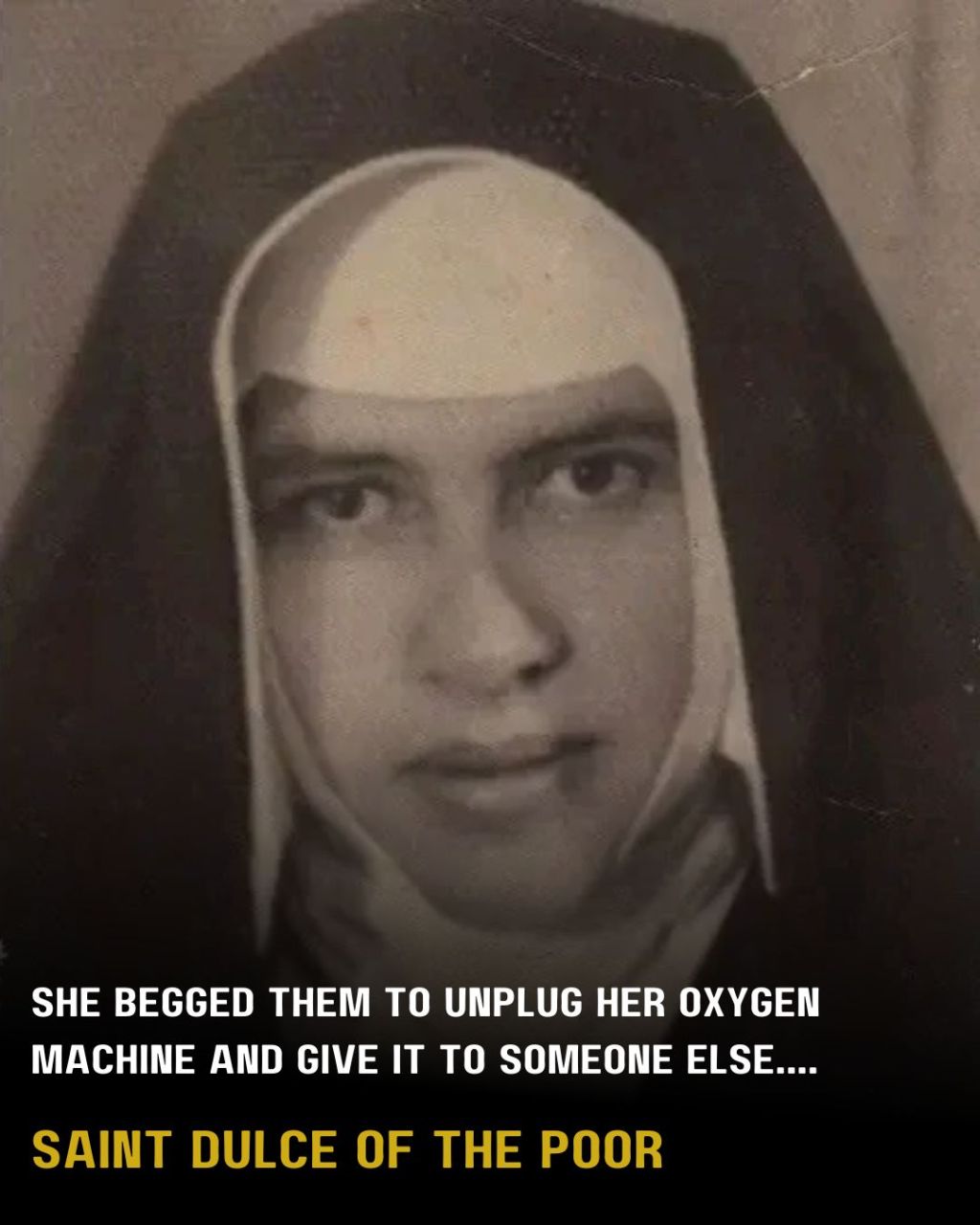
She begged them to unplug her oxygen machine and give it to someone else.
The doctors froze. Sister Dulce’s lungs were failing. Without that machine, she would die within minutes. But she wasn’t asking—she was insisting. Another patient needed it more.
This was the same woman who had spent six decades owning nothing, who now wanted to give away her final breaths.
It all began in a place no one else would enter.
Salvador, Brazil, 1933. Dulce was eighteen when she took her vows as a Catholic nun. The convent assigned her to teach privileged children. Safe work. Respectable work.
But she couldn’t stop seeing them: the dying in the streets, the sick with nowhere to go, bodies curled in doorways that pedestrians passed without a glance.
So she brought them home.
An abandoned chicken coop behind the convent became Brazil’s most unlikely hospital. She carried in the wounded, the fevered, the forgotten. Homeless men, discarded women, children abandoned by fate.
The other nuns were horrified. “You’re bringing disease into our home!” they warned.
Dulce kept washing wounds and feeding mouths that hadn’t eaten in days.
Word spread through the favelas: there was a nun who turned no one away, no matter how sick, poor, or hopeless. They came in waves—hundreds, then thousands. The chicken coop couldn’t hold them all.
Sister Dulce needed medicine, beds, doctors, money. She had none.
So the shy teenager who owned nothing became the greatest beggar Brazil had ever seen. She walked into offices of businessmen, stopped workers on the street, knocked on doors in rich neighborhoods—not for herself, always for them, the forgotten dying alone.
Her conviction was magnetic. Donations began to flow. Small ones, then larger ones, enough to dream the impossible.
In 1959, she persuaded city officials to donate an abandoned market building. With donated materials and volunteer labor, she transformed it into Santo Antônio Hospital—a place where Brazil’s poorest could receive care without paying a cent.
The building was crumbling, equipment scarce, and doctors few. But Dulce worked eighteen-hour days, every day. She bathed patients too weak to move, changed bandages on infected wounds, held dying hands at three in the morning when no one else was watching.
Her work expanded—orphans, the elderly with no families, the disabled who society ignored. By the 1980s, her network served over three thousand people every single day.
And still, she owned nothing. One worn habit. No bed—she slept upright in a wooden chair. She ate scraps after everyone else. Visitors were stunned: this woman controlled facilities worth millions and had no interest in comfort. She wanted only to serve.
Decades of breathing diseased air and exhaustion ravaged her body. By her seventies, she needed supplemental oxygen just to survive, yet she refused to slow down.
Brazil finally understood what had been living among them. This tiny nun had become the Angel of Bahia. Pope John Paul II visited in 1980, specifically to see her, and cried when he witnessed her work. Nobel Peace Prize nominations and international recognition followed. She didn’t care.
“I’m only doing what God asks of all of us,” she said.
March 1992. Her lungs finally surrendered. Doctors placed her on an oxygen machine in the very hospital she had built from nothing.
Even then, her thoughts turned outward. She saw other patients struggling, limited equipment, impossible choices. That’s when she asked them to disconnect her machine.
The doctors refused, of course. But everyone understood. This was Sister Dulce’s final lesson: real love gives everything—even the air from your own lungs.
She died peacefully on March 13, 1992. Tens of thousands came to her funeral—rich and poor, children from her orphanages, elderly from her nursing homes, patients whose lives she had saved. They came to honor the woman who showed them what love looks like when it holds nothing back.
In 2019, the Catholic Church canonized her as Saint Dulce of the Poor, the first Brazilian-born woman to become a saint. But the people of Salvador had known it long before.
Her hospitals still serve the poor. Her orphanages still shelter abandoned children. Her legacy of radical giving continues.
Sister Dulce’s life asks the question we all avoid: what would you sacrifice to help someone else? Where is your line?
She had no line. She gave her comfort, her health, her life—and at the very end, she tried to give away her final breaths.
This is what love looks like when it is real. Love that keeps nothing for itself.
Source: Fear Not
 Nelson MCBS
Leave a comment