
She was a forgotten name in a sealed tomb.
No biography.
No written history.
And yet Heaven revealed her as Saint Philomena.
In 1802, archaeologists exploring the Catacombs of Priscilla in Rome uncovered a small sealed tomb.
Inside were the remains of a young girl.
Next to the bones was a small vial containing dried blood — a traditional sign that the person buried there had died as a martyr.
Three terracotta slabs sealed the tomb. When they were rearranged, they formed a simple message in Latin:
“PAX TECUM FILUMENA.”
“Peace be with you, Philomena.”
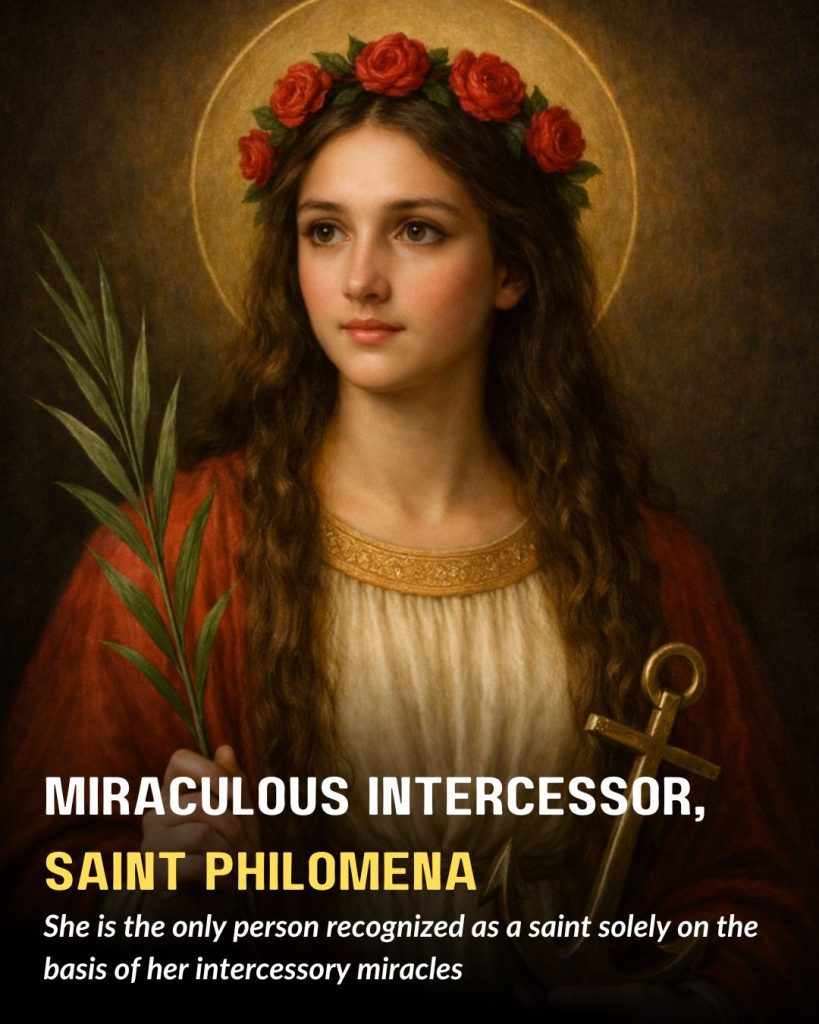
Carved beside the inscription were symbols recognized by early Christians: a lily, arrows, an anchor, and a palm branch — signs of purity and martyrdom, like those associated with saints such as Agatha of Sicily, Lucy of Syracuse, Agnes of Rome, and Cecilia of Rome.
The archaeologists documented the bones.
But at the time, almost no one noticed.
All they knew was this:
She was a young virgin martyr, likely from the 4th century.
Then something unexpected happened.
Three years later, a priest from a small Italian village heard about the discovery. His name was Canon Francesco De Lucia.
Moved by devotion to the unknown martyr, he requested that her relics be transferred to his parish in Mugnano.
The request was approved.
Her relics were placed in the Church of Our Lady of Grace, in the town now known as the Sanctuary of Saint Philomena, not far from Naples.
And then the miracles began.
People reported extraordinary healings after praying at her shrine.
Cancer disappearing.
Blindness cured.
Seemingly impossible illnesses suddenly vanishing after prayers through her intercession.
Conversions multiplied.
One of the most famous miracles involved Blessed Pauline Jaricot, who was suddenly healed of a severe heart disease after praying through Philomena’s intercession.
At the same time, mystics in different parts of the world reported receiving visions describing the life of the young martyr.
One of the most detailed accounts came from Sr. Luisa di Gesù in 1833.
According to these revelations, Philomena had consecrated her virginity to Christ.
When the Roman emperor Diocletian desired to marry her, she refused.
She was only thirteen years old.
Enraged, the emperor ordered her tortured.
But she would not renounce Christ.
She endured suffering and imprisonment before finally being executed for her faith.
Over the decades, kings and queens, saints and blesseds, princes and paupers alike journeyed to Mugnano seeking the intercession of St. Philomena.
Even Blessed Pope Pius IX celebrated Mass at her altar on November 7, 1849.
In 1827, Pope Leo XII gave the original terracotta tomb slabs from the catacombs to the church in Mugnano.
Because of the numerous miracles reported at her tomb, Pope Gregory XVI declared Philomena a saint in 1837. Such recognition — based largely on her powerful miraculous intercession — was extraordinary.
He reportedly said:
“Whatever you ask from Saint Philomena, she will obtain for you.”
He called her “Thaumaturga” — the Wonder-Worker.
Some of the greatest saints of the modern Church became devoted to her.
One of them was Saint John Vianney, the humble parish priest of Ars.
He loved her deeply.
He built a shrine to her in his church and constantly entrusted his needs — and the needs of his parish — to her.
When miracles occurred — and they did — he refused any credit.
“It is not I,” he would say.
“It is Saint Philomena.”
Pilgrims poured into Ars by the thousands.
Hardened sinners returned to confession.
Souls were transformed.
And the Curé of Ars always pointed to the same heavenly helper.
Another saint who cherished her was Saint Padre Pio.
Padre Pio reportedly held a deep devotion to this young martyr, encouraging others to seek her intercession and trusting in her powerful help.
Today, pilgrims still travel to Mugnano to pray before her relics.
The forgotten girl in a catacomb.
The thirteen-year-old who chose Christ over an emperor.
The martyr whose miracles awakened the modern world.
Saint Philomena reminds us:
God can raise up the unknown.
Faith can defeat empires.
And Heaven still answers prayer.
If your problems seem impossible…
If hope feels distant…
If you wonder whether God still works miracles.
Remember the young martyr whose name slept beneath the earth — until Heaven made it known.
Saint Philomena, Wonder-Worker and patroness of the impossible, pray for us.
Source: Fear Not
 Nelson MCBS
Leave a comment