

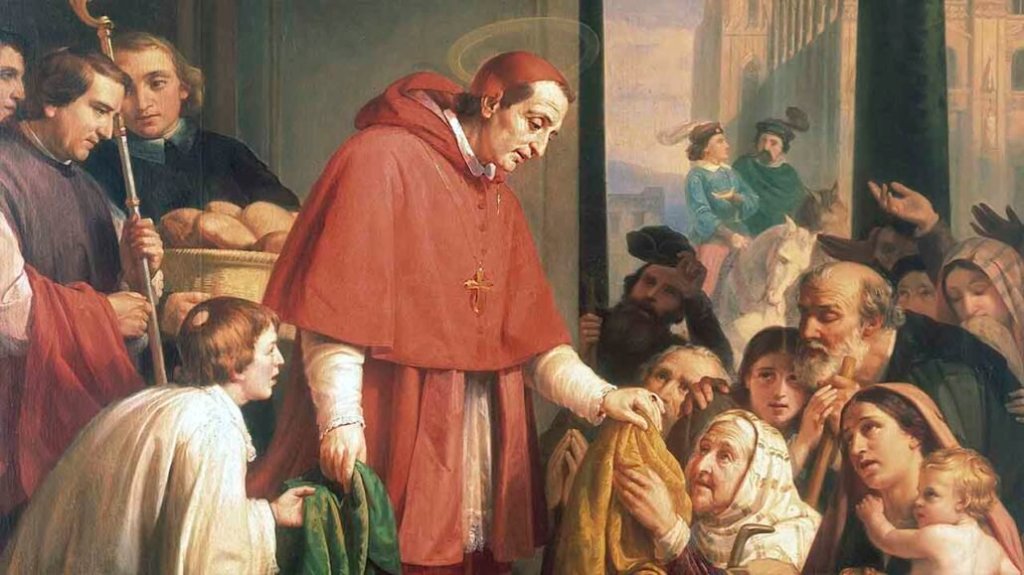
St. Charles Borromeo stands as a towering figure in the history of the Catholic Church, renowned for his decisive role in reforming ecclesiastical life in the wake of Catholicism’s greatest trial, the Protestant Reformation. His image has endured through centuries: thoughtful, austere, compassionate, unrelenting in his pursuit of holiness. For those seeking inspiration in the service of God and neighbor, Borromeo’s life remains an inexhaustible wellspring.
Early Life and Nobility
Born on October 2, 1538, in the castle of Arona on Lake Maggiore in northern Italy, Charles Borromeo hailed from a noble and influential family. His father, Count Gilbert Borromeo, was a member of the prestigious Milanese aristocracy, and his mother, Margaret de’ Medici, belonged to the Papal family that produced two popes and untold dignitaries. Charles’s uncle, Giovanni Angelo Medici, would later become Pope Pius IV—a relationship that would profoundly affect his vocation and influence.
From a young age, Charles was marked by sobriety and religious inclination. He received the tonsure, a sign of minor clergy, when he was just twelve; displaying an unusual depth of piety and seriousness, he shunned the excesses of his social class. Rather than indulging in the privileges and amusements available to him, Charles preferred study, prayer, and quiet introspection.
Education
Charles Borromeo studied at the University of Pavia, excelling in canonical and civil law. Despite a speech impediment that made public speaking difficult, his intellectual gifts shone through. He completed his studies with a doctorate at age 21, his erudition matched by an unwavering moral seriousness, which set him apart from his contemporaries.
Rise to Power and Service in Rome
At only 22 years of age, Charles’s uncle ascended to the papacy as Pope Pius IV, and summoned the young scholar to Rome. Charles was appointed cardinal-deacon and administrator of the Archdiocese of Milan, the largest diocese in Italy at the time, though he had not yet been ordained a priest. Given access to the papal court’s vast resources, Charles could have enjoyed a comfortable, prestigious existence. Instead, he devoted himself to urgent ecclesiastical reform.
The Council of Trent and Implementation
The 16th century was a tumultuous era for the Catholic Church: the Protestant Reformation had splintered Christendom and eroded confidence in the hierarchy, exposing widespread abuses and laxity. The Council of Trent (1545–1563) emerged as Catholicism’s concerted response. As secretary of state to Pope Pius IV, Charles Borromeo played a pivotal role in the Council’s final, productive sessions.
But what made Charles truly exceptional was not merely his involvement in the Council’s decrees. Rather, it was his relentless pursuit of their implementation. Where many reformers limited themselves to pronouncements, Charles insisted that what was decided in Trent must be lived, locally and universally.
He supervised the composition of the Roman Catechism, the revision of the Breviary, and reform of seminaries. His labor resulted in ecclesiastical discipline that would last for centuries, centralizing education and setting a high standard for priestly formation.
Archbishop of Milan: A Sacrifice of Comfort for Service
The Archdiocese of Milan had not seen its bishop present in over 80 years; instead of governing from a distance, Charles insisted on shepherding his people on the ground. In 1565, Charles was ordained priest and—immediately thereafter—bishop, at his own urging. He left Rome for Milan, exchanging the cosmopolitan life of the papal court for the challenging realities of diocesan leadership.
Upon his arrival, Charles was appalled by the condition of his clergy and laity. Education was poor, discipline nearly absent, and corruption rife. He embarked on a systematic reform: founding seminaries, colleges, and communities, he enforced residence obligations for clergy, standardized liturgical practice, and insisted on the moral and spiritual regeneration of his priests and people.
The pastoral visitation became his hallmark. He traveled tirelessly through the diocese’s parishes, inspecting, correcting, inspiring. Through personal example and tireless labor, he revived the faith of a city adrift.
Spirituality and Asceticism
Charles Borromeo’s life was marked by ascetic discipline and fervent prayer. His austerity went beyond appearances: he wore simple garments, fasted regularly, and slept but a few hours a night. Yet this discipline was not an end in itself, but a means of drawing closer to Christ and modeling the behavior he demanded from his clergy.
Every night, Charles spent hours in prayer before the Blessed Sacrament, meditating on the Passion of Christ. His spiritual rule was strict yet not joyless. He insisted that all true reform must begin within: “The first and greatest reform,” he wrote, “must be the reform of oneself.”
Charity in Action: The Plague Years
Perhaps Charles Borromeo’s most resplendent hour came during the plague of 1576. When the city was ravaged by pestilence, Charles did not flee to safety as many of his peers did. Instead, he personally organized relief efforts, distributed food, set up hospitals, and ministered to the dying. At considerable risk to his own life, Charles administered the sacraments, comforted the afflicted, and urged compliance with public health measures.
He exhausted his own fortune for the city’s welfare, living in poverty so that others might survive. This heroic charity won the admiration of friend and foe alike. Even Protestant observers were moved by the devotion and fearlessness he displayed as archbishop.
Vision for Priestly Life
Recognizing the centrality of priestly formation, Charles Borromeo’s reforms focused intensely on seminaries. He founded his first seminary in Milan in 1564, establishing rigorous standards for admissions, training, and spiritual discipline. He believed that only a well-formed priesthood could restore faith to a troubled world.
His model became the template for seminaries throughout Europe. He instituted daily Mass, spiritual direction, solitude, and study as core aspects of formation. Charles’s vision anticipated centuries of clerical discipline, grounding the priestly vocation in prayer, education, and moral example.
Defense Against Opposition
Borromeo’s reforms provoked resistance. Many clergy resented the new standards; vested interests sought to undermine his authority. Charles was undeterred. Once, while he prayed in his private chapel, a disgruntled priest fired a shot at him, narrowly missing. Charles calmly continued praying, later interceding for his assailant’s pardon.
His unflinching resolve earned him respect. He insisted on exercising mercy as well as justice, serving both as reformer and pastor. His humility and courage became legendary.
Ecumenical Impact and Legacy
Charles Borromeo’s influence extends beyond Catholicism. His reforms transformed the Catholic Church in the decades after Trent, preserving its spiritual vitality and institutional resilience. His commitment to seminary education, sacramental discipline, and pastoral care influenced generations of clergy and bishops.
Charles also affected broader Christian thought. Protestant observers respected his integrity, charity, and administrative genius, even where they disagreed. He remains a potent symbol of Catholic renewal and holiness.
Personal Traits: Compassion, Discipline, Humility
Charles was a paradox: strict, yet gentle; powerful, yet humble. He enforced discipline, but never lost sight of mercy. Known for his patience and kindness to the poor, his guidance to troubled souls reflected deep empathy.
He refused honors and luxuries, channeling his resources to the needy. His writings reveal a man intensely focused on God, prudent in administration, creative in reform, and unwavering in hope. For Charles, the purpose of all his actions was the glory of God and the salvation of souls.
Death and Canonization
In the autumn of 1584, Charles’s health faltered due to years of rigorous labor and penance. At age 46, after making a retreat and living in prayer, he died on November 3, surrounded by fellow clergy. His loss was felt deeply in Milan and throughout Christendom.
Popular devotion to Charles Borromeo grew rapidly. He was canonized in 1610 by Pope Paul V, recognized as a saint whose life epitomized reform, courage, and holiness.
Borromeo’s Relevance Today
Why does St. Charles Borromeo matter in the 21st century?
His life is an answer to every era’s challenges:
- For those confronting corruption or turmoil, Charles reveals the power of reform rooted in humility.
- For priests, bishops, and Christian leaders, he is the model of self-sacrifice and care.
- For all believers, his devotion to personal holiness and service stands as a beacon.
Borromeo’s lessons apply wherever faith is challenged, institutions require renewal, and the poor cry out for compassion.
Major Works and Artistic Depictions
Charles’s writings, though not extensive, reflect deep spirituality. His letters, sermons, and treatises on pastoral reform influenced countless successors. Milan and numerous churches worldwide honor him with statues, paintings, and dedications—his figure appears in Renaissance art as a cleric in simple robes, hand extended in blessing.
Patronage
St. Charles Borromeo is the patron of bishops, seminarians, and spiritual leaders engaged in reform. His example inspires those facing the daunting task of renewing Church or society in times of difficulty.
A Prayer to St. Charles Borromeo
At the conclusion of this study, let us invoke his intercession:
Prayer to St. Charles Borromeo
O glorious St. Charles Borromeo,
You bore the burdens of the Church,
And led with wisdom, humility, and courageous reform.
Model of pastors,
Defender of faith,
Servant of the poor and afflicted,
You sought holiness above comfort,
And gave yourself for the salvation of souls.
Intercede for us,
That we may grow in love for Christ and His Church;
Grant us wisdom to discern,
Courage to persevere,
And charity to serve those in need.
Bless our shepherds, the bishops and priests,
That they may imitate your zeal and purity;
Guide the faithful,
Protect the vulnerable,
And inspire reform and renewal in our hearts.
O God, who gave St. Charles Borromeo
a spirit of unwavering service,
grant that, through his prayers and example,
we may seek holiness and serve the Church faithfully.
St. Charles Borromeo, pray for us.
Amen.
St. Charles Borromeo’s memory endures as a light for all who seek to follow Christ, especially in turbulent times. His life—and his prayers—remind us that courage, humility, and charity are the hallmarks of true discipleship.
 Nelson MCBS
Leave a comment