
A Bishop Who Stood Before Emperors and Upheld the Sovereignty of the Church
Introduction: When Faith Confronts Power
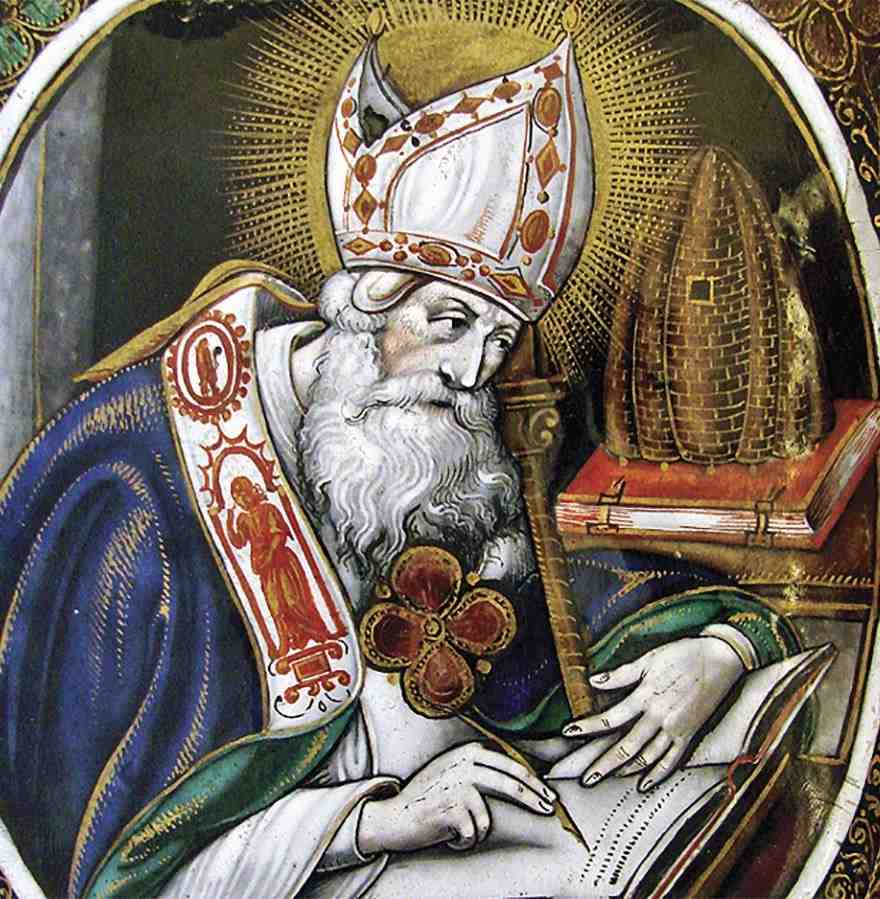
In the history of Christianity, there are moments when the Church is called not merely to teach, but to stand—firmly, courageously, and publicly—before the powers of the world. One of the clearest examples of such a moment is found in the life of St. Ambrose of Milan.
Living in the fourth century, Ambrose became one of the most influential bishops of the early Church, not only for his theological contributions but for his fearless defense of the Church’s authority in the face of imperial pressure. At a time when the Roman Empire was transitioning into a Christian state, the relationship between Church and State was still being defined. Would the emperor control the Church? Or would the Church retain its spiritual independence?
Ambrose answered this question not with abstract arguments, but with decisive action. He insisted that while emperors held power in civil matters, they remained subject to the moral and spiritual authority of the Church.
This article explores the life, context, and legacy of Ambrose, focusing especially on how he defended the authority of the Church—an authority rooted not in political power, but in fidelity to Jesus Christ.
1. The Unlikely Bishop
Milan, one of the most important cities of the late Roman Empire, was the setting for Ambrose’s remarkable rise to prominence.
Born around 340 AD into a Christian family of high social standing, Ambrose received an excellent education in law and rhetoric. He pursued a successful career as a civil official and was appointed governor of the region of Aemilia-Liguria.
At this point, Ambrose was not even baptized.
Yet, when the bishop of Milan died, a dispute arose between different Christian factions over his successor. Ambrose, as governor, went to maintain order. In a surprising turn of events, the crowd began to acclaim him as bishop.
Within a matter of days:
- He was baptized
- Ordained
- Consecrated as bishop
This extraordinary transition from civil authority to ecclesiastical leadership would shape his entire approach to Church governance.
2. The Historical Context: Church and Empire
The fourth century was a time of dramatic change.
Following the conversion of Emperor Constantine, Christianity moved from persecution to imperial favor. However, this new relationship created new challenges.
Questions emerged:
- Should the emperor influence Church doctrine?
- Could the state control ecclesiastical decisions?
- Where did ultimate authority lie?
At the same time, theological controversies—especially Arianism—continued to divide the Church.
Ambrose found himself at the center of both political and doctrinal struggles.
3. Defending Orthodoxy Against Arianism
One of Ambrose’s first major challenges was the persistence of Arianism, which denied the full divinity of Christ.
Although the Council of Nicaea had affirmed that Christ is fully divine, Arianism still had powerful supporters, including members of the imperial family.
When the Arian-leaning Empress Justina demanded that Ambrose hand over a church building in Milan for Arian worship, he refused.
This was not merely a property dispute—it was a matter of faith.
Ambrose declared that:
- The Church cannot be handed over to heresy
- The bishop must protect the integrity of worship
- Imperial power does not extend to doctrinal matters
His resistance led to a tense standoff, but he did not yield.
4. “The Emperor is in the Church, Not Above the Church”
One of Ambrose’s most famous principles can be summarized in this statement:
“The emperor is in the Church, not above the Church.”
This idea was revolutionary.
In the Roman world, emperors were often seen as supreme authorities, even in religious matters. But Ambrose insisted that:
- The emperor is a member of the Church
- He is subject to its teachings
- He must submit to its moral authority
This does not mean that Ambrose rejected civil authority. Rather, he distinguished between:
- Temporal power (held by the state)
- Spiritual authority (held by the Church)
This distinction would become foundational for later Christian thought.
5. The Confrontation with Emperor Theodosius
Perhaps the most dramatic example of Ambrose’s defense of Church authority occurred in his confrontation with Emperor Theodosius I.
In 390 AD, a violent uprising in Thessalonica led to the death of a Roman official. In retaliation, Theodosius ordered a brutal massacre, resulting in the deaths of thousands of civilians.
Ambrose responded with courage.
He wrote to the emperor, condemning the massacre and calling for repentance. More strikingly, he refused to allow Theodosius to receive the Eucharist until he had publicly repented.
This was unprecedented:
- A bishop publicly correcting an emperor
- Denying him access to the sacraments
- Insisting on moral accountability
Eventually, Theodosius submitted. He performed public penance, demonstrating that even the most powerful ruler was subject to the moral authority of the Church.
6. The Authority of the Church Rooted in Christ
For Ambrose, the authority of the Church is not derived from political power or human institutions. It is rooted in Christ Himself.
The Church:
- Proclaims the truth of the Gospel
- Administers the sacraments
- Guides believers in moral life
This authority is spiritual, not coercive.
Ambrose understood that:
- The Church does not rule by force
- It leads through truth and holiness
7. Scripture and Tradition in Ambrose’s Teaching
Ambrose was deeply grounded in Scripture.
He:
- Interpreted biblical texts with theological insight
- Used Scripture to defend doctrine
- Applied biblical principles to contemporary issues
At the same time, he valued Tradition as the living transmission of the faith.
This combination gave his teaching both depth and authority.
8. Pastoral Leadership and Moral Courage
Ambrose’s defense of Church authority was not merely theoretical—it was pastoral.
He cared deeply for:
- The unity of the Church
- The integrity of worship
- The moral life of believers
His courage was not rooted in ambition, but in conviction.
9. Influence on St. Augustine of Hippo
One of Ambrose’s most lasting contributions is his influence on St. Augustine of Hippo.
Through his preaching and example:
- Augustine was drawn to the Christian faith
- He encountered a deeper understanding of Scripture
- He ultimately converted
This shows that Ambrose’s authority was not only institutional—it was personal and transformative.
10. Legacy and Relevance Today
St. Ambrose of Milan remains highly relevant.
a. Church and State
He provides a model for maintaining the independence of the Church.
b. Moral Accountability
He reminds us that no one is above moral truth.
c. Courage in Leadership
He challenges leaders to act with integrity.
d. Faithfulness to Christ
He calls the Church to remain rooted in its mission.
Conclusion: A Bishop Who Shaped History
St. Ambrose of Milan stands as one of the most powerful witnesses to the authority of the Church.
Through his life, he demonstrated that:
- The Church must remain faithful to Christ
- It must not be controlled by political power
- It must speak truth, even to the powerful
His legacy continues to inspire.
In every age, the Church faces new challenges. But the example of Ambrose reminds us that true authority lies not in dominance, but in fidelity—to Christ, to truth, and to the mission entrusted to the Church.
 Nelson MCBS
Leave a comment