
Introduction
Among the remarkable wonders that God has granted to His Church throughout history, Eucharistic miracles stand as extraordinary signs of His infinite power and His profound love for humanity. These supernatural events—in which the consecrated Hosts or the Precious Blood manifest visible, incorruptible phenomena—serve as powerful reminders of the Catholic doctrine of transubstantiation: that bread and wine, when consecrated by a validly ordained priest, truly become the Body and Blood of Christ. Among the most striking and well-documented of these miracles is the Eucharistic Miracle of Siena, Italy, which occurred in 1730 and continues to bear witness to Christ’s Real Presence nearly three centuries later.
The Miracle of Siena stands apart from many other Eucharistic miracles because it involves not a sudden transformation or bleeding, but rather the miraculous preservation and incorruptibility of 351 consecrated Hosts that were stolen, lost, and then recovered in extraordinary circumstances. This miracle speaks profoundly to the power of God to protect His most sacred gifts and to work wonders that defy all natural explanation.
Historical Context: Siena in 1730
To understand the full significance of the Eucharistic Miracle of Siena, we must first consider the spiritual climate of the city and the Church in 1730. Siena, a medieval city renowned for its spiritual heritage and rich Catholic traditions, was the birthplace of Saint Catherine of Siena, one of the Church’s greatest mystics and saints. The city had long been a center of devotion and faith, with its beautiful churches, vibrant religious communities, and deeply faithful population.
In 1730, Europe was experiencing significant spiritual challenges. The Age of Enlightenment was dawning, with rationalist philosophies beginning to question the foundations of Christian faith. Materialism and skepticism were spreading throughout educated circles. The Church itself faced challenges to her teachings, particularly regarding the mystery of the Eucharist and the doctrine of transubstantiation. Against this backdrop of spiritual uncertainty, God would grant Siena a sign—a miracle of mercy and divine compassion that would strengthen the faith of believers and demonstrate, beyond any shadow of doubt, the reality of Christ’s presence in the Blessed Sacrament.
The Theft: August 14, 1730
The events that led to the miracle began on August 14, 1730, during the vigil of the Feast of the Assumption of the Blessed Virgin Mary. This was an important liturgical feast in Siena, and the entire city had gathered in various churches to participate in the devotions and celebrations honoring the Mother of God. The priests and faithful were absorbed in their religious observances, leaving the churches relatively unattended.
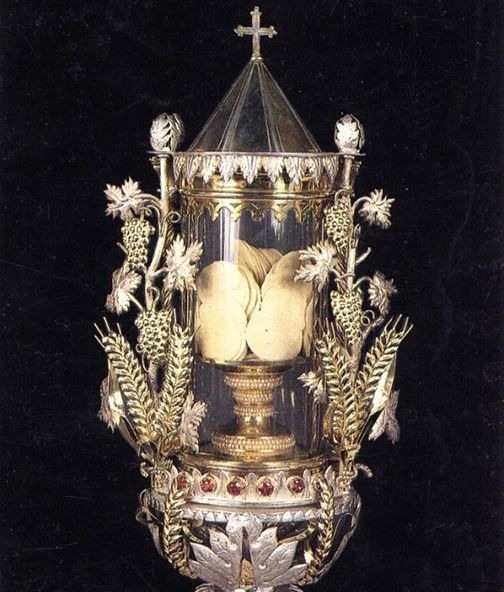
Taking advantage of this situation, a group of thieves targeted the Basilica of San Francesco (Saint Francis Church), one of Siena’s principal houses of worship. The thieves entered the deserted church and made their way directly to the sanctuary, where they knew the Blessed Sacrament was reserved in the tabernacle. With practiced efficiency, they picked the lock of the tabernacle and stole the golden ciborium—the sacred vessel containing 351 consecrated Hosts that had been consecrated according to the Church’s solemn ritual and were the Body of Christ.
The theft went undetected until the following morning, when a priest opened the tabernacle to distribute Holy Communion at Mass. Finding the tabernacle empty, the alarm was raised. Soon afterward, a parishioner discovered the ornate lid of the ciborium lying in the street, confirming the horror of what had transpired: the Blessed Sacrament had been desecrated, stolen by sacrilegious thieves.
The news of this terrible sacrilege sent shockwaves through the entire city. The theft was not merely a crime against property; it was an offense against God Himself. The anguish and spiritual desolation that gripped the hearts of the faithful was profound and overwhelming. The planned festivities for the Feast of the Assumption were immediately cancelled as a sign of mourning and reparation. Archbishop Alessandro Zondadari, moved by the gravity of the situation, ordered urgent public prayers of reparation to implore God’s mercy and forgiveness for this heinous act. The civil authorities launched an immediate search to recover the stolen Hosts and apprehend the criminals responsible.
The Miraculous Recovery: August 17, 1730
For three agonizing days, the consecrated Hosts remained missing, their fate unknown. The faithful of Siena and the clergy prayed intensely, offering penances and acts of reparation. Then, on August 17, 1730—exactly three days after the theft—a priest named Antonio Vannini was praying in the Church of Santa Maria in Provenzano (Saint Mary of Provenzano), a sanctuary devoted to the Virgin Mary. As he knelt in prayer at a pre-dieu (a kneeling bench), something white caught his eye protruding from the offering box attached to his prie dieu—the alms box where the faithful deposited their donations.
With a mixture of curiosity and reverence, Father Vannini investigated what he had seen. To his amazement and overwhelming joy, he discovered that the white object was a consecrated Host. Realizing the profound significance of what he had found, he immediately informed the other priests in the church, who in turn notified the Archbishop and the Franciscan friars from San Francesco Church.
When the offering box was solemnly opened in the presence of local clergy and an official representative of the Archbishop, the assembled witnesses beheld a miracle: within the box, covered with dust and debris that had accumulated in its interior, lay a large number of consecrated Hosts. Some were suspended by delicate cobwebs; others lay on the bottom of the box. Fifty years later, detailed records would indicate that 348 whole Hosts and six halves had been recovered—matching exactly the number that the Franciscan friars had estimated were in the ciborium when it was stolen.
The appearance of the stolen Hosts in the offering box of a church dedicated to the Virgin Mary is itself profoundly symbolic. It suggests that the Virgin Mother herself had protected and preserved the Hosts of her Son, guiding them to a place of honor in a sanctuary devoted to her veneration. This connection between the recovery and Mary’s sanctuary deepened the devotional meaning of the miracle in the hearts of the Sienese faithful.
Authentication and Preservation
After the miraculous recovery, the consecrated Hosts were carefully cleaned by the priests to remove the dust and debris. They were then placed in a new ciborium and reserved in the tabernacle of the main altar of the Church of Santa Maria in Provenzano. The following day, in a solemn and jubilant procession accompanied by a great gathering of townspeople, Archbishop Alessandro Zondadari carried the recovered Sacred Hosts back to the Basilica of San Francesco, from which they had been stolen. This procession, in contrast to the cancelled festivities days before, became a glorious celebration of God’s mercy and protective power.
Over the following decades, the preserved Hosts remained in the church, venerated by the faithful and carefully guarded by the friars. However, a natural question arose among the clergy and the theologians: why were the Hosts not consumed by a priest during Mass, which was the ordinary ecclesiastical procedure when dealing with consecrated particles? While no definitive answer was ever recorded, historical accounts suggest two likely explanations. First, the enormous crowds of pilgrims and faithful who traveled to Siena to offer prayers of reparation before the sacred particles necessitated their preservation for extended veneration. Second, as news of the miracle spread, Church authorities may have recognized the extraordinary nature of what was occurring and decided to preserve the Hosts for further examination and as a permanent sign of God’s power.
Fifty years after the recovery, in 1780, an official investigation was undertaken by the Franciscan Order to verify the authenticity and nature of the miracle. Father Carlo Vipera, the Minister General of the Franciscan Order, personally examined the Hosts on April 14, 1780. In a remarkable act that demonstrated both his faith and his commitment to verification, he tasted one of the consecrated particles—an action that would have been unthinkable except that this was a genuine consecrated Host. To his astonishment and the vindication of all believers, the Host was found to be perfectly fresh, incorrupt, and apparently newly consecrated despite the passage of fifty years.
Father Carlo Vipera immediately recognized the profound significance of what he had witnessed. He ordered that the remaining 230 particles be placed in a new ciborium and issued a formal prohibition against any further distribution of the Hosts. This decision recognized that these particles had become a permanent sign and testimony—a miracle preserved by God’s power for the perpetual edification of the Church.
Scientific Verification and the Control Experiment
Perhaps the most compelling evidence for the authenticity of the miracle is provided by a remarkable control experiment conducted by the Church in the years following the 1780 examination. During an investigation in 1789, Archbishop Alessandro Zondadari ordered that several unconsecrated hosts (ordinary bread that had not been consecrated) be placed in a sealed box under lock and key in the diocesan chancery office. These unconsecrated hosts were kept under identical conditions to those in which the miraculous Hosts were preserved.
Ten years later, in 1799, these control hosts were removed from their sealed container and examined. The results were striking and unambiguous: the unconsecrated hosts were found to be significantly disfigured and withered. The natural processes of decay—oxidation, microbial degradation, and simple aging—had worked their inevitable effect on ordinary bread left sealed for a decade.
However, when these same conditions were extended further, the evidence became even more compelling. In 1850—a full 61 years after they had been placed in the sealed box—the unconsecrated control hosts were examined again. They had been reduced to particles of a dark yellow color, severely degraded and barely recognizable as bread. Yet during this same 61-year period, the consecrated Hosts of the miracle remained in their original state: whole, shiny, maintaining the characteristic scent of unleavened bread, and showing absolutely no signs of natural decay or corruption.
This contrast is scientifically remarkable and, in the estimation of the Catholic Church, inexplicable by natural causes alone. The conditions were identical; the initial material was identical in composition; the only difference was consecration—the divine transformation of the bread into the Body of Christ. The Church’s unanimous conclusion was that the perfect preservation of the miraculous Hosts over centuries, in stark contrast to the complete decay of the control hosts, constitutes powerful evidence of the supernatural character of the miracle.
The Miracle Today: Continuing Testimony
Nearly three centuries have now passed since the theft of the Hosts in 1730 and their miraculous recovery in 1730. Throughout this entire period, the consecrated Hosts have remained in a state of perfect preservation, continuing to bear witness to the Real Presence of Christ in the Eucharist. The miraculous Hosts can be venerated in the Basilica of San Francesco in Siena, where they are reserved with great reverence and devotion.
Today, 223 of the original 351 Hosts remain intact and incorrupt—a number reduced because some particles were distributed over the centuries to other churches and for special devotional purposes, but the majority have been preserved for the perpetual edification of the faithful. With a unanimous voice, the faithful, priests, bishops, cardinals, and popes have marveled at and worshiped the holy Hosts, recognizing in them a permanent miracle both complete and perfect that has endured for over 290 years.
The miracle of Siena stands as one of the Church’s most carefully documented and scientifically verifiable signs of the Real Presence. It demonstrates that Christ’s Body, once consecrated, remains His Body—protected, preserved, and glorified by God’s omnipotent power.
Theological Significance and Spiritual Lessons
The Eucharistic Miracle of Siena carries profound theological implications. First and foremost, it provides irrefutable testimony to the doctrine of transubstantiation—that in the consecration, the substance of bread and wine are truly and wholly converted into the Body and Blood of Christ, while the appearances (accidents) of bread and wine remain. The fact that 351 particles of what appears to be bread have remained perfectly preserved for nearly three centuries, while ordinary bread would decay to dust, speaks eloquently to their true nature: they are the Body of Christ, preserved by divine power.
Second, the miracle demonstrates God’s extraordinary care for the Eucharist and His willingness to intervene miraculously to protect His most sacred gift. Even when thieves desecrate the Blessed Sacrament through sacrilege, God’s protective power transcends human wickedness. The Hosts were not destroyed or lost forever; they were guided, preserved, and restored to a place of honor and veneration.
Third, the miracle speaks to the power of intercessory prayer and reparation. The three days of intense prayers offered by the faithful of Siena and their Archbishop, their public acts of penance, and their genuine sorrow for the sacrilege committed were answered by God’s miraculous intervention. The theft and recovery demonstrate that sin and sacrilege cannot ultimately triumph against God’s mercy and power.
Fourth, the connection between the miracle and the Virgin Mary—whose feast was being celebrated when the theft occurred, and in whose church the Hosts were miraculously recovered—speaks to Mary’s unique maternal care for her Son’s Eucharistic presence. She interceded for the protection and recovery of the consecrated Hosts, demonstrating her role as the Mother of the Church and Co-redemptrix of grace.
Prayer of Devotion to the Eucharistic Miracle of Siena
Let us conclude with a prayer honoring this remarkable miracle and seeking to deepen our faith in Christ’s Real Presence:
O Most Sacred Heart of Jesus, truly present in the Blessed Sacrament,
We come before You with profound reverence and gratitude, marveling at the extraordinary miracle You granted to the faithful of Siena in the year 1730. In this miracle, You demonstrated to all generations the reality of Your Eucharistic presence and Your infinite power to protect and preserve Your sacred gifts.
We thank You for the preserved Hosts that continue, even to this day, to bear witness to the truth of transubstantiation and to call us to deeper faith, reverence, and love for the Blessed Sacrament.
Grant us, O Lord, the grace to recognize Your Real Presence in every consecrated Host, that we may approach the Eucharist with ever-increasing devotion, awe, and gratitude.
May the Eucharistic Miracle of Siena strengthen our faith, purify our hearts, and lead us to a more profound union with You through the reception of Your Body and Blood in Holy Communion.
Holy Virgin Mary, Mother of God and Protectress of the Eucharist, intercede for us, that we may cherish the Blessed Sacrament as the greatest treasure of the Church and the source of our spiritual nourishment.
Through Jesus Christ, Our Lord. Amen.
 Nelson MCBS
Leave a comment