

Second Sunday of Annunciation
Luke 1:26-38
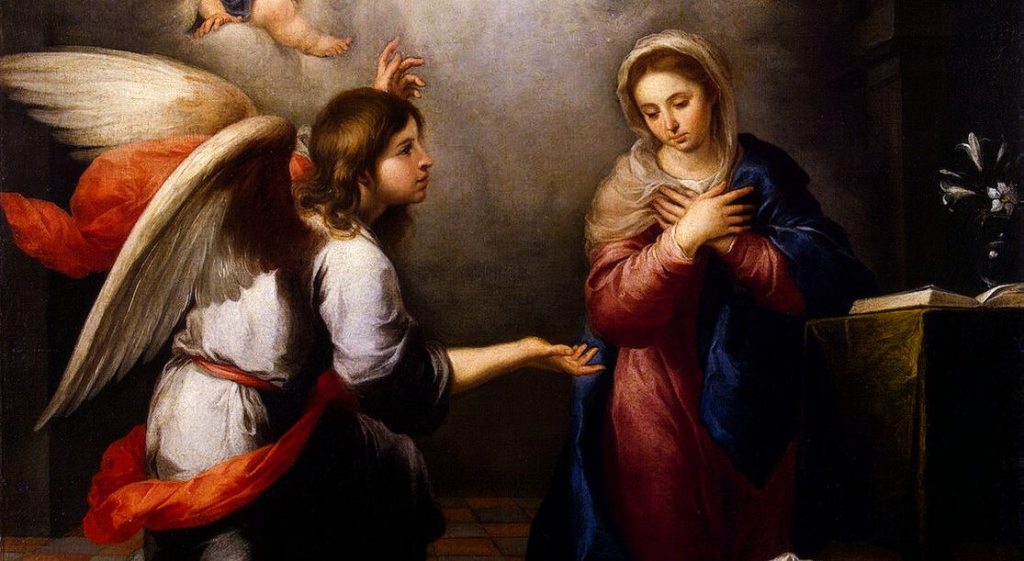
The Annunciation to the Blessed Mother.
“Let It Be Done to Me”
The Gospel today takes us away from all the noise, back to Nazareth. A quiet house. A young woman at prayer. And an angel not arriving with thunder or spectacle, but with a greeting: “Hail, full of grace, the Lord is with you.”
The angel Gabriel is sent by God, not to a palace or a temple, but to a hidden village in Galilee to a young woman whose only wealth is her faith. The greatest moment in history begins not in the center of power, but in silence.
St. Bede reminds us that the angel’s visit comes “in the sixth month” a symbol of the world grown old and weary with sin and waiting for redemption. Humanity has reached the end of its strength, and at that very moment, God Himself begins anew. God chooses the moment when our strength runs out to begin His greatest work. That’s how He always works. When our plans are exhausted, when our hearts are tired that’s when He enters quietly.
Nazareth was no one’s idea of importance. It was the town people mocked: “Can anything good come from Nazareth?” Yet that’s exactly where God chose to dwell. So often, we expect God to meet us in the grand or dramatic, but the Incarnation begins with an almost invisible “yes.”
“Full of Grace” — The New Beginning
Gabriel’s first word to Mary is not a command but a blessing: “Hail, full of grace.”
St. Jerome marvels that this greeting had never been spoken before. Others receive grace in part, he says, but in Mary the fullness of grace dwells. In her, the ancient story of Eve’s “NO” begins to be healed by a new “YES.”
St. Augustine says: “He is in your heart by faith, and in your womb by the Incarnation.” Before Christ takes flesh in her body, He already reigns in her soul.
This is what Advent invites us to rediscover that grace is not abstract, not distant. It is the very presence of God within us. The same Lord who filled Mary with grace wants to dwell in you and me in our fears, our families, our work.
And notice her reaction: “She was troubled at his saying.” Mary is not troubled by the angel she is troubled by being praised. It’s the mark of true holiness to be humble when praised. She doesn’t think, “Finally, I’m special.” She simply wonders, “What is God asking of me?”
We live in a culture that tells us to seek attention, to curate our own image. Mary shows us another way: the greatness of humility, the beauty of being transparent before God. In her humility, Mary mirrors what the Church is called to be in Advent: open, listening, ready to receive rather than to perform.
“You Will Conceive and Bear a Son”
The angel then speaks the promise that every prophet had longed to hear: “You will conceive and bear a son, and you shall call His name Jesus.”
St. Cyril of Alexandria captures the paradox beautifully: “He whom the heavens cannot contain will dwell within you.” This is the mystery that Advent invites us to contemplate — God’s greatness revealed in humility, His power veiled in weakness, His presence enfleshed in simplicity.
The throne of David is no longer a distant seat of power; it becomes a humble heart, open and receptive. The infinite One makes His dwelling among us, inviting us to meet Him in ordinary life, in hidden acts of faith, in hearts prepared for His presence.
It is also a call for us: if God can become small, so too must our hearts learn humility to welcome Him. The mystery is not just historical—it continues today: Christ comes to dwell within us, in our hearts, our families, and our communities, transforming the ordinary into a space of divine presence.
Pope Benedict XVI once said, “God’s sign is simplicity… He becomes small to enter our hearts and our lives.” Advent, then, is not merely a countdown to a festive day on the calendar; it is a season of spiritual preparation, a time to open the chambers of our hearts, to make room for the Presence that surpasses all understanding.
That is the Christmas we are preparing for, not a spectacle, but a Presence, a profound encounter with the Living God who comes to dwell with us. Each act of kindness, each moment of prayer, each gesture of love becomes a place where the eternal enters into time, where the infinite meets the finite.
In embracing simplicity, humility, and attentiveness, we participate in the mystery of God’s nearness, preparing ourselves to welcome the Christ who comes not to impress, but to transform, not to dominate, but to indwell. This holy season invites us to journey into this mystery, to learn the art of receptivity, and to recognize that the God who made the heavens is also the God who makes a home in our hearts.
Mary’s Question — Faith Seeking Understanding
Mary asks, “How shall this be, since I do not know man?”
She does not doubt, as Zechariah did — she wonders how. Her question is not unbelief, but faith seeking understanding.
Gabriel’s answer unveils the heart of the mystery: “The Holy Spirit will come upon you, and the power of the Most High will overshadow you.”
And then comes the moment all creation was waiting for. From the silence of Nazareth comes the word that changes history: “Behold the handmaid of the Lord. Be it done unto me according to your word.”
St. Bernard imagines all heaven holding its breath, waiting for her response. When she says yes, the eternal Word becomes flesh. Her “yes” is the hinge on which salvation turns.
Her fiat, her “yes” is not a moment of passivity, but the boldest act of faith in history. It is the faith that welcomes God into human life.
Saint John Paul II said that every Christian is called to share in Mary’s fiat. Each of us, in our own way, is asked to say to God: “Be it done unto me.” That’s the secret of discipleship, not control, but consent. Not perfection, but surrender.
Our Advent “Yes”
What does this mean for us, here and now, in the noise and fatigue of our modern Advent?
It means that faith still begins in the same way with a word from God and a response of the heart.
Mary said yes to something she didn’t fully understand. She didn’t ask for a plan or a guarantee she simply trusted that the Lord was with her.
This is where Advent leads us: not only to Bethlehem, but to Nazareth, to the moment of surrender that makes Christmas possible.
Mary’s fiat is meant to become ours. Each time we receive the Word of God, we are invited to echo her response: “Be it done unto me.”
Be it done in my family, in my work, in my fears, in my waiting.
St. John Paul II said that every Christian, in a sense, is called to be a new “Nazareth” , a place where the Word can take flesh again.
Every “yes” to grace, however small, allows Christ to be born again in the world.

 Nelson MCBS
Leave a comment