

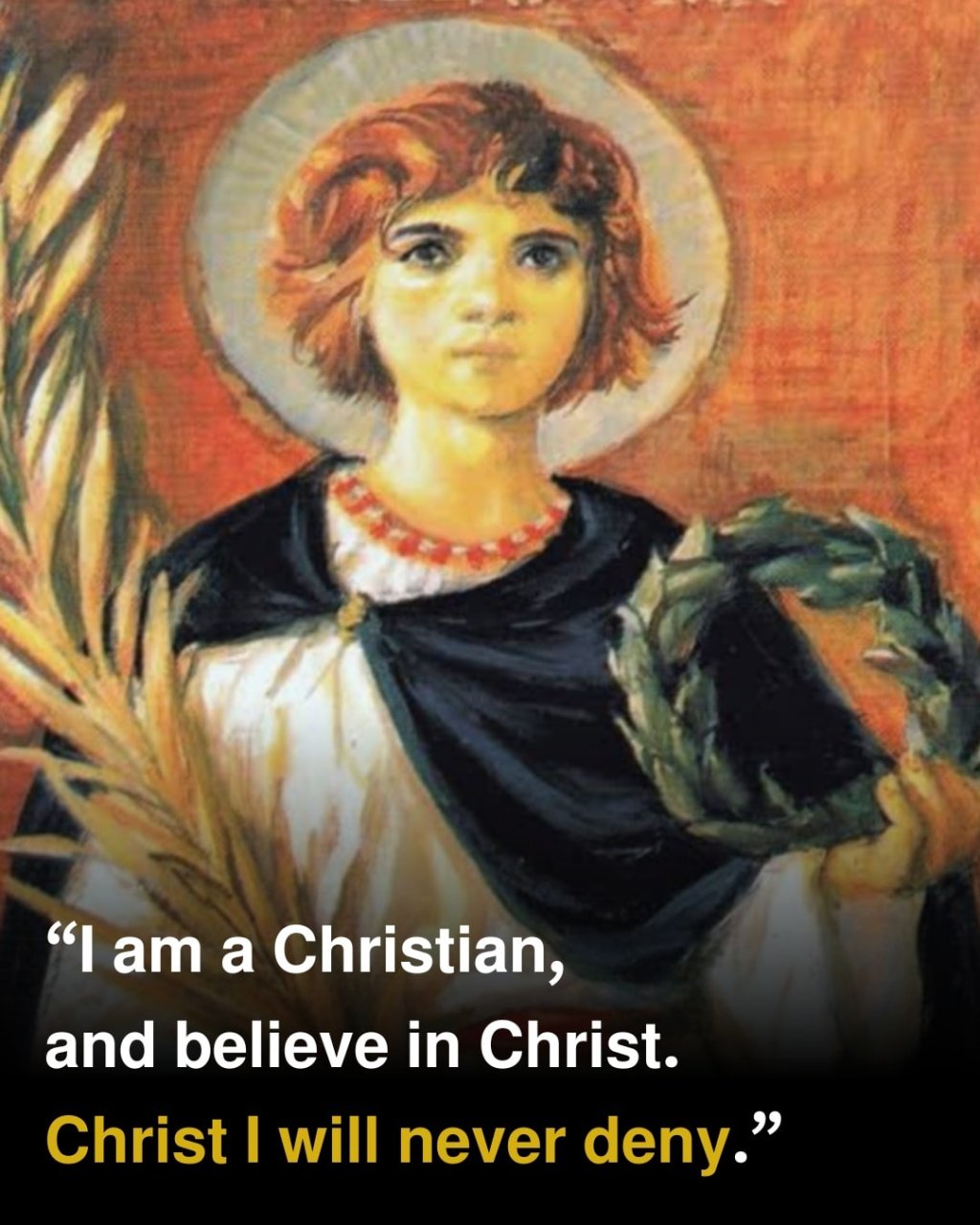
St. Pelagius was a thirteen year old Christian martyred for refusing to denounce his faith and convert to Islam, in Cordoba, Spain, 925.
10th century Cordoba was the most powerful and glorious of the muslim caliphates in the world and boasted the largest mosque outside of the Caaba in Mecca. Pelagius was, as a ten year old boy, taken hostage by the Moors of Cordoba during a rampage in a Christian town.
For some reason, however, the exchange prisoners never arrived, and for three years the poor youngster remained captive. Not that he was treated badly. Indeed, as he grew into his teens and proved to be a handsome, self-possessed youth, those who had charge of him brought good reports about him to the Caliph.
Caliph Abd-ar-Rahman eventually summoned Pelagius into his presence. He, too, was impressed by the lad’s potential. He even announced to him that he would willingly liberate him and confer upon him many favors. He would give him money, fine clothes, fine horses to ride, and increasing honors, but on one condition: that he renounce his Catholic faith and accept Mohammed as his prophet.
The prospect of freedom and riches would ordinarily have enchanted the average thirteen-year-old, as the caliph well knew. But the young hostage to whom he was talking was no ordinary boy. Throughout his captivity, Pelagius had kept his faith strong by prayer. His jail companions could have become a corrupting influence, but he had preserved himself from the effects of their bad example.
Pelagius knew that if he would but say those few words once, the caliph would be satisfied. But that meant to deny Christ. As far as he knew, no fellow Christian would witness his denial. Even if he were at last claimed by his own people, they need never know of his momentary apostasy. But it would nonetheless be a great sin, and surely, his holy guardian angel stood at his side, watching over him, as would his Lord. He lifted brave eyes to the caliph. “I will, indeed, be true to thee and obedient in all else,” he answered; “but first, I am Christ’s. Nothing may part me from Him.”
At this, the caliph grew angry, especially coming from one being offered such an honor: to be freed from imprisonment and made one of his pages in court. This outrage provoked the caliph and his aides, who now looked upon the handsome boy with anger.
“I am a Christian, and believe in Christ. Christ I will never deny.” One of the caliph’s aides laughed. “He mocks you,” he said in the caliph’s ear: “the Spaniard boy mocks you, as his friend the bishop did, in his Christian insolence.” Pelagius’ refusal chafed at Abdurrahman’s weakest spot—his pride, a pride already hurt by the conduct of Bishop Hermoygius. The caliph became ever more infuriated. He had suffered enough at the hands of the boy’s uncle. Should this boy too, here, in his own palace—a boy whom he wished to befriend and to place, as a companion, with his sons; a boy to whom he had openly offered all these advantages—should this youngster defy him to his face and shout aloud the name of his Christ, it would be simply too much insolence.
As the narrations of “Passions of the Saints” continue to tell, the caliph, already much infuriated, was moved by lust, and decided to at least take advantage of the young Christian boy’s handsomeness. But if little Pelagius showed great fortitude in his firm profession of faith in Christ, the boy also showed an admirable fortitude towards the caliph’s immoral sexual desire, and resisted just as resolutely. Such impudence, such insolence, from this young Christian Spaniard, was unheard of in the Moorish palace. There nothing left to do but finish little Pelagius off. And so, the caliph ordered his torture: “Take him out,” he said to the executioner, “and hang him up by his wrists till the pain forces him to deny his Christ.”
When the executioner came back, he informed the caliph that Pelagius had fainted. The caliph ordered him to bring Pelagius back to court. He did so. The young boy was bleeding from his wrists. “Once more, and for the last time,” the caliph said, “infidel and ungrateful as thou art, I give thee another chance. Happy freedom, honor, my favor and protection—or death. Choose!” And with the courage of a true Christian martyr, the boy resolutely responded, “I have chosen: Christ!”
“Take him away,” said Abdurrahman; “cut off his hands and feet and throw him into the river.” And so, as the Roman Martyrology recounts at the Hour of Prime, little Pelagius was literally torn to pieces with cruel iron pincers. Such was the dear price he paid for his faith and his chastity.
Source: Fear Not
 Nelson MCBS
Leave a comment