
𝗧𝗵𝗲 𝗖𝗮𝘃𝗲 𝗼𝗳 𝗦𝘁. 𝗝𝗲𝗿𝗼𝗺𝗲: 𝗪𝗵𝗲𝗿𝗲 𝘁𝗵𝗲 𝗖𝗮𝘁𝗵𝗼𝗹𝗶𝗰 𝗖𝗵𝘂𝗿𝗰𝗵 𝗚𝗮𝘃𝗲 𝘁𝗵𝗲 𝗕𝗶𝗯𝗹𝗲 𝘁𝗼 𝘁𝗵𝗲 𝗪𝗼𝗿𝗹𝗱
(By: The Catholic Faith Guardian)
Long before printing presses, denominations, or modern debates about Scripture, there was a cave—silent, cold, and hidden beneath sacred stone—where the Word of God was painstakingly given a voice for the Christian world.
That cave is known today as the Cave of St. Jerome, and its legacy exposes an uncomfortable truth often ignored: the Bible exists because of the Catholic Church.
𝘼 𝘾𝙤𝙢𝙢𝙞𝙨𝙨𝙞𝙤𝙣 𝙛𝙧𝙤𝙢 𝙩𝙝𝙚 𝘾𝙝𝙖𝙞𝙧 𝙤𝙛 𝙋𝙚𝙩𝙚𝙧
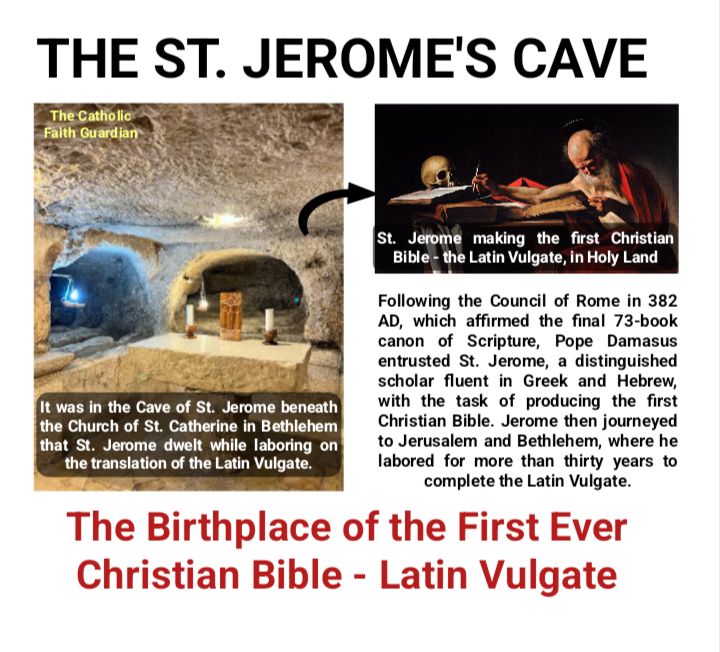
In 382 AD, following the Council of Rome, the Catholic Church—under the authority of Pope Damasus I—affirmed the definitive 73-book canon of Sacred Scripture.
This was not speculation, not private opinion, but an authoritative ecclesial act.
With the canon settled, Pope Damasus entrusted an immense task to one man uniquely qualified for it: St. Jerome, one of the greatest scholars Christianity has ever produced.
Jerome was no ordinary monk. He was fluent in Greek, deeply learned in Hebrew, and rigorously trained in Latin rhetoric.
At the command of the Pope, he was commissioned to translate the Scriptures faithfully according to the canon the Church had already decided.
This was not Jerome inventing a Bible—it was the Church authorizing, defining, and providing one.
𝘼 𝘾𝙖𝙫𝙚 𝙏𝙝𝙖𝙩 𝘾𝙝𝙖𝙣𝙜𝙚𝙙 𝘾𝙝𝙧𝙞𝙨𝙩𝙞𝙖𝙣 𝙃𝙞𝙨𝙩𝙤𝙧𝙮
To complete this sacred labor, St. Jerome traveled to the Holy Land, settling in Bethlehem, just south of Jerusalem.
Beneath what is now the Church of St. Catherine of Alexandria, adjacent to the Church of the Nativity, lies the cave where Jerome lived, prayed, studied, and translated.
This cave was not a symbol—it was his shelter, his study, and his cell.
For nearly thirty years, Jerome labored there, consulting ancient manuscripts, engaging Jewish scholars, and wrestling line by line with the sacred text.
By oil lamp and prayer, he produced what would become the Latin Vulgate—the first complete Christian Bible for the Western world.
This was not a casual project. It was a lifetime offering.
Jerome famously said, “Ignorance of Scripture is ignorance of Christ.” He lived that conviction in stone and silence.
𝙒𝙝𝙚𝙧𝙚 𝙀𝙭𝙖𝙘𝙩𝙡𝙮 𝙄𝙨 𝙩𝙝𝙚 𝘾𝙖𝙫𝙚 𝙏𝙤𝙙𝙖𝙮?
The Cave of St. Jerome is located beneath the Church of St. Catherine, a Catholic church attached to the Church of the Nativity complex in Bethlehem—the very place where Christ was born.
Pilgrims descend beneath the church into a network of grottoes traditionally associated with St. Jerome, St. Paula, and St. Eustochium, his companions and supporters.
The site is managed by the Franciscan Custody of the Holy Land, a Catholic institution charged for centuries with safeguarding Christianity’s most sacred places.
These friars are not caretakers of ruins—they are guardians of memory, faith, and continuity.
𝘼 𝙇𝙞𝙫𝙞𝙣𝙜 𝙋𝙞𝙡𝙜𝙧𝙞𝙢𝙖𝙜𝙚 𝙎𝙞𝙩𝙚
The Church of the Nativity complex receives millions of pilgrims each year, making it one of the most visited Christian holy sites in the world.
While exact figures for Jerome’s cave alone are not separately recorded, countless pilgrims pass through it annually, praying in the very place where the Bible they read was once translated.
Nearby features include:
 The Grotto of the Nativity, marking the birthplace of Christ
The Chapel of St. Joseph
The Cave of the Holy Innocents
Ancient monastic spaces that reflect early Catholic life
This is not legend—it is living history.
The Unavoidable Truth About the Bible
The Catholic Church did not borrow the Bible.
The Church identified the canon, commissioned its translation, preserved its manuscripts, copied it by hand for centuries, and propagated it throughout the world.
The Latin Vulgate became the standard Bible of Western Christianity for over a thousand years.
The first printed Bible in history—the Gutenberg Bible—was a Catholic Vulgate.
By contrast, Protestantism arrived more than a millennium later. It did not define the canon.
It did not produce the first Bible. It did not preserve Scripture through persecution, exile, and empire.
It received what the Catholic Church had already given—then removed books and claimed Scripture alone.
The irony is unavoidable:
 To hold a Bible is to hold a Catholic inheritance.
𝘼 𝘾𝙖𝙫𝙚 𝙏𝙝𝙖𝙩 𝙎𝙩𝙞𝙡𝙡 𝙎𝙥𝙚𝙖𝙠𝙨
The Cave of St. Jerome stands as a quiet but unyielding witness.
It proclaims that Scripture did not fall from heaven leather-bound and indexed.
It was born in the womb of the Church, translated under papal authority, and sanctified by sacrifice.
In that cave, the Catholic Church did not merely defend the Word of God—it gave it to the world.
And stone still remembers.
 Nelson MCBS
Leave a comment