
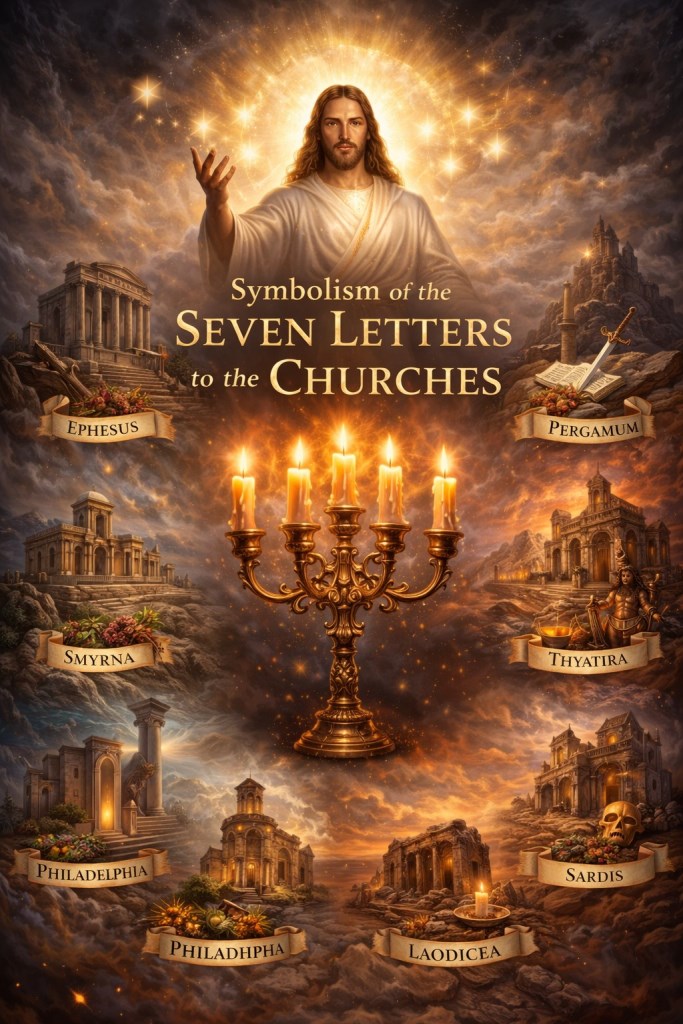
The Seven Letters (chapters 2–3) serve as a “state of the union” for the early Church, but in Catholic tradition, they are seen as much more than historical correspondence. They represent the Seven Ages of Church History and the seven internal dispositions of every local parish and individual soul.
Because “seven” denotes biblical perfection or completion, these seven specific churches in Asia Minor (modern-day Turkey) represent the Universal Church.
1. The Structure of the Letters
Each letter follows a remarkably consistent “divine legal” pattern, mirroring ancient treaty formats:
- The Address: “To the angel of the church in…”
- The Title of Jesus: A specific attribute of Christ drawn from the vision in Chapter 1.
- The Commendation: “I know your works…” (What they are doing well).
- The Complaint: “But I have this against you…” (Except for Smyrna and Philadelphia).
- The Counsel: An exhortation to repent or endure.
- The Promise: A reward for “the one who conquers” (linked to the New Jerusalem).
2. The Seven Churches: A Spiritual Map
1. Ephesus: The Loveless Church
- The Issue: They have “abandoned the love they had at first.” They are doctrinally sound and reject heretics (the Nicolaitans), but their faith has become mechanical.
- Catholic Perspective: This warns against Legalism. It is possible to be 100% “orthodox” in your theology but 0% “charitable” in your heart.
- The Promise: “To eat from the Tree of Life.”
2. Smyrna: The Persecuted Church
- The Issue: They are facing “tribulation and poverty.” Jesus warns them of an upcoming “ten days” of imprisonment.
- Catholic Perspective: Smyrna was the home of St. Polycarp, a disciple of John who was martyred. This letter reminds us that suffering is not a sign of God’s abandonment, but of sharing in the Cross.
- The Promise: “The crown of life” and protection from the “second death.”
3. Pergamum: The Compromising Church
- The Issue: They live “where Satan’s throne is” (likely a reference to the massive Great Altar of Zeus). While they are brave, they tolerate false teachers who encourage “eating food sacrificed to idols.”
- Catholic Perspective: This warns against Syncretism—trying to blend the Gospel with the toxic elements of the surrounding culture.
- The Promise: “The hidden manna” (a clear Eucharistic reference).
4. Thyatira: The Corrupt Church
- The Issue: They are growing in works and love, but they tolerate a “Jezebel” figure who leads people into sexual immorality.
- Catholic Perspective: This is a warning to Church Leadership. Charity is never an excuse to tolerate grave sin or false teaching within the community.
- The Promise: “The morning star” and authority over the nations.
5. Sardis: The Dead Church
- The Issue: They have a “reputation of being alive,” but they are actually dead. Their works are “not complete.”
- Catholic Perspective: This represents Cultural Catholicism—having the outward name of “Christian” but lacking a living interior life of grace.
- The Promise: “White garments” and their name kept in the Book of Life.
6. Philadelphia: The Faithful Church
- The Issue: They have “little power” but have kept the Word. Jesus has set before them an “open door.”
- Catholic Perspective: This represents the Missionary Church. Despite being small or weak in the eyes of the world, their fidelity makes them a pillar in God’s temple.
- The Promise: To be made a “pillar in the temple of my God.”
7. Laodicea: The Lukewarm Church
- The Issue: They are “neither cold nor hot.” Because they are wealthy and self-sufficient, they don’t realize they are “wretched, pitiable, poor, blind, and naked.”
- Catholic Perspective: This is the most famous warning in Revelation. Lukewarmness (acedia or spiritual sloth) is seen as more dangerous than being “cold” (openly hostile), because the lukewarm person feels no need for a Savior.
- The Promise: To sit with Jesus on His throne.
3. Key Catholic Themes in the Letters
The “Angels” of the Churches
Catholic tradition often interprets the “angel” of each church as its Bishop. St. Augustine and others suggested that the letter is addressed to the Bishop as the spiritual head who is responsible for the “health” of his flock.
The Nicolaitans and Jezebel
These aren’t just names; they represent the heresy of Gnosticism and moral relativism. They taught that because the “spirit” was saved, what you did with your “body” (like eating pagan meat or committing adultery) didn’t matter. The letters reaffirm the Catholic view that faith and morals are inseparable.
“Behold, I Stand at the Door and Knock”
Often used in modern evangelical “altar calls,” this verse (Rev 3:20) was originally written to baptized Christians in Laodicea. In a Catholic context, this is an invitation to the Eucharistic Feast. Jesus knocks at the door of the heart, asking to enter so that He may “dine” with us—a foreshadowing of the Mass.
Summary Table: The Divine Medicine
| Church | Diagnosis | The Cure |
| Ephesus | Routine/Dryness | Remember your “First Love.” |
| Smyrna | Fear of Suffering | “Be faithful unto death.” |
| Pergamum | Cultural Compromise | Repent of false doctrines. |
| Thyatira | False Tolerance | Hold fast to what you have. |
| Sardis | Spiritual Death | “Wake up” and strengthen what remains. |
| Philadelphia | Weakness | Persevere in the “Open Door.” |
| Laodicea | Self-Sufficiency | Buy “gold refined by fire” (Grace). |
 Nelson MCBS
Leave a comment