
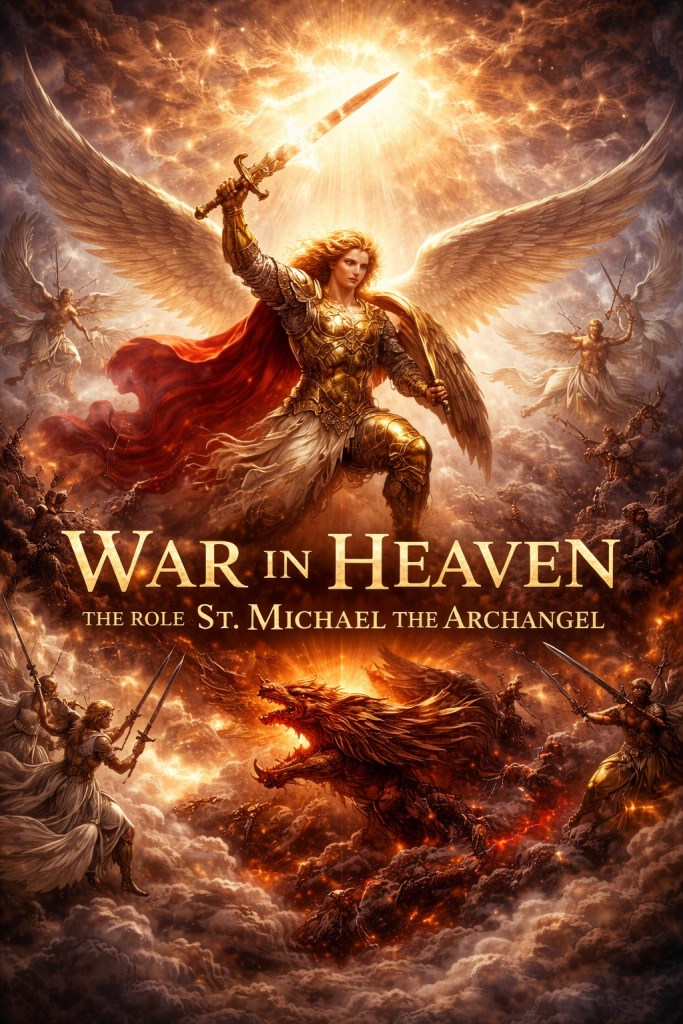
Immediately following the appearance of the Woman and the birth of her Child, the vision shifts from the earthly realm to a cosmic battlefield. Revelation 12:7-12 describes the “War in Heaven,” a passage that serves as the biblical foundation for the Catholic theology of Angels and the specific role of St. Michael the Archangel.
1. The Battle of the Two Armies
John describes a sudden eruption of celestial violence:
“Now war arose in heaven, Michael and his angels fighting against the dragon; and the dragon and his angels fought…” (Rev 12:7)
Who is St. Michael?
His name in Hebrew (Mi-ka-el) is not just a name; it is a battle cry. It means “Who is like God?” According to Catholic tradition, when Lucifer (the Dragon) rebelled against God due to pride, Michael rose up to defend God’s honor. His name serves as a perpetual rebuke to the Dragon’s desire to be his own god.
Why is there “War” in a perfect Heaven?
Catholic theologians, such as St. Thomas Aquinas, explain this “war” not as a physical battle with swords and shields, but as a battle of wills and intellects.
- The Dragon’s Sin: Pride and envy. Tradition suggests the angels were tested with a revelation of God’s plan for the Incarnation—that God would become a lowly human. Lucifer refused to serve a God who would humble Himself in such a way.
- Michael’s Response: Humility and obedience. He led the faithful angels in choosing to serve God’s plan, even if they didn’t fully comprehend it.
2. The Result: The Casting Down
The Dragon and his angels (the demons) are “defeated” and “thrown down to the earth.” This is a pivotal moment in the Catholic understanding of spiritual warfare:
- Loss of Place: The demons no longer have “any place” in Heaven. They are permanently excluded from the Beatific Vision (seeing God face-to-face).
- The Accuser is Silenced: One of the Dragon’s primary titles in this passage is “The Accuser of our brethren.” In the Old Testament (like in the Book of Job), Satan acts as a kind of heavenly prosecutor, pointing out human sins to God. After Christ’s victory, the “Accuser” is thrown down. He can no longer prosecute those who are covered by the Blood of the Lamb.
3. How the “War” is Won by Humans
The most striking part of this passage is that although Michael wins the battle in Heaven, the “brethren” (human beings) win the battle on Earth. Revelation 12:11 provides the Catholic “Three-Fold Formula” for Spiritual Victory:
“And they have conquered him by the blood of the Lamb and by the word of their testimony, for they loved not their lives even unto death.”
- The Blood of the Lamb: Victory starts with the Sacraments, particularly the Eucharist and Baptism, which apply Christ’s sacrifice to the soul.
- The Word of Testimony: This is the public profession of faith. It’s not enough to believe privately; one must live the Gospel openly.
- Sacrificial Love: The willingness to suffer or die rather than deny Christ. This is the ultimate defeat of the Dragon, who uses the fear of death to enslave humanity.
4. St. Michael in Catholic Devotion
Because of this passage, St. Michael is venerated as the Prince of the Heavenly Host and the Protector of the Church.
- The Leonine Prayer: In the late 19th century, Pope Leo XIII composed the famous Prayer to St. Michael (“St. Michael the Archangel, defend us in battle…”). He ordered it to be said after every Low Mass to protect the Church from spiritual attacks.
- The Four Offices of Michael: In Catholic tradition, Michael has four roles:
- To fight against Satan.
- To rescue the souls of the faithful from the power of the enemy, especially at the hour of death.
- To be the champion of God’s people (the Church).
- To call away from earth and bring men’s souls to judgment.
5. The “Short Time” of the Dragon
The passage ends with a warning: the Dragon has come down to earth in “great wrath,” knowing that “his time is short.” (Rev 12:12).
For Catholics, this explains the paradox of the world today: Christ has already won the definitive victory (The Resurrection), but the “mopping up” operation continues. The Dragon is like a defeated general who is causing as much destruction as possible before the final surrender.
Summary: The Heavenly Hierarchy
| Figure | Symbolism/Role |
| St. Michael | The “General” of God; the model of humility and protection. |
| The Dragon | The “Ancient Serpent”; the source of accusation and pride. |
| The Fallen Angels | Those who chose “Non Serviam” (I will not serve). |
| The Heavenly Voice | Represents the triumph of the Kingdom of God over earthly empires. |
 Nelson MCBS
Leave a comment