
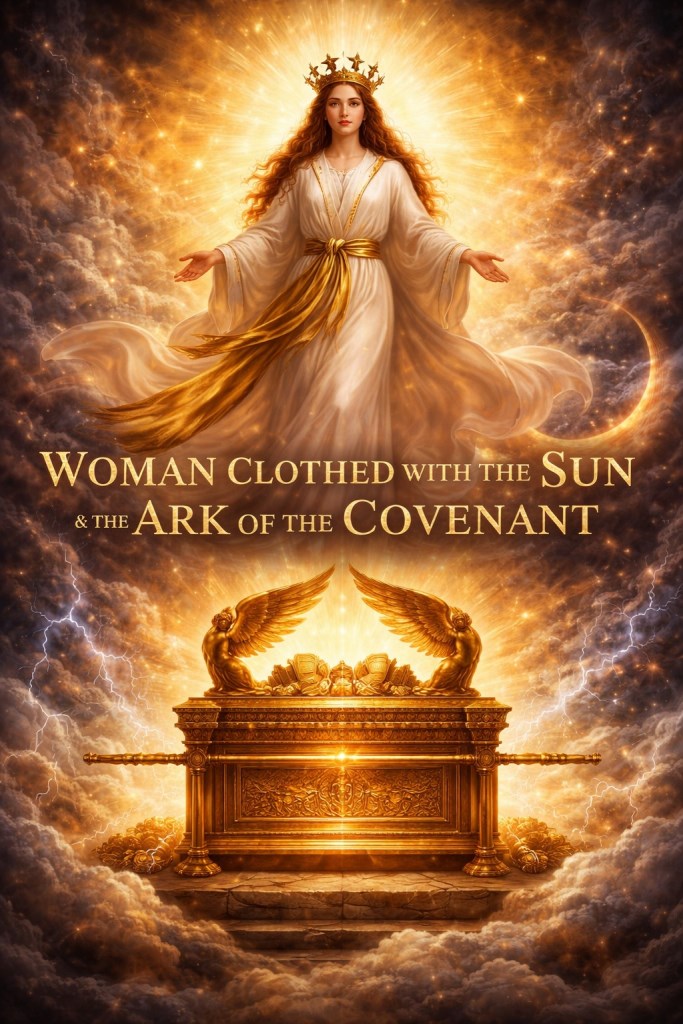
The connection between the Woman Clothed with the Sun and the Ark of the Covenant is one of the most beautiful examples of how the Catholic Church reads the Bible as a single, unified story.
In the original Greek text, there is no chapter break between Revelation 11 and 12. When read together, the transition creates a “cinematic” reveal that identifies Mary as the New Ark.
1. The Context: The Missing Ark
To understand the impact of John’s vision, we have to look at the history of Israel. The original Ark of the Covenant—which held the Ten Commandments—was the holiest object on earth. It was the “footstool” of God’s presence.
However, when the Babylonians destroyed the Temple in 587 BC, the Ark vanished. For 600 years, the “Holy of Holies” in the Temple was empty. Jewish tradition (recorded in 2 Maccabees 2:4-8) held that the prophet Jeremiah had hidden the Ark and that it would not be seen again until God gathered His people together.
The Great Reveal
In Revelation 11:19, John sees exactly what every first-century Jew was longing for:
“Then God’s temple in heaven was opened, and the ark of his covenant was seen within his temple.”
The readers would have been holding their breath, expecting a gold-covered wooden box. But immediately, in the very next verse (Revelation 12:1), John describes what he actually sees:
“And a great portent appeared in heaven, a woman clothed with the sun, with the moon under her feet, and on her head a crown of twelve stars.”
For the Catholic Church, the “Woman” is the “Ark.” The box was the shadow; the woman is the reality.
2. The Biblical “Type”: Old Ark vs. New Ark
The Church Fathers noticed striking parallels between the Ark of the Old Testament and Mary. St. Luke’s Gospel actually uses specific “Ark language” to prepare us for John’s vision in Revelation.
| The Old Ark (Exodus) | Mary, the New Ark (Luke/Revelation) |
| Contained the Stone Tablets (The Law). | Carried the Word made Flesh (The Law-giver). |
| Contained the Manna (Bread from Heaven). | Carried the Living Bread (The Eucharist). |
| Contained the Rod of Aaron (The Priesthood). | Carried the Eternal High Priest. |
| The “Cloud of Glory” overshadowed it. | The Holy Spirit overshadowed her (Luke 1:35). |
| David danced before it (2 Sam 6:14). | John the Baptist leaped in the womb (Luke 1:41). |
3. The Identity of the Woman
While some argue the Woman is only Israel or only the Church, the Catholic Church teaches a “polyvalent” (multi-layered) meaning. She is Mary and the Church.
Why she is Mary:
- The Child: She gives birth to a male child who will “rule all the nations with a rod of iron” (Rev 12:5). This is undeniably Jesus (Psalm 2:9). Since Mary is the literal mother of Jesus, she is the literal woman of the vision.
- The Individual: John describes a specific person with a crown, under attack by a specific Dragon.
Why she is the Church:
- The Pain: She “cries out in birth pangs.” Since Mary was traditionally held to have given birth without the “pains of Eve” due to her Immaculate Conception, the “pangs” are often interpreted as the Church suffering to “give birth” to Christ in the hearts of believers.
- The Offspring: The Dragon goes off to make war on the “rest of her offspring” (Rev 12:17)—which are the Christians.
4. The Dogmatic Significance: The Assumption
This passage is the primary scriptural foundation for the Dogma of the Assumption.
In Revelation 12, the Woman is seen in heaven, body and soul (clothed with the sun, moon under her feet). She is not a ghost or a disembodied spirit; she is a physical person glorified in the presence of God. Just as the Old Ark was taken up into the Temple, the New Ark (Mary) was taken up into the Heavenly Temple so that where the King is, the Queen Mother might also be.
5. The War with the Dragon
The vision concludes with a cosmic battle. The Dragon (Satan) stands before the Woman to devour her child. This echoes Genesis 3:15, where God promised that the “seed of the woman” would crush the serpent’s head.
In the Catholic view:
- The Dragon represents the “Culture of Death” and worldly empires that oppose God.
- The Woman represents the “Culture of Life” and the protective power of the Church.
By identifying Mary as the Woman of Revelation, the Church reminds us that the battle is not just historical—it is happening now. Mary, as the Mother of the Church, continues to protect the “rest of her offspring” against the Dragon.
 Nelson MCBS
Leave a comment