

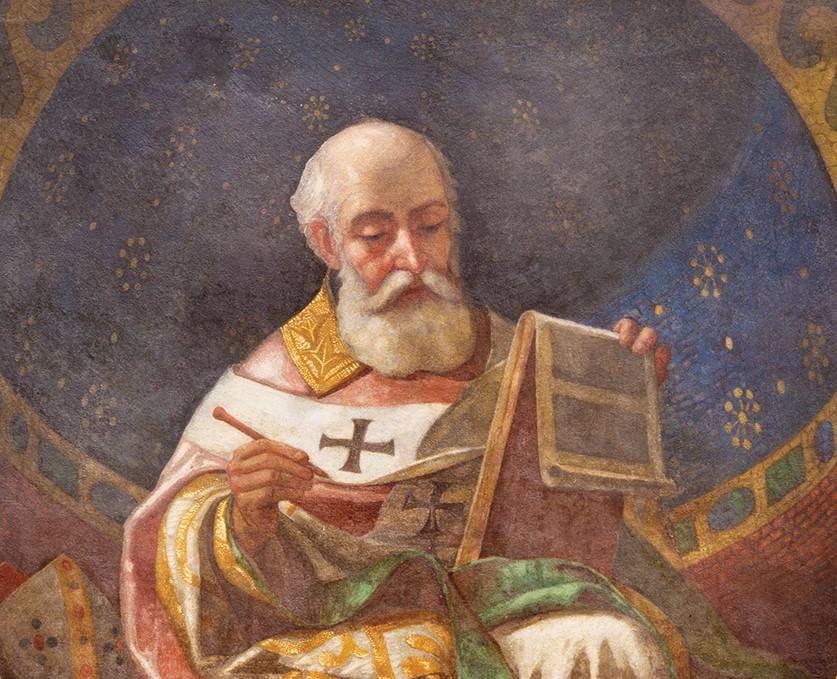
A Mind That Sought Truth, A Heart That Found God, A Voice That Shaped the Ages
Introduction: Why Augustine Still Matters
Across two millennia of Christian history, countless saints, thinkers, and theologians have attempted to articulate the mystery of God and the meaning of human life. Yet among them all, St. Augustine of Hippo stands uniquely towering—an intellectual giant whose influence extends far beyond his own time.
To call Augustine the “greatest theologian of all time” is not an exaggeration but a recognition of the breadth and depth of his contribution. He did not simply explain doctrines—he reshaped the way Christianity thinks about God, grace, sin, time, history, and the human person.
His writings continue to:
- Form the backbone of Western Christian theology
- Influence philosophers and theologians across traditions
- Speak directly to the restless modern soul
Augustine’s genius lies in the fact that he is not only profound but deeply human. His theology is born not in abstraction, but in struggle, conversion, and encounter with Jesus Christ.
1. Early Life: Between Two Worlds
Tagaste, a small town in Roman North Africa, was where Augustine was born in 354 AD. His upbringing was marked by a tension that would define his early life:
- A father rooted in Roman culture and paganism
- A mother, St. Monica, deeply committed to Christ
Monica’s persistent prayers would later become legendary, but during Augustine’s youth, her influence seemed limited.
From an early age, Augustine displayed extraordinary intellectual ability. He was sent to Carthage for higher studies, where he immersed himself in rhetoric—the art of persuasion—and the literature of classical Rome.
Yet alongside intellectual growth came moral disorder.
He later confessed:
- A life driven by ambition
- A struggle with sensual desires
- A pursuit of worldly success
His famous reflection on stealing pears—not out of hunger, but for the thrill of wrongdoing—reveals his deep insight into human sin:
We do not sin only out of need, but out of disordered desire.
2. The Restless Search for Truth
Augustine’s life is best understood as a long intellectual and spiritual journey.
a. Manichaeism: The Illusion of Easy Answers
For nearly a decade, Augustine followed the teachings of Mani.
Manichaeism offered:
- A dualistic explanation of good and evil
- A rational framework for understanding the universe
- A sense of intellectual superiority
It attracted Augustine because it seemed to solve the problem of evil without implicating God.
But eventually, he realized its weaknesses:
- Its explanations were simplistic
- Its leaders lacked intellectual depth
- Its cosmology was flawed
b. Skepticism: The Crisis of Doubt
Disillusioned, Augustine turned to skepticism.
He began to question whether truth could be known at all.
This stage is crucial—it reflects a deeply modern experience:
- Doubt about certainty
- Distrust of authority
- Intellectual instability
Yet Augustine refused to remain in doubt. His restless mind continued searching.
c. Neoplatonism: The Awakening of the Mind
Through Neoplatonic philosophy, Augustine encountered a new vision of reality.
He discovered:
- God as immaterial and transcendent
- Evil as a privation of good
- The soul’s ascent toward truth
This philosophical framework helped him overcome earlier misunderstandings of Christianity.
But philosophy alone could not save him.
3. Conversion: The Triumph of Grace
Augustine’s conversion in Milan is one of the most powerful spiritual moments in history.
Influenced by St. Ambrose of Milan, Augustine began to see Christianity in a new light:
- Scripture was not simplistic but profound
- Faith was intellectually credible
- Christ was the answer to his deepest questions
Yet he struggled.
He famously prayed:
“Lord, make me chaste—but not yet.”
This reveals the tension between:
- Intellectual conviction
- Moral weakness
Finally, in a moment of surrender, he heard a voice:
“Take and read.”
Opening the Scriptures, he encountered a passage that pierced his heart.
In that moment, resistance gave way to grace.
He was baptized in 387 AD.
4. Augustine the Bishop: Shepherd and Thinker
Returning to North Africa, Augustine eventually became bishop of Hippo.
As bishop, he was:
- A preacher
- A teacher
- A defender of the faith
- A pastor deeply engaged with his people
He preached thousands of sermons and wrote extensively, addressing both ordinary believers and intellectual opponents.
5. The Doctrine of Grace: God’s Initiative
One of Augustine’s greatest contributions is his teaching on grace.
In opposition to Pelagius, Augustine insisted:
- Human beings cannot save themselves
- Sin has deeply wounded human nature
- Salvation is entirely dependent on God’s grace
Grace, for Augustine, is:
- Unmerited
- Transformative
- Essential
This teaching emphasizes God’s initiative in salvation.
6. Original Sin: The Broken Human Condition
Augustine developed a profound understanding of Original Sin.
He taught that:
- Humanity inherits a fallen condition from Adam
- This affects both will and intellect
- Sin is not just individual but communal
This doctrine explains:
- Why humans struggle with good
- Why grace is necessary
- Why salvation is universal
7. The Trinity: A Mystery Explored
In his work On the Trinity, Augustine offers one of the most profound explorations of the Triune God.
He uses psychological analogies:
- Memory
- Understanding
- Will
These reflect the unity and diversity within the human mind.
Yet he acknowledges:
- No analogy fully captures God
- The Trinity remains a mystery
8. Time, Eternity, and the Human Experience
Augustine’s reflections on time are among the most famous in philosophy.
He asks:
What is time?
His answer is deeply insightful:
- The past exists in memory
- The present in attention
- The future in expectation
Time, for Augustine, is not merely external—it is deeply tied to human consciousness.
9. The City of God: History Reimagined
After the fall of Rome, Augustine wrote The City of God.
He contrasts:
- The City of God (love of God)
- The City of Man (love of self)
History, in this view, is a spiritual drama.
10. The Church: Sacrament of Unity
Augustine defended the unity of the Church against divisions.
He emphasized:
- The importance of sacraments
- The role of the Church as teacher
- Unity over purity
11. Spirituality: The Journey Within
Augustine’s spirituality is deeply interior.
He teaches:
- God is found within the soul
- Self-knowledge leads to God
- Prayer is essential
12. Influence Across Centuries
St. Augustine of Hippo influenced:
- Medieval theology
- Thomas Aquinas
- Martin Luther
His reach is unmatched.
13. Augustine and the Modern World
Augustine speaks to modern issues:
- Identity
- Desire
- Truth
- Freedom
Conclusion: The Restless Heart Finds Rest
St. Augustine of Hippo remains the greatest theologian not because he answered every question, but because he asked the deepest ones.
His life tells us:
- Truth is worth seeking
- Grace is real
- God can be found
And above all:
Our hearts are restless until they rest in God.
 Nelson MCBS
Leave a comment