
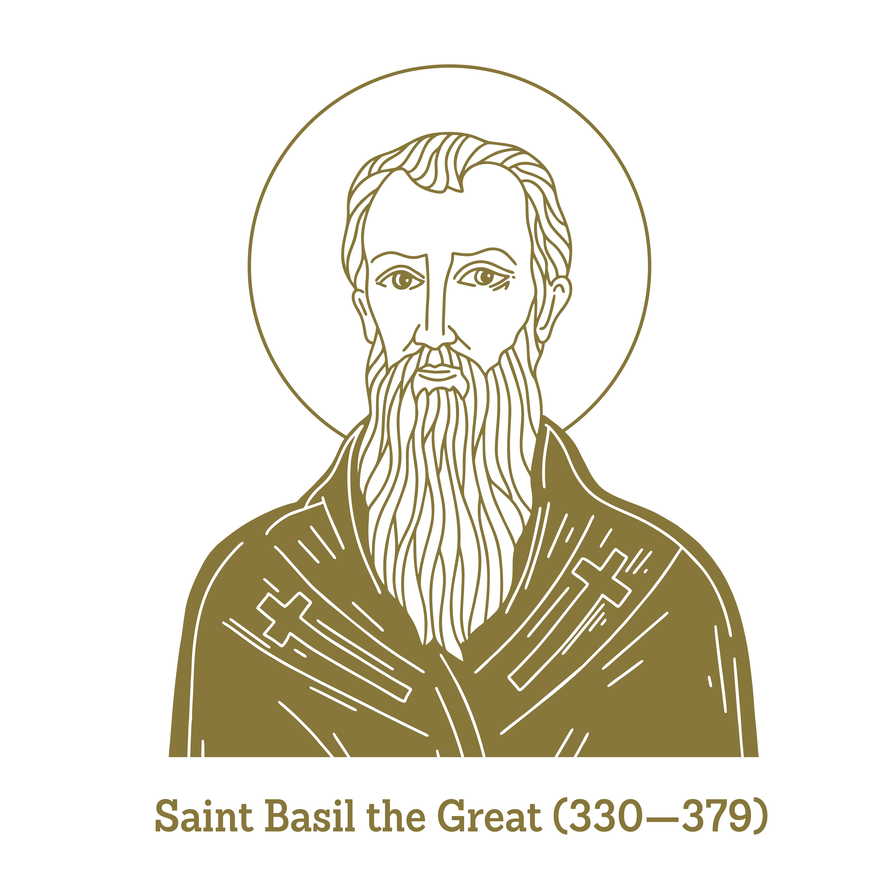
Defender of the Spirit, Architect of Trinitarian Clarity
Introduction: A Theologian for the Mystery of God
Among the great architects of Christian doctrine, St. Basil the Great stands as one of the most influential voices in shaping the Church’s understanding of the Holy Trinity. Living in the fourth century—a time marked by intense theological controversy—Basil helped articulate, defend, and clarify the Church’s belief in one God in three Persons: Father, Son, and Holy Spirit.
While the divinity of Jesus Christ had been strongly affirmed at the Council of Nicaea, the status of the Holy Spirit remained a subject of dispute. Into this theological uncertainty stepped Basil, whose writings and pastoral leadership played a decisive role in affirming the full divinity of the Holy Spirit and explaining the unity and distinction within the Trinity.
This article explores Basil’s life, his theological contributions, and his enduring teaching on the mystery of the Triune God.
1. The Life and Formation of Basil
Caesarea (in present-day Turkey) was the birthplace of Basil around 330 AD. He was born into a deeply Christian family known for its holiness and intellectual depth.
His grandmother, St. Macrina the Elder, had lived through the persecutions of earlier centuries. His parents and siblings—including St. Gregory of Nyssa and St. Macrina the Younger—were also renowned for their faith.
Basil received an excellent education, studying in places like Athens, where he formed a lifelong friendship with St. Gregory of Nazianzus.
Despite his success in rhetoric and philosophy, Basil chose a life of asceticism and prayer. He later became Bishop of Caesarea, where he combined theological brilliance with pastoral care, social service, and strong leadership.
2. The Theological Crisis of the Fourth Century
The fourth century was marked by ongoing debates about the nature of God.
While the Council of Nicaea had affirmed that the Son is fully divine, new controversies arose:
- Some groups questioned the divinity of the Holy Spirit
- Others struggled to explain how God could be one and yet three
A group known as the Pneumatomachians (“fighters against the Spirit”) denied that the Holy Spirit was fully God.
This created a theological imbalance:
- The Father was recognized as God
- The Son was affirmed as God
- But the Holy Spirit was treated as lesser
Basil recognized that this undermined the unity of the Trinity.
3. The Cappadocian Contribution
Basil, along with St. Gregory of Nazianzus and St. Gregory of Nyssa, is known as one of the Cappadocian Fathers.
Together, they helped clarify the language needed to express the mystery of the Trinity.
They distinguished between:
- Ousia (essence) – what God is
- Hypostasis (person) – who God is
This allowed them to articulate the doctrine clearly:
One essence, three persons
This formulation became foundational for later Trinitarian theology.
4. Basil’s Teaching on the Holy Spirit
Basil’s most important contribution to Trinitarian theology is found in his work On the Holy Spirit.
In this text, he argues that the Holy Spirit is fully divine.
a. Scriptural Evidence
Basil draws on Scripture to show that the Spirit:
- Is involved in creation
- Gives life
- Sanctifies believers
- Is worshipped alongside the Father and the Son
b. Liturgical Practice
He points out that Christians:
- Baptize in the name of the Father, Son, and Holy Spirit
- Offer doxologies that include the Spirit
For Basil, the way the Church prays reveals what it believes.
c. Equality within the Trinity
Basil insists that the Spirit is not inferior but equal in dignity and glory.
5. Unity and Distinction in the Trinity
One of Basil’s greatest achievements is his ability to hold together two essential truths:
a. Unity
There is only one God. The Father, Son, and Holy Spirit share the same divine essence.
b. Distinction
The three persons are not identical. They are distinct in their relations:
- The Father is unbegotten
- The Son is begotten
- The Spirit proceeds
This balance avoids two extremes:
- Modalism (which collapses the persons into one)
- Tritheism (which divides God into three gods)
6. The Role of the Holy Spirit in Salvation
For Basil, the Holy Spirit is not an abstract concept—He is active in the life of believers.
The Spirit:
- Sanctifies the soul
- Illuminates the mind
- Unites believers with God
- Makes participation in divine life possible
Without the Spirit, the Christian life cannot exist.
7. The Trinity in Worship and Prayer
Basil emphasizes that the Trinity is not just a doctrine—it is a reality experienced in worship.
Christian prayer is inherently Trinitarian:
- To the Father
- Through the Son
- In the Holy Spirit
This structure reflects the inner life of God.
8. Basil’s Pastoral and Ecclesial Vision
As Bishop, Basil applied his theology to practical life.
He:
- Promoted unity in the Church
- Opposed heresy
- Cared for the poor and marginalized
- Established monastic communities
His famous social complex, often called the “Basileias,” served the sick, the poor, and travelers.
This shows that true theology leads to action.
9. Influence on the Council of Constantinople
Basil did not live to see the full resolution of the Trinitarian controversies, but his work paved the way for the Council of Constantinople.
This council affirmed:
- The full divinity of the Holy Spirit
- The Nicene faith in its completeness
Basil’s influence is evident in its teachings.
10. Relevance for Today
St. Basil the Great remains deeply relevant.
a. Understanding the Trinity
He helps us approach a mystery that is central to Christian faith.
b. Unity in Diversity
His teaching offers a model for unity without uniformity.
c. Integration of Faith and Life
He shows that theology must be lived.
d. Reverence for the Holy Spirit
He calls us to rediscover the Spirit’s role in our lives.
Conclusion: A Lasting Light in Trinitarian Theology
St. Basil the Great stands as one of the great teachers of the Church.
Through his writings, leadership, and holiness, he helped the Church proclaim with clarity:
- One God
- Three Persons
- Equal in glory and majesty
His defense of the Holy Spirit ensured that the fullness of the Trinity would be recognized and worshipped.
Today, as we profess our faith in the Father, the Son, and the Holy Spirit, we stand in continuity with Basil’s witness.
And through his teaching, we are invited not only to understand the Trinity—but to enter into its life of love.
Leave a Reply