
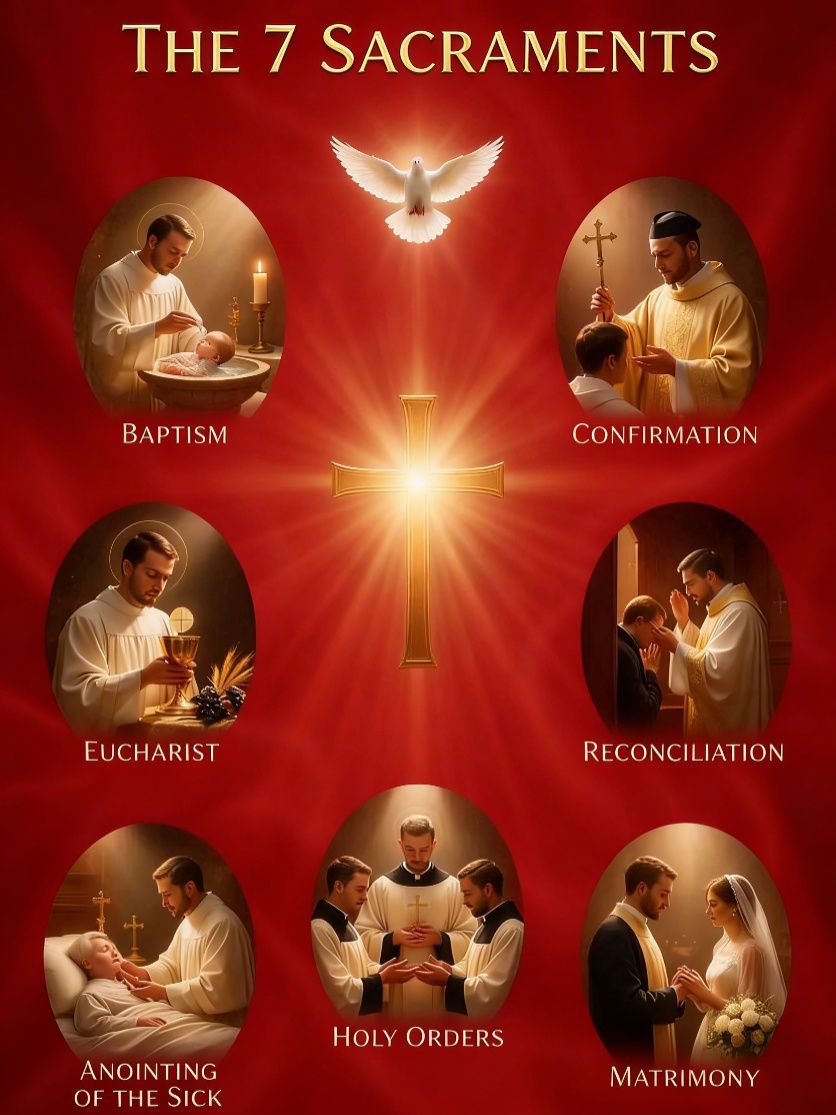
The 7 Sacrament according to Catechism of the Catholic Church (CCC)
1. Baptism
CCC 1213–1284
Baptism is the first and fundamental Sacrament that initiates us into the life of Christ and the Church. Through water and the word, it washes away Original Sin and all personal sins, makes us children of God, members of Christ, and temples of the Holy Spirit. It leaves an indelible spiritual mark (character) on the soul, meaning it can never be repeated. It is the gateway to all other Sacraments.
2. Confirmation
CCC 1285–1321
Confirmation perfects the grace received at Baptism. Through the anointing with Sacred Chrism and the laying on of hands, the Holy Spirit is given in a special way to root us more deeply as children of God, unite us more firmly to Christ, and increase the gifts of the Holy Spirit within us. It gives us strength and grace to publicly profess and defend the faith, and to live as true witnesses of Christ. Like Baptism, it imprints a permanent spiritual character.
3. Eucharist
CCC 1322–1419
The Eucharist is the “source and summit of the Christian life.” In this Sacrament, under the appearances of bread and wine, Christ Himself is truly, really, and substantially present—His Body, Blood, Soul, and Divinity. It is the memorial of His sacrifice on the Cross, the spiritual nourishment that strengthens our union with God and one another, and a foretaste of the heavenly banquet. It renews the grace we have received and unites us more closely to the Mystical Body of Christ.
4. Reconciliation (Penance / Confession)
CCC 1422–1498
Given by Christ to His Church for the forgiveness of sins committed after Baptism. Through the acts of the penitent (contrition, confession, and satisfaction) and the absolution of the priest, God grants pardon and peace, reconciling the sinner to Himself and to the Church. It heals the damage caused by sin, restores sanctifying grace, and helps us grow in spiritual maturity and virtue.
5. Anointing of the Sick
CCC 1499–1532
This Sacrament is administered to those who are seriously ill, elderly, or in danger of death. Through the anointing with oil and prayer, it gives the person grace, strength, peace, and courage to endure their suffering in union with Christ. It forgives sins if the person is unable to confess, and often brings spiritual healing, and sometimes physical healing if it is God’s will. It unites the suffering of the sick to the passion of Christ for the good of the Church and their own salvation.
6. Holy Orders
CCC 1536–1600
The Sacrament through which men are ordained to serve the Church in the person of Christ. It has three degrees: Diaconate, Priesthood, and Episcopacy. Through the laying on of hands and consecratory prayer, they receive the grace and authority to teach the faith, celebrate divine worship, and shepherd the faithful. It configures them to Christ as Priest, Teacher, and Shepherd, and also leaves an indelible spiritual character that configures them permanently to Christ.
7. Matrimony
CCC 1601–1666
A covenant by which a man and a woman establish between themselves a lifelong partnership, ordered to the good of the spouses and the procreation and education of children. God raises this natural union to the dignity of a Sacrament, making it a sign of the love between Christ and His Church. It gives the couple special grace to love one another as Christ loves us, to build a Christian family, and to witness to the faith in the world. It is permanent and exclusive, binding the spouses until death.
Source: Catechists of St. Francis Xavier
Leave a Reply