
In the early decades of the sixteenth century—when the land known today as Mexico was still emerging from the upheaval of conquest—there lived a quiet, humble man named Cuauhtlatoatzin, meaning “the one who speaks like an eagle.” He belonged to the indigenous Chichimeca people of Anáhuac and grew up in the village of Cuauhtitlán, far from the tumultuous heart of the newly formed Spanish colony. His was a simple life: he cultivated the land, wove mats, tended his meager crops, and cherished the ordinary rhythms of family and community. Nothing about his early life suggested extraordinary destiny, and yet, Heaven had set eyes on this quiet soul.
An Ordinary Man in Extraordinary Times
At roughly 50 years of age—a time when many of his contemporaries were already worn down by hard labor—Cuauhtlatoatzin became one of the earliest indigenous converts to the Christian faith. In 1524, twelve Franciscan missionaries had arrived in Mexico, and through them, he encountered a new message: the God who became man, who died on a cross out of love, who rose again and offered salvation. The Gospel touched him deeply. He received baptism, took the Christian name Juan Diego, and began to live a life marked by quiet devotion.
His baptism did not erase his indigenous identity. Instead, it infused his culture with new meaning. He continued to walk barefoot across the stony paths of his land, wrapped himself in his tilma, a rough cloak woven from cactus fibers, and prayed for his people—many of whom struggled under the weight of the conquest, the loss of their traditions, and an uncertain future. Juan Diego longed for a new dawn of peace in the wounded land, but he never imagined that he would be chosen as a vessel to bring that very dawn.
The December Morning That Changed History
On December 9, 1531, a cold Saturday before dawn, Juan Diego left his simple home in Tulpetlac and began his long walk toward Tlatelolco, where he attended catechism and the early Mass. As he approached the barren hill of Tepeyac, he heard something astonishing—music unlike anything of this world. It was like the sound of birds singing harmoniously, melodies rising and falling as though composed by Heaven itself. The hill, once a place associated with indigenous worship of the mother goddess Tonantzin, now shimmered with ethereal light.
Drawn by the sound, Juan Diego climbed the hill. There he beheld a vision he could scarcely describe: a radiant Lady stood before him, taller than any earthly woman yet tender in presence, clothed in a garment shining with the sun, surrounded by a glowing aura. The brilliance around her did not blind but warmed him with peace.
She spoke to him in his native Nahuatl, the language of his heart, calling him with a tenderness that pierced his soul:
“Juanito, Juan Dieguito, my little son—where are you going?”
He trembled, not with fear but with awe. He answered that he was on his way to Mass in Tlatelolco. The Lady’s voice was soft but filled with majesty:
“Know, my son, that I am the ever-perfect Holy Mary, Mother of the true God, from whom comes all life.”
With that, she revealed her desire:
She wished for a church to be built on the hill of Tepeyac, a sanctuary where she could show her love, her compassion, her protection, and offer solace to all who sought her help.
She entrusted Juan Diego with the mission of carrying her message to Bishop Juan de Zumárraga, the Franciscan entrusted with the care of the growing Christian community.
Juan Diego bowed with humility. He felt unworthy of such an immense task, but his heart burned with joy. He promised to fulfill her request and hurried to the bishop’s residence in Mexico City.
The Bishop’s Doubt and Juan’s Humility
When Juan Diego presented himself before Bishop Zumárraga, the bishop listened attentively but not without caution. New to the land, struggling to understand its people, and facing many false rumors and political tensions, the bishop could not immediately accept the claim of an apparition. He told Juan Diego to return later and speak again.
Juan Diego left discouraged but not defeated. He returned to Tepeyac to report the bishop’s hesitation. The Lady appeared again, listening to his words with maternal gentleness. Juan begged her to send someone more worthy, someone with status, someone the bishop would trust.
But Mary looked at him with deep affection:
“Listen, my little son. There are many I could send, but it is you I want. It is through you that I wish to accomplish my desire.”
Her words strengthened him. He promised to return to the bishop.
A Second Visit, and a Test
On December 10, Juan Diego visited Bishop Zumárraga a second time. The bishop questioned him closely, trying to determine the sincerity and truth of his account. Still cautious, he asked Juan Diego for a sign—something tangible, something Heaven-sent—so he could know that the request truly came from the Mother of God.
Juan Diego agreed and returned to Tepeyac. Mary appeared again and promised to provide a sign the following morning.
But life’s trials intervened.
The Detour of Love: Juan Bernardino’s Illness
When Juan Diego returned home, he found his beloved uncle, Juan Bernardino, gravely ill—so weak that he believed death was near. The suffering of his uncle consumed him. Juan Diego stayed by his side through the night, praying fervently, asking God to preserve him. The next morning, December 11, he could not return to Tepeyac as promised; duty and love held him at home.
By December 12, Juan Bernardino’s condition worsened. Desperate to find a priest to administer the last rites, Juan Diego set out toward Tlatelolco. Not wanting to delay the priest’s arrival, he decided to avoid the hill of Tepeyac. But Heaven had other plans.
As he skirted the base of the hill, Mary appeared again, gently intercepting him:
“My little son, what troubles you? Where are you going?”
Ashamed, Juan explained the situation, apologizing for failing to meet her the previous day, and asking permission to continue his errand.
Mary’s eyes shone with compassion.
“Do not be troubled or afraid. Am I not here, I who am your Mother? Are you not under my protection? Your uncle is already healed.”
Her words were not poetry—they were fact. At that very moment, Juan Bernardino was miraculously restored to health.
Then Mary told Juan Diego to climb to the top of the hill and gather the flowers he would find there.
The Miracle of the Roses
Tepeyac Hill in December was barren, cold, and dry—nothing bloomed there in winter. Yet when Juan Diego climbed the hill, he gasped in wonder. Before him spread a garden of roses—Castilian roses, foreign to Mexico, lush and fragrant, blooming impossibly in the frost.
He gathered them into his tilma, carefully cradling them as Mary arranged them with her own hands. She told him to take them to the bishop. This, she said, would be the sign.
Juan Diego hurried to Mexico City, holding the precious burden close, afraid that even a single petal might fall.
The Tilma and the Heavenly Image
When he arrived at the bishop’s residence, the servants—remembering his earlier visits—hesitated to let him in. But persistence won the day.
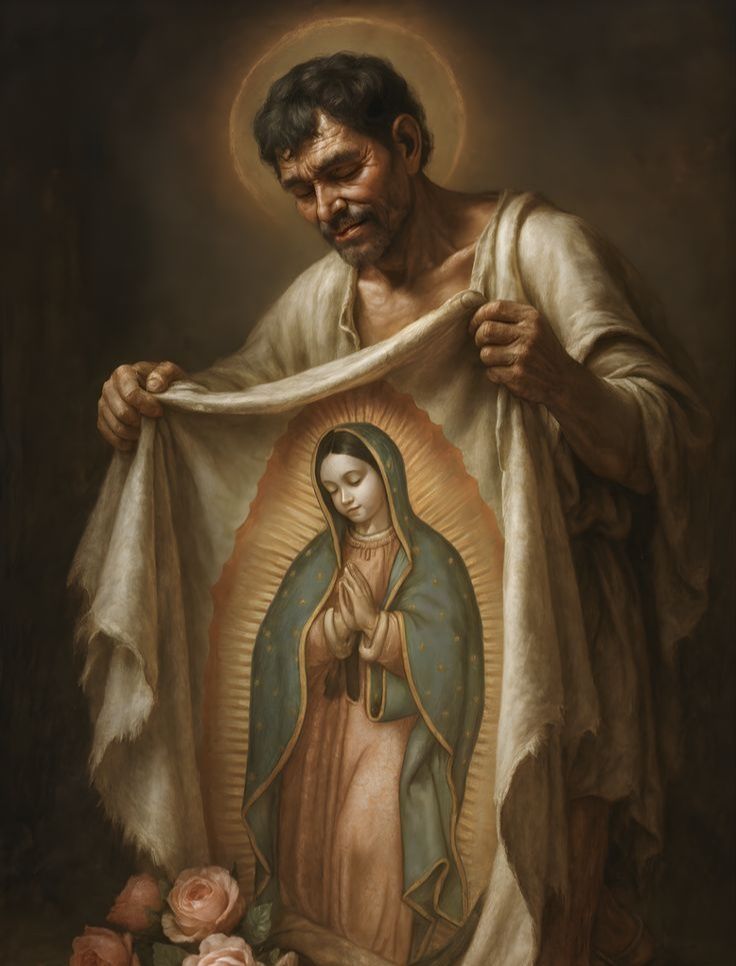
Before the bishop, Juan unfolded his tilma to release the roses.
The flowers fell to the ground like a cascade of Heaven’s perfume.
But the true miracle was not the roses.
On the rough cactus-fiber cloak, an image had appeared—perfect, radiant, alive with color and meaning:
The image of the Lady who had appeared at Tepeyac.
Our Lady of Guadalupe.
Clothed with the sun.
Standing upon the moon.
Surrounded by the stars of the December sky of 1531.
The bishop fell to his knees, tears flowing, recognizing the unmistakable hand of God.
The tilma was placed in the bishop’s private chapel. The Lady’s request was fulfilled: a chapel was built on Tepeyac, and Juan Diego became a caretaker, dedicating the rest of his life to sharing what he had seen and heard.
The Mission of a Lifetime
After the apparitions, Juan Diego did not return to his old life. With gentle insistence, the bishop gave him a small dwelling near the sanctuary on Tepeyac, where he lived as a humble hermit. He spent his days welcoming pilgrims, explaining the message of the Virgin, caring for the miraculous tilma, and praying continuously for the conversion and healing of his people.
For 17 years, until his death in 1548, he remained a quiet witness of a divine intervention that would transform a continent.
The apparitions of Our Lady of Guadalupe did what no political power, no missionary effort, no human strategy could achieve:
They brought reconciliation, hope, and unprecedented faith to millions.
Within a decade, nearly nine million indigenous people embraced Christianity—not by force, but drawn by the maternal love of a Mother who revealed herself in their own language, with symbols they understood, on a hill they revered.
The tilma, astonishingly preserved for nearly 500 years without decay, continues to draw millions of pilgrims to this day. Scientists have studied it extensively, puzzled by its inexplicable durability, the depth of its colors, and the mysterious reflections in the eyes of the Virgin.
But for believers, its meaning has always been clear:
God chose a humble man—soft-spoken, poor, and unimportant in the eyes of the world—to deliver a message of love that would touch countless hearts across centuries.
The Legacy of Juan Diego
Saint Juan Diego is a saint not because he saw the Virgin Mary, but because of his humility, obedience, faith, and extraordinary trust in God’s will. Through trials, doubts, and fear, he remained steadfast, and through him, God accomplished something magnificent.
His canonization on July 31, 2002, by Pope Saint John Paul II, was not merely a recognition of his visions but an affirmation of the dignity, worth, and spiritual richness of all indigenous peoples.
Before a crowd of millions in Mexico City, Pope John Paul II said:
“The Lord sends His messengers to the humblest of hearts.”
Juan Diego’s life reminds us that holiness is not about power, learning, or earthly greatness. It is about listening. Trusting. Believing that God can shine through the ordinary.
Prayer to Saint Juan Diego
O Saint Juan Diego,
humble messenger of Our Lady of Guadalupe,
faithful servant and gentle soul,
you who walked the stony paths with a heart full of hope,
teach us the grace of humility and the courage of obedience.
You heard the voice of the Mother of God
speaking in the language of your heart,
and you responded without hesitation.
Help us to listen to God’s voice in our own lives—
in quiet moments,
in the cries of the suffering,
in the needs of our families,
and in the whisper of conscience.
Intercede for us,
that we may trust, as you did,
in the tender care of the Virgin who said:
“Am I not here, I who am your Mother?”
Pray for our families,
that peace may reign;
pray for our hearts,
that faith may grow;
pray for our world,
that hope may rise where sorrow dwells.
Saint Juan Diego, beloved child of Mary,
guide us always toward her Son, Jesus Christ,
so that we, too, may become bearers of God’s love
to all we meet.
Amen.
References
- “Nican Mopohua” – The earliest written account of the apparitions of Our Lady of Guadalupe, attributed to Antonio Valeriano (1556).
- The Tilma of Juan Diego: A Study of Its History and Preservation – Archdiocese of Mexico, Historical Archives.
- Pope John Paul II, Canonization Homily of Saint Juan Diego – July 31, 2002, Basilica of Our Lady of Guadalupe, Mexico City.
- “Our Lady of Guadalupe: History and Devotion” – Pontifical Commission for Latin America, Vatican Publishing Office.
- Franciscan Missionary Records (1524–1548) – Chronicles of early evangelization efforts in New Spain.
- Eduardo Chávez, Our Lady of Guadalupe and Saint Juan Diego – St. Pauls Publishing, 2006.
(Fr. Chávez is the postulator of Juan Diego’s canonization cause.) - Stafford Poole, C.M., Our Lady of Guadalupe: The Origins and Sources of a Mexican National Symbol – University of Arizona Press.
- Virgilio Elizondo, Guadalupe: Mother of the New Creation – Orbis Books.
- Robert A. Maryks (ed.), A Companion to Early Modern Catholic Global Missions – Brill Academic, sections on evangelization in New Spain.
- Basilica of Our Lady of Guadalupe – Official Website and Historical Archives – Mexico City.
- Catholic Encyclopedia (New Advent), “Juan Diego” and “Our Lady of Guadalupe” – Public domain sources summarizing historical and theological background.
- Lumen Gentium, Vatican II – Sections discussing Marian apparitions and private revelation within the Church.
- The Image of Our Lady of Guadalupe: Scientific Analysis Reports – Centro de Estudios Guadalupanos, Mexico City.
 Nelson MCBS
Leave a comment