

Advent Joy | Is 35:1-6a, 10; Jas 5:7-10; Mt 11:2-11
Today the Church invites us to stand at a turning point in the Advent journey. This Sunday is called Gaudete Sunday, from the Latin word meaning “Rejoice!” — “Gaudete in Domino semper” — “Rejoice in the Lord always” (Phil 4:4).
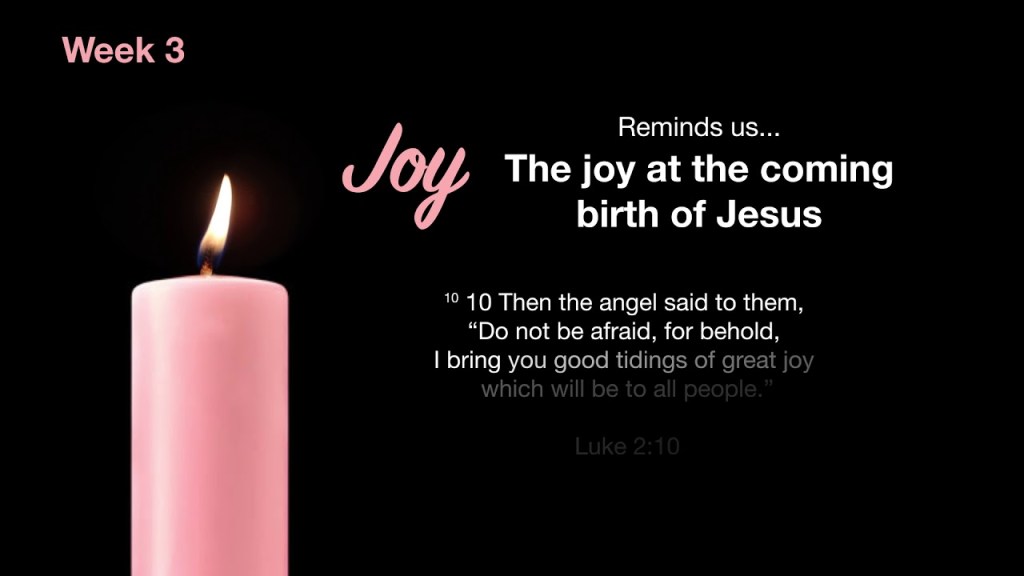
On the third Sunday of Advent, the Church’s liturgy gently shifts its tone. The rose-colored vestments and the “rose candle” in the Advent wreath remind us, we are approaching closer to Christmas, our joy gets more and more intense as we advance in our journey of faith.
The first reading gives us the theological foundation for Gaudete. Isaiah stands before a people worn out by exile, fear, and uncertainty, and he declares a message that cuts through all discouragement: “Courage! Do not be afraid; look, your God is coming.”
Our God is generous and loving, coming to His people with gifts, mercy, and blessings. Isaiah opens the treasury of God and shows us what is inside:
“Then the eyes of the blind be opened, the ears of the deaf be cleared; then will the lame leap like a stag, then the tongue of the mute will sing”.
Isaiah culminates with a vision that goes straight to the center of Gaudete Sunday: the joy that accompanies the Lord’s coming. He describes a people who have waited patiently and faithfully, now overflowing with gladness:
“They will come to Zion shouting for joy; everlasting joy will shine on their faces, and sorrow and lament will vanish.”
The liturgy today offers us a glimpse of the joy that Christmas brings, a foretaste of the nearness of our Savior. This is the deep, patient joy that Advent invites us to embrace a joy rooted not in our circumstances, but in the certainty that God is at work. It opens our hearts to the small mercies, acts of love, and moments of grace that bloom even in the deserts of our lives.
In today’s Gospel, we find John the Baptist in prison, sending his disciples to Jesus with a startling question:
“Are you the one who is to come, or should we look for another?”
It surprises us. This is John the fearless prophet who leapt in his mother’s womb at the presence of Christ, the one who baptized Jesus, and proclaimed Him as the Lamb of God. And now, he voices a question from the darkness of his cell.
St. John Chrysostom reminds us that John does not ask for himself. His question is a final act of teaching for his disciples. Even in chains, his mission continues. From the depths of confinement, he points others toward Christ.
This brings us to the first lesson for Advent joy: it begins where honesty meets faith. Sometimes, joy is blocked not by sorrow itself, but by pretending that everything is fine. John shows us that joy can flourish when we dare to bring our doubts, longings, and uncertainties directly to the Lord.
True joy does not require a perfect life; it requires a heart willing to be seen by God, even in its questions, fears, and shadows. In this honesty, Christ’s light begins to shine.
When John’s disciples ask Jesus if He is the one to come, He does not respond with a simple definition. Instead, He points to His works: the blind see, the lame walk, lepers are cleansed, the deaf hear, the dead rise, and the poor receive good news. St. Ambrose calls each of these a “joyful reversal” of human misery.
Joy, then, is not merely an emotion. It is recognition. It is the grace-filled vision that allows us, through faith, to perceive the quiet, persistent, and transformative work of God unfolding beneath the surface of our lives. The hardest seasons we endure; the deserts of illness, loss, or discouragement often become the very soil where God’s grace takes deeper root. Our most painful wounds can become the sacred places where Christ’s tenderness and power are revealed with surprising clarity.
Advent teaches us to notice these hidden movements, to attend to the subtle signs of God’s presence, and to rejoice not because everything feels joyful, but because God is quietly accomplishing His purpose within us.
Joy Comes from Knowing Who You Are in Christ
Jesus tells us: “Amen, I say to you, among those born of women there has been none greater than John the Baptist; yet the least in the kingdom of heaven is greater than he.”
St. Augustine reminds us that the baptized Christian, filled with grace, has access to a joy and intimacy that even John could only point toward. John saw Christ from a distance; we receive Him in the Eucharist. John proclaimed the Lamb of God; we receive the Lamb of God upon our tongues.
This is the source of true joy: identity. Joy flows from knowing who you are in Christ. You belong to Him, and He belongs to you. Nothing in the world, no circumstance, no prison, no trial can separate you from that reality. When we grasp this, joy is not dependent on what happens around us; it is rooted in the unshakable presence of Christ within us.
Joy Cannot Be Imprisoned
John the Baptist presents a profound paradox: he sits in a dark, confining dungeon, yet his witness spreads joy beyond the prison walls. St. Chrysostom calls this “a school of faith” for his disciples, showing that joy is not bound by circumstances, but by the perspective and presence of Christ. Even in chains, John’s heart is free, and his mission continues—illuminating the path to Christ for others.
St. Gregory the Great reminds us that John rejoices not in miracles, crowds, or worldly success, but in the voice of the Bridegroom, Christ Himself. His joy is rooted not in what he can see or control, but in the intimate knowledge that the Lord is near. This is the secret of Advent joy: it is independent of comfort, status, or external conditions. It is not chained by hardships, long seasons of waiting, or shadows of doubt and fear.
Consider the prison of your own life: moments of suffering, loneliness, illness, or uncertainty. Even here, joy can take root if Christ is near. Like John, we are invited to recognize that joy is a gift that flows from God’s presence, not from circumstances. Our struggles and limitations can become the very soil where grace grows most powerfully.
Advent teaches us that joy is resilient. It does not vanish when trials come; it does not fade in the face of darkness. Instead, it grows quietly in the heart that trusts God, waits patiently, and recognizes His hand at work in every act of mercy, every moment of consolation, every sign of hope. Joy becomes a testimony, spreading light even when our surroundings seem bleak.
Gaudete Sunday is an invitation to embrace the paradox of Advent: a season of waiting that is also a season of rejoicing. We are called to rejoice not because everything is perfect, but because the Lord is coming. We rejoice because God has already entered our world and continues to move within it, bringing light to our darkness, hope to our despair, and love to our hearts. This joy, rooted in trust and expectation, prepares us not only to celebrate Christmas but to encounter Christ in our lives every day.
✍ Fr James Abraham
 Nelson MCBS
Leave a comment