

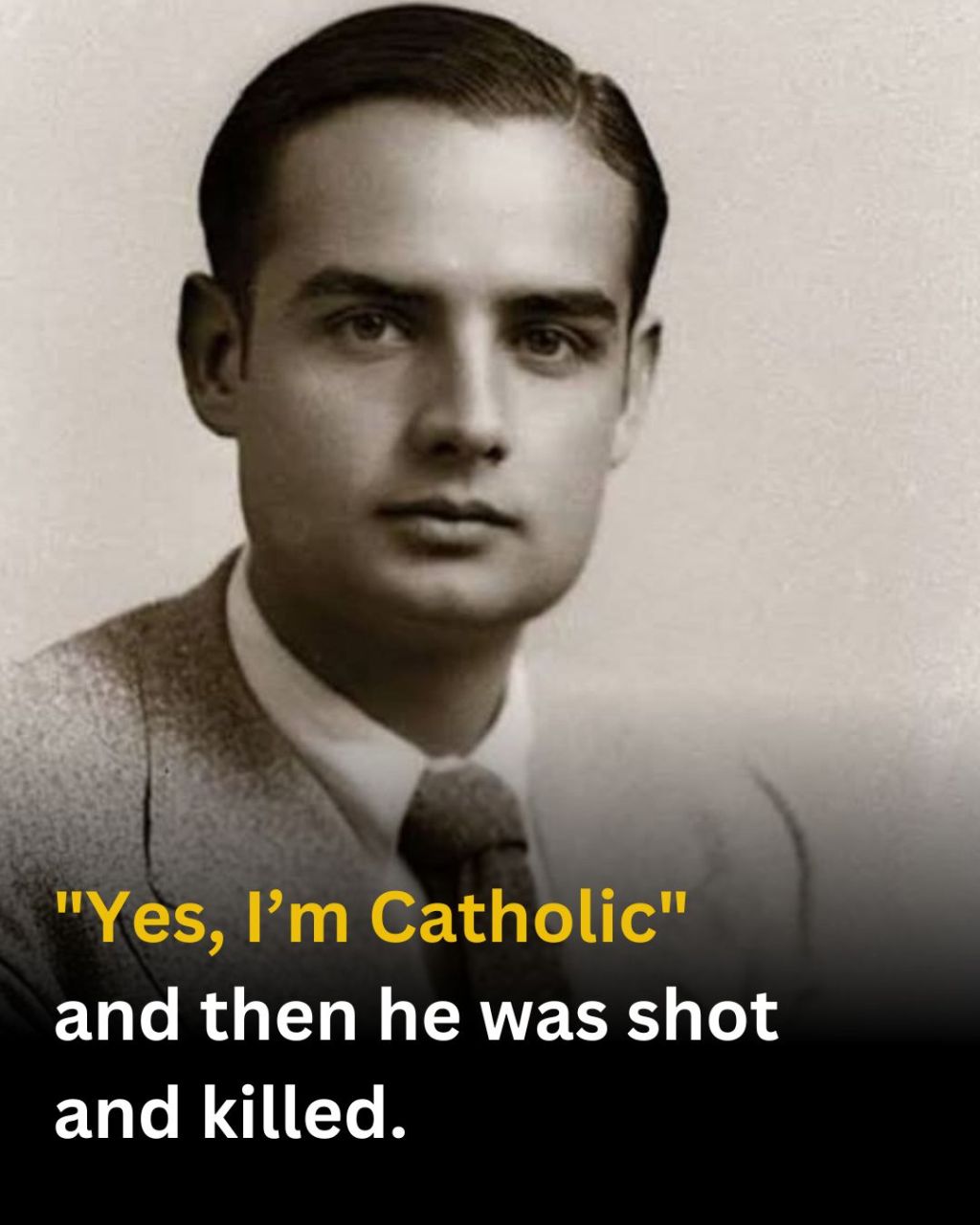
Blessed Francesc (Francisco) de Paula Castelló Aleu offers a luminous example of youthful holiness, apostolic zeal, and courageous martyrdom in the midst of the Spanish Civil War. His short life, marked by deep Eucharistic devotion, generous service in Catholic Action, and an heroic acceptance of death “for Christ the King,” continues to inspire lay faithful, especially young people, to live their faith with clarity, joy, and total surrender to God.
Early life and family background
Francesc de Paula Castelló Aleu was born on 19 April 1914 in Alicante, Spain, into a Catholic family that would be tested by suffering and change. His father, a railway employee, died when Francesc was still very young, and his widowed mother soon had to relocate to support the family, first to Lleida (Lérida) in July 1914 and later to Juneda in 1922, where she worked as a teacher. These early upheavals helped shape in Francesc a strong character, a sense of responsibility, and a deep bond with his mother and sisters.
From childhood he was known for a lively, passionate temperament, full of energy and determination. At the same time, he could be stubborn, and he soon realized that his character needed to be purified and guided by grace. The Eucharist became central to this transformation: Francesc made his First Holy Communion on 4 May 1924 and began to draw strength from frequent Communion to fight his defects and grow in virtue.
Spiritual awakening and formation
Around the age of thirteen, Francesc went through a deep, though mostly hidden, spiritual crisis that led him to a more mature decision for Christ. From this struggle emerged a young man whose faith was no longer only inherited from family and culture, but personally owned and consciously embraced. His teachers and companions noted his seriousness about prayer, his love for the Church, and his growing desire to serve others in an explicitly Christian way.
On 14 April 1930, just before turning sixteen, Francesc obtained his high school diploma with distinction, revealing both intellectual ability and a disciplined approach to his studies. Later that year, in November 1930, he met Jesuit Father Román Galán, who would become his spiritual director and close friend, guiding him in the way of Ignatian spirituality. Under Fr. Galán’s direction, Francesc made the Spiritual Exercises of St Ignatius of Loyola in 1932, a decisive moment that helped him integrate prayer, discernment, and apostolic zeal in a coherent way of life.
Studies and professional life
Called by talent and inclination to scientific work, Francesc pursued studies in chemistry at the University of Barcelona. He studied engineering and chemistry with diligence, not in search of prestige, but with the intention of sanctifying his profession and serving society through his scientific competence. After completing his studies, he worked as a chemist, including employment in a factory in Lleida, where his concern for the workers’ conditions led him to combine technical work with Christian social engagement.
In his workplace, he observed the intellectual and moral needs of the workers and became increasingly involved in lay apostolates that brought formation and Gospel witness into the world of labor. His professional life was not an obstacle to holiness; rather, it was the concrete arena in which he lived his baptismal call with integrity, humility, and courage.
Lay apostolate and Catholic Action
Francesc was one of the key lay leaders of Catholic Action in Lleida and Catalonia. He joined the Movement of Christian Young Workers of Catalonia, linked to Catholic Action and known as the “Fejocistas,” a vigorous Christian youth movement that sought to form lay apostles in the workplace and in society. More than 300 members of this movement would eventually die for the faith during the Spanish Civil War, and Francesc stands among them as a shining example of lay martyrdom.
Within Catholic Action and related movements, Francesc was appreciated for his outgoing and cheerful nature, his clear doctrinal convictions, and his capacity to attract others by friendship and example. He promoted the initiatives of the Parochial Cooperators of Christ the King, inspired by Jesuit Fr. Francis de Paul Vallet, which emphasized retreats, spiritual exercises, and the social kingship of Christ. In these circles he also met the young woman who would become his fiancée, a relationship that was deeply Christian and oriented toward a future marriage centered on faith.
Love and engagement
Francesc’s engagement shows that Christian perfection is not opposed to human love, but rather elevates it. He loved his fiancée with a sincere, chaste, and joyful affection, and they prepared for a life together rooted in prayer, apostolic commitment, and mutual support. The Spanish Civil War, however, would interrupt their plans, confronting them with the mystery of the Cross in a radical way.
Moments before his execution, Francesc wrote a tender and faith-filled letter to his fiancée, asking her to forgive him for leaving her and encouraging her to build a Christian family if God granted her that path. He expressed the desire that his own offered life might bear fruit in her future vocation and in the faith of their eventual children. Years later, she did marry, have children, and lived a Christian life until her death in 1976, thus fulfilling, in another way, the love that had united them.
The Spanish Civil War and arrest
The outbreak of the Spanish Civil War in 1936 unleashed a fierce persecution against the Church, with thousands of priests, religious, and lay faithful killed “for being Christians, for their faith in Christ, for being active members of the Church.” Francesc, known for his involvement in Catholic Action and his public witness, soon came under suspicion of the revolutionary authorities.
He was accused, falsely, of being a fascist and an enemy of the people, charges that thinly veiled the real reason for his persecution: his Catholic faith and apostolic leadership. Arrested and brought before a so‑called “people’s court” at the town hall, he faced a prosecutor who demanded the death penalty. Francesc was given the opportunity to defend himself by denying or softening his adherence to the Church, but instead he firmly declared that he was a Catholic and was proud to be one.
Trial, witness, and interior joy
In that makeshift tribunal, Francesc did not respond with bitterness or hatred. He calmly affirmed his faith, testifying that he would gladly die for Jesus Christ if necessary. His serenity impressed even some of his opponents, who saw in him neither fanaticism nor aggression, but a quiet, unshakable fidelity.
After the sentence of death was pronounced, he was taken with other condemned prisoners to an underground passage and then to a dungeon, where he awaited execution. There, he wrote letters to his family, his spiritual director, and his fiancée, letters that radiate peace, forgiveness, and a supernatural joy in offering his youth as a sacrifice for Christ and the Church. Aleteia later highlighted these last letters as texts that make us think about heaven while remaining deeply rooted in love for the things of earth: family, work, and human affection, all seen in the light of eternity.
Martyrdom and last words
On the night of 29 September 1936, the feast of the Archangels, Francesc was taken from his cell together with six other prisoners and loaded onto a truck that carried them to the place of execution. Along the way, he began to sing, filled with an inner joy born of union with Christ, but the militiamen slapped him to silence him; he responded by forgiving them.
Arriving at the execution site along a dark path, Francesc stood with hands clasped and head lifted toward heaven. As the firing squad prepared, he loudly proclaimed: “¡Viva Cristo Rey!” – “Long live Christ the King!” Shot shortly thereafter, he died around 11:30 p.m., his heart beating for a few moments more before he collapsed, having sealed his witness with his blood.
Beatification among the 233 Spanish Martyrs
The memory of Francesc de Paula Castelló Aleu remained alive in Lleida and among Catholic Action members, leading in time to the opening of his cause of beatification. The diocesan informative process in Lleida began on 2 February 1959 and concluded on 16 May 1971, collecting testimonies and documentation about his life and martyrdom. On 22 July 1986, the cause was formally introduced in Rome under Pope John Paul II, and he was titled a Servant of God.
The Congregation for the Causes of Saints validated the diocesan process in 1991 and examined the Positio, the dossier on his life and martyrdom, during the following decade. The theological consultors approved the cause on 10 November 2000, and the cardinals and bishops of the Congregation did likewise on 12 December 2000, recognizing that he had been killed “in odium fidei,” out of hatred for the faith. On 11 March 2001, Pope John Paul II beatified him in Rome together with 232 other Spanish martyrs, the largest single group of martyrs beatified up to that time. In his homily, the Pope pointed to their martyrdom as a call for the Church in Spain to renew its fidelity and courage in witnessing to the Gospel.
Spiritual legacy and message for today
Blessed Francesc Castelló’s legacy is particularly relevant for lay people, students, professionals, and engaged couples. As a young chemist and lay apostle, he shows that holiness can be fully lived in the secular world, amid studies, work, friendships, and engagement, without compromising fidelity to Christ. His life unites intellectual seriousness, professional competence, and a deep interior life nourished by the Eucharist and Ignatian spirituality.
For young people, his example invites a courageous, joyful Christian identity that does not hide when faced with mockery, pressure, or hostility. For engaged couples, his relationship with his fiancée shows that authentic love is open to God’s will even when it leads through the Cross. For all the faithful, his final cry, “Long live Christ the King!”, recalls the call to place Christ at the center of personal life, social engagement, and public witness, confident that no earthly power can overcome the victory of the risen Lord.
Blessed Francesc de Paula Castelló Aleu continues to intercede for the Church from heaven, especially for young lay men and women in the world of work, for Catholic Action and similar apostolic movements, and for those called to bear witness in difficult environments. His feast is celebrated on 29 September, inviting the faithful each year to remember his youthful courage and to ask for the grace to live, suffer, and, if necessary, die with the same radiant love for Christ the King.
 Nelson MCBS
Leave a comment