
My brothers and sisters in Christ, tonight we stand at the threshold of the Sacred Triduum. The air in this sanctuary is thick with a strange duality: it is the fragrance of the Chrism oil and the scent of the Upper Room, but it is also the chilling draft of Gethsemane.
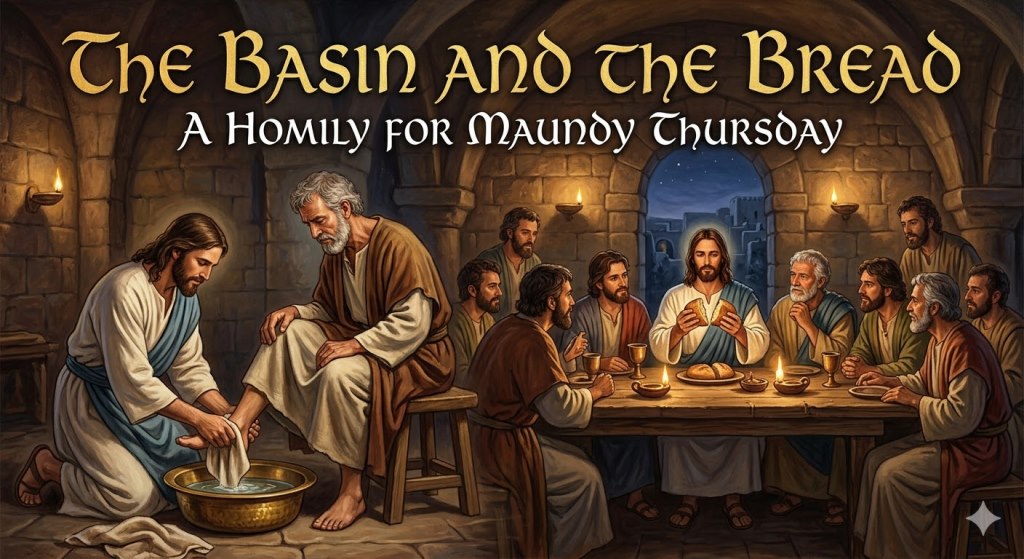
Tonight is the night of the “Mandatum”—the Commandment. But before it was a commandment, it was a gesture. Before it was a doctrine, it was a meal. On this night, Jesus Christ did two things that redefined what it means to be God and what it means to be human: He knelt at the feet of sinners, and He gave Himself to be eaten.
I. The Descent of Majesty: The Washing of the Feet
St. John’s Gospel tells us that Jesus, “knowing that the Father had given all things into his hands, and that he had come from God and was going to God,” did not ascend a throne. Instead, He rose from the table, laid aside His outer garments, and tied a towel around His waist.
Consider the shock of the Apostles. In the ancient world, the washing of feet was the task of the lowest slave. It wasn’t just menial; it was a mark of social invisibility. St. Augustine beautifully captures this paradox:
“He rose from the table and laid aside His garments, who, being in the form of God, emptied Himself. He girded Himself with a towel, who took the form of a servant… He poured water into a basin, with which to wash the feet of the disciples, who shed His blood on the earth to wash away the filth of sins.”
The Story of the Desert Fathers
There is a story from the Apophthegmata Patrum (The Sayings of the Desert Fathers) about Abba Agathon. It is said he spent years living in silence and prayer. One day, he met a leper on the road who asked to be carried to the market. Agathon carried him. Then the leper asked him to stay and sell his goods for him. Agathon stayed. Finally, the leper asked for the money. Agathon gave it.
As Agathon turned to leave, the leper revealed himself as an angel, saying, “Agathon, you are filled with the divine spirit.” Agathon didn’t see a leper; he saw a foot to be washed. He understood that Maundy Thursday is not a historical reenactment; it is a blueprint for the Christian life.
When Jesus approaches Peter, Peter recoils. “You shall never wash my feet!” It is the cry of a man who wants a King, not a Servant. But Jesus’s response is the pivot of the Gospel: “If I do not wash you, you have no share with me.”
St. Ambrose of Milan explains this to us:
“Jesus knew that the stains of the soul are harder to remove than the dust of the road. He washes our feet so that we may have the strength to walk the narrow path that leads to the Cross.”
II. The Mystery of the Altar: The Institution of the Eucharist
If the washing of the feet shows us the extravagance of God’s humility, the Institution of the Eucharist shows us the totality of His presence.
In the Upper Room, Jesus took bread, blessed it, broke it, and said: “This is my Body.” He did not say, “This represents my body” or “This is a symbol of my memory.” He spoke with the same creative authority that said, “Let there be light.”
The “Real” Presence according to the Saints
The Fathers of the Church were unwavering on this point. St. Cyril of Jerusalem, writing in the 4th century, challenged the skepticism of the senses:
“Do not see in the bread and wine merely natural elements, because the Lord has expressly said that they are His Body and His Blood: faith assures you of this, though your senses suggest otherwise.”
And St. John Chrysostom, the “Golden-Mouthed,” adds a dimension of fire to this teaching:
“How many of you say: I should like to see His face, His garments, His shoes. You do see Him, you touch Him, you eat Him. He gives Himself to you, not only that you may see Him, but also to be your food and nourishment.”
The Story of St. Tarcisius
Think of the young boy, Tarcisius, in the 3rd century. During the Roman persecutions, he was carrying the Blessed Sacrament to prisoners. A mob of pagans confronted him, demanding to see what he carried. He refused to surrender the Eucharist, clutching the “Bread of Life” to his chest until they stoned him to death. When they searched his body, the Host had vanished—it had become one with his own flesh.
Tarcisius understood Maundy Thursday better than many theologians. He knew that the Eucharist isn’t an “it”; it is a Who.
III. The New Commandment: Love as He Loved
“A new commandment I give to you, that you love one another; even as I have loved you.”
What makes this “new”? The Jews already had the commandment to love their neighbor as themselves. The novelty lies in the standard: “As I have loved you.” To love as Jesus loves is to love without a “return on investment.” It is to love the Judas at your table. Remember, on this night, Jesus washed the feet of Judas Iscariot. He fed Judas the first Eucharist.
St. Therese of Lisieux wrestled with this. She wrote:
“I used to think I loved my sisters, but I realized I only loved those who were kind to me. To love as Jesus loves means to love the sister who is unpleasant, who interrupts my prayers, who has a grating voice. That is the Mandatum.”
The “Bread” of Charity
St. Mother Teresa of Calcutta often said that the Eucharist and the Poor are the same Body of Christ. She once told a story of a family that hadn’t eaten for days. She brought them a bag of rice. The mother immediately divided the rice into two and went out. When she returned, Mother Teresa asked where she went. She replied, “To my neighbors; they are hungry too.”
Mother Teresa remarked, “I was not surprised that she gave; I was surprised that she knew they were hungry.” That “knowing” is the fruit of Maundy Thursday.
IV. The Agony: The Transition to the Passion
As the Mass of the Lord’s Supper ends, we do something jarring. We strip the altar. We remove the linens, the candles, and the ornaments. The church becomes bare, reflecting the nakedness of Christ in His suffering.
We process to the “Altar of Repose.” We follow Him to Gethsemane.
St. Thomas Aquinas, who wrote the Pange Lingua (Sing, My Tongue) for this very night, reminds us that the Eucharist is the bridge between the Last Supper and the Cross:
“The Word-made-Flesh, the true bread by His word He makes His flesh; and if sense fails, to confirm a sincere heart, Faith alone suffices.”
Tonight, Jesus asks us the same question He asked Peter, James, and John: “Could you not watch one hour with me?” The world is noisy, distracted, and often cold. But for these three days, we are invited to enter the silence. We are invited to stay awake.
Conclusion: The Invitation
My dear friends, tonight we are not spectators of an old ritual. We are participants in a living mystery.
- To the weary: Come to the basin. Let Him wash the dust of your failures and your anxieties away. You do not have to be clean to come to Him; He makes you clean by His touch.
- To the hungry: Come to the Table. Eat the Bread of Angels that gives strength for the journey.
- To the lonely: Stay in the Garden. He is there, and He knows the weight of your heart.
As we strip the altar tonight, let us ask the Lord to strip away our pride, our grudges, and our indifference. Let us leave this place in a holy silence, carrying the “Mandatum” in our hearts: to wash, to feed, and to love until He comes again.
St. Francis of Assisi once said:
“O sublime humility! O humble sublimity! That the Lord of the whole universe, God and the Son of God, should humble Himself as to hide Himself under the form of a little bread, for our salvation.”
May we never get over the wonder of this night.
 Nelson MCBS
Leave a comment