
A Comprehensive Homily for the Resurrection of the Lord
I. The Proclamation of the Impossible
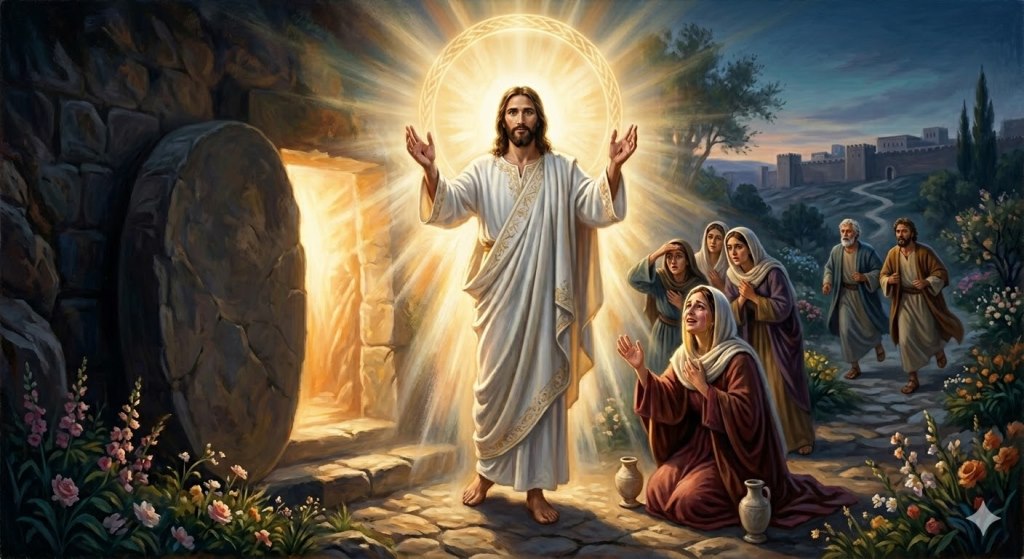
1. The Breaking of the Seal “He is risen!” These three words are the epicenter of human history. They are the seismic shift that tilted the world off the axis of despair and onto the path of eternal hope. Every other religious leader in history has a grave that can be visited, a location where their remains returned to the dust. But the central claim of the Christian faith is an empty space—a tomb that could not hold its guest, a death that was swallowed up by a greater life.
Easter is not merely the celebration of a “nice idea” or the symbolic “rebirth of spring.” If Jesus merely lives on in our “good memories” or in the “kindness we show others,” then we are, as St. Paul says, the most pitiable of people. Easter is the proclamation of a physical, historical, and cosmic reality: The man who was dead is now alive, and because He lives, the very structure of reality has changed.
2. The End of the Old World On Good Friday, we saw the sun darkened. On Holy Saturday, we felt the earth keep silence. But on this First Day of the Week—which the Fathers call the “Eighth Day”—the light that was before the sun was created has returned to flood the world. We are no longer citizens of a kingdom governed by the laws of decay. We are citizens of the New Jerusalem.
II. Voices of the Fathers: The Cosmic Victory
The early Church Fathers did not view the Resurrection as a private event for Jesus; they saw it as a cosmic rescue mission that fundamentally altered human nature.
3. St. John Chrysostom: The Paschal Catechesis Perhaps no one captured the sheer audacity of Easter better than St. John Chrysostom in his famous Paschal Homily, read in every Orthodox church on this night:
“Let no one fear death, for the Death of our Savior has set us free. He has destroyed it by enduring it. He despoiled Hell when He descended into Hell. He vexed it even as it tasted of His flesh… Hell took a body, and discovered God. It took earth, and encountered Heaven. It took what it saw, and was overcome by what it did not see. O Death, where is thy sting? O Hell, where is thy victory? Christ is risen, and thou art overthrown!”
Chrysostom’s theology is one of divine irony. Death thought it was consuming a mortal man, only to find it had swallowed a “divine fire” that burned it from the inside out.
4. St. Athanasius: The Incorruptible Life In his masterpiece, On the Incarnation, St. Athanasius argues that the Resurrection was the only way to “re-manufacture” humanity. He writes:
“For as when a large city is inhabited by a great king, no enemy will dare to attack it… so it is with the Monarch of all. Since He has come into our realm and taken up His abode in a body like our own, every conspiracy of the enemy against mankind is checked, and the corruption of death which before prevailed against them is done away.”
For Athanasius, Jesus entered the “house” of death to kick out the intruder. By rising, He injected “incorruption” back into the human bloodstream.
III. The Scriptural Symphony: From Promise to Presence
5. The First Witness: Mary Magdalene (John 20:1-18) It is profoundly significant that the first witness to the Resurrection was not a king, a priest, or even one of the Twelve Apostles. It was Mary Magdalene. In a culture where a woman’s testimony was not legally valid, God chose a woman to be the “Apostle to the Apostles.”
When she encounters Jesus in the garden, she initially mistakes Him for the gardener. This is not an accident of the text; it is a profound theological point. Jesus is the New Gardener. He is the New Adam in the New Eden. Where the first Adam brought death in a garden, the New Adam brings life in a garden. When He speaks her name—”Mary”—the veil of grief falls. He is not a ghost; He is the Beloved.
6. The Victory over the Grave (1 Corinthians 15:54-57) St. Paul provides the logical backbone of our Easter joy. He writes:
“When the perishable has been clothed with the imperishable, and the mortal with immortality, then the saying that is written will come to pass: ‘Death has been swallowed up in victory.’ … But thanks be to God! He gives us the victory through our Lord Jesus Christ.”
Paul uses the Greek word nikos (victory). He reminds us that the Resurrection is not a “draw” or a “truce” with death. It is a total, unconditional surrender of the grave.
7. The Road to Emmaus (Luke 24:13-35) On Easter afternoon, two disciples are walking away from Jerusalem, downcast. Jesus joins them, but “their eyes were kept from recognizing him.” He explains the Scriptures to them, showing how the Messiah had to suffer to enter His glory.
This story teaches us that the Risen Lord is often present in our journey even when we don’t recognize Him. It is in the “breaking of the bread”—the Eucharist—that their eyes are opened. Easter is not just a past event; it is a present encounter every time we gather at the altar.
IV. Wisdom of the Saints: Living the Resurrection
8. St. Augustine: The Alleluia People St. Augustine famously said, “We are an Easter people and Alleluia is our song.” But he cautioned that this song must be sung with our lives, not just our lips. He taught that the Resurrection gives us a “holy restlessness.” We no longer belong to the world’s cycles of vanity; we belong to the “Eternal Sunday.”
9. St. Seraphim of Sarov: The Radiant Joy The great Russian saint, Seraphim of Sarov, lived the Easter reality so intensely that he greeted everyone he met—year-round—with the words: “My joy, Christ is risen!” He believed that the primary goal of the Christian life was the “acquisition of the Holy Spirit,” and the proof of that Spirit was a joy that no earthly circumstance could extinguish.
10. St. Teresa of Avila: The Living Christ St. Teresa, in her mystical experiences, emphasized that the Risen Christ is a living friend. She wrote:
“To always have Christ present… is what I have found most helpful. We need no wings to go in search of Him, but have only to look upon Him present within us.”
Easter means that the “historical Jesus” has become the “indwelling Christ.” He is no longer restricted by time or space. He is as close to us as our own breath.
V. A Story of Inspiration: The Resurrection in the Gulag
In the mid-20th century, during the height of the Soviet Union’s persecution of the Church, a group of political prisoners and Christians were held in a brutal labor camp. They were forbidden from practicing their faith, under pain of solitary confinement or death.
One Easter Sunday, the prisoners were lined up for a mandatory lecture by a state commissar. For over an hour, the official shouted scientific “proofs” that God did not exist, that Jesus was a myth, and that the Resurrection was a lie used by the bourgeoisie to enslave the workers. He ended his long, aggressive speech with a smirk, looking at the weary, starving men.
“Does anyone have anything to say?” he asked mockingly.
A young, frail priest stepped forward. The commissar sneered, “You have five minutes.”
The priest looked at his fellow prisoners, then turned to the official and said, “I don’t need five minutes. I only need three words.”
He turned back to the crowd of prisoners and shouted with every ounce of strength in his lungs: “Christ is Risen!”
Instantly, the hundreds of prisoners erupted in a thunderous roar that shook the camp: “He is Risen indeed!”
The official stood speechless. All his arguments, his power, his threats, and his “scientific” proofs evaporated in the face of a truth that lived in the hearts of men who had lost everything else. They were in a tomb of a prison, but they were the only truly free people in that camp. That is the power of Easter. It turns a gulag into a cathedral.
VI. Practical Application: How to Be an Easter Person
If the stone has been rolled away from the tomb, what stones need to be rolled away from our lives? The Resurrection demands a response.
11. Roll Away the Stone of Unforgiveness Resurrection is about new life. You cannot live a “new life” if you are carrying the rotting corpses of old grudges. To forgive someone is to participate in the Resurrection; it is to pull a relationship out of the grave of bitterness. Today, identify one person you have “buried” in your heart with resentment and ask the Risen Lord for the grace to let them out.
12. Live with “Grave-Defying” Courage If the worst thing that can happen to us—death—has been defeated, what are we afraid of? We often live small, timid lives because we are afraid of failure, afraid of judgment, or afraid of loss. Easter tells us that even failure and loss are not final. As the saying goes, “Everything will be okay in the end. If it’s not okay, it’s not the end.” Take a risk for the Gospel this week. Speak the truth, serve the poor, or stand up for the vulnerable, knowing that your “investment” is backed by the King of Life.
13. Practice the “Eighth Day” Mentality The world lives in a seven-day cycle of work and exhaustion. But the “Eighth Day” (Sunday) is the day beyond the cycle. It is a foretaste of eternity. Do not let your Sundays be just “the day before Monday.” Make them a day of deliberate joy, of community, and of resting in God’s finished work. When you enter the world on Monday, do so as an ambassador of a Kingdom that has already won.
VII. Conclusion: The Eternal Morning
Brothers and sisters, the shadow of the Cross was long, and the silence of the Tomb was deep. But the light of this morning is everlasting. We are not followers of a dead philosopher; we are the disciples of a Living God.
The Resurrection is the “Yes” of God to every human “No.” It is the promise that love is stronger than hate, that light is stronger than darkness, and that life is the final word.
Let us go forth from this place, not as people who are searching for the truth, but as people who have been found by it. Let us be the fragrance of the Resurrection in a world that smells of decay. Let us be the “Alleluia” in a world that is crying out for hope.
As we conclude this reflection, let us carry the words of the great St. Francis de Sales with us into the coming weeks:
“The same Eternal Father who cared for you yesterday will take care of you today and every day. Either he will shield you from suffering, or he will give you unfailing strength to bear it. Be at peace then and put aside all anxious thoughts and imaginations. For the Lord has risen, and He has made all things new.”
Christ is Risen! Alleluia!
 Nelson MCBS
Leave a comment