
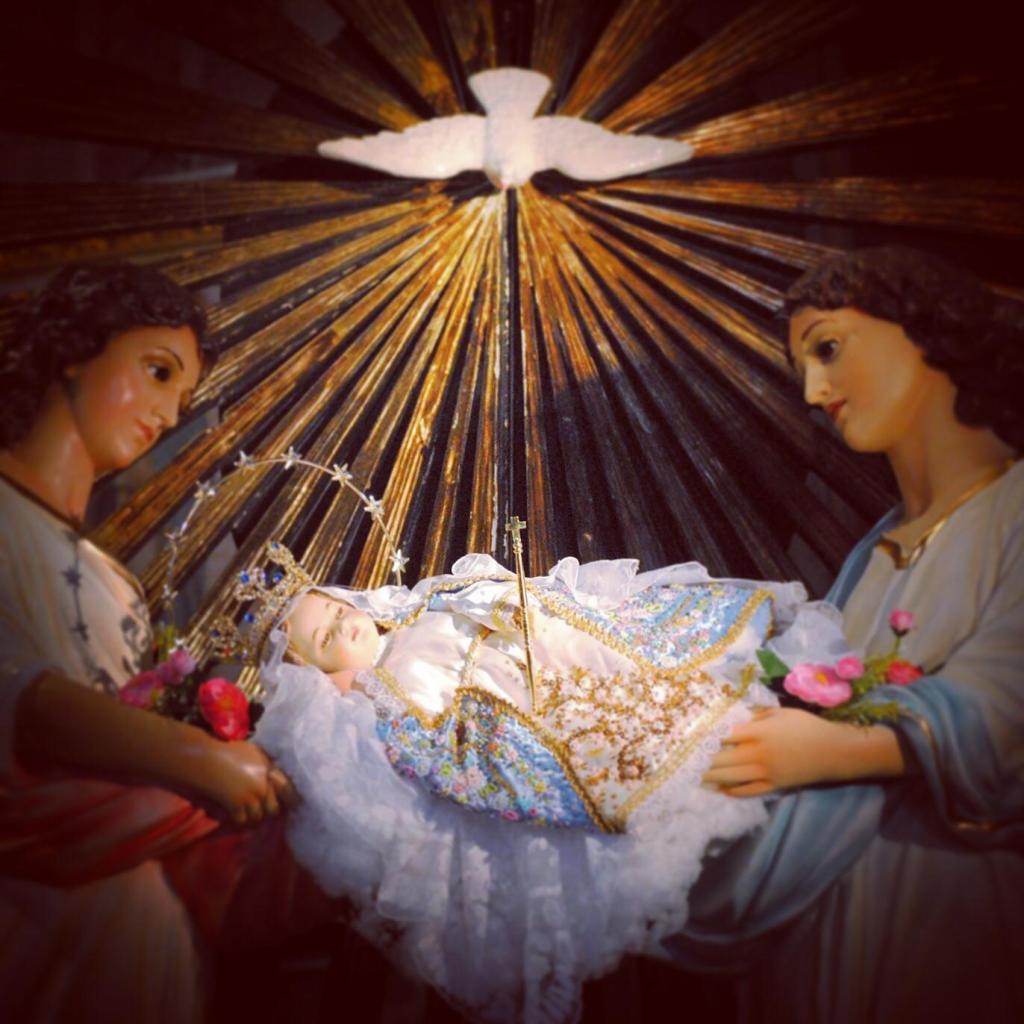
Nativity of the Blessed Virgin Mary
Today we celebrate a very beautiful feast — the birthday of the Blessed Virgin Mary. The Church celebrates only three earthly birthdays: Jesus Christ (December 25), John the Baptist (June 24), and the Blessed Virgin Mary (September 8). Already this tells us something very important: Mary’s birth is not simply about her; it is about Christ, her Son, and the salvation He brings.
The date of today’s feast — September 8 — is not about historical accuracy, but liturgical truth. It falls nine months after the Solemnity of the Immaculate Conception (December 8), just as Christmas comes nine months after the Annunciation (March 25). The liturgy is teaching us that from her very beginning Mary was set apart by God. Her birth is the dawn of salvation, the first light before the rising of the Sun of Justice, Jesus Christ.
These liturgical rhythms are not about historical accuracy, but about theological truth. They proclaim that Mary’s life — from her conception to her birth — is entirely caught up in God’s saving plan. She is the chosen vessel, preserved from sin, destined to be the Mother of the Redeemer. Her birth is already a sign of hope for the entire human family.
The feast originated in the Eastern Church, where it was celebrated in the 6th century, and spread to the West by the 8th century. Its placement reflects the dedication of the Church of St. Anne in Jerusalem, traditionally believed to be the house where Mary was born.
Think of it this way: when the first rays of the sun begin to shine in the morning, the whole world rejoices because light is coming. Mary’s nativity is that dawn. Christ, her Son, is the full day.
For generations Israel had been waiting, watching, and longing for the Messiah. With Mary’s birth, the waiting draws to an end. She is the final flower of Israel’s faith, the one in whom God’s promises begin to blossom into fulfillment. St. Augustine beautifully captures this truth when he says: “She is the flower of the field from whom bloomed the precious lily of the valley. Through her birth the nature inherited from our first parents is changed.”
The prophet Micah (5:1–4) foretold that from Bethlehem would come forth a ruler prepared “from ancient days.” Mary’s nativity is the hidden beginning of that prophecy’s fulfillment. Her birth, like Bethlehem itself, is humble, unnoticed, and small. Yet in God’s eyes it is great. Just as the tiny village of Bethlehem was chosen to welcome the King of kings, so too Mary, a simple maiden of Nazareth, was chosen to be the Mother of God. Both Mary and Bethlehem reveal the paradox of God’s ways: He chooses what is little to accomplish what is mighty.
The Fathers of the Church loved to describe Mary’s nativity as the dawn before the rising of the Sun. St. John Damascene said: “The day of the Nativity of the Mother of God is a day of universal joy. The whole creation is glad for her, the immaculate flower of the human race, who will bear the flower that shall never fade.” And St. Augustine tells us that in her birth, the nature we inherited from Adam and Eve begins to be renewed.
Pope St. Paul VI in Marialis Cultus called Mary’s nativity “the hope and the dawn of salvation for the world.” St. John Paul II encouraged us to see her birthday as the beginning of a life more radiant than any other, for from her would be born the “Sun of Justice.”
Mary’s birthday is a feast of hope. God is always faithful to His promises. After centuries of waiting, dawn appears. Mary’s nativity teaches us that God works patiently in history, preparing His plan in silence and hiddenness. The world took no notice of her birth. Yet in that quiet moment, God was setting into motion the salvation of the whole human race. In the same way, God often works in our lives in hidden and humble ways. What seems small in our eyes can be great in His.
The world was weary under the weight of sin, but with her birth a new chapter opened. As St. Anselm said: “The childbearing of Eve brought us sorrow, but the birth of Mary has brought us joy.” Her coming is the sign that God does not abandon His people. He fulfills His promises, and He will never fail us.
Mary’s birthday is a feast of joy. St. Andrew of Crete said: “Today is the beginning of joy for the whole world; the birth of the Mother of God is the prelude to the gift of salvation.” Her nativity invites us to share this joy. It tells us that God’s mercy triumphs over sin and that a Redeemer is indeed on His way. This joy is not mere sentiment; it is rooted in the certainty of God’s promise and the unfolding of salvation history.
St. Anselm once wrote: “The childbearing of Eve brought us sorrow, but the birth of Mary has brought us joy.” Her coming into the world tells us that sin will not have the last word. A Redeemer is on His way.
Mary’s birthday is a feast of faith. Her nativity invites us to reflect on our own faith. Just as Mary’s life was lived in total openness and trust in God’s will, so we are called to grow in faith, welcoming God’s presence in our lives.
Her life of faith transformed the course of history, and her example challenges us to live faithfully, even in times of uncertainty. Her life shows us that holiness begins not in grand gestures, but in trust, humility, and openness to God’s will.
St. Louis de Montfort reminds us that every devotion to Mary points us to Jesus — “to Jesus through Mary.” On her birthday, she does not keep the attention for herself; she leads us to her Son.
Pope St. John Paul II encouraged us: “Let us celebrate with joy the birth of Mary, the dawn of salvation for the world, the beginning of a life more radiant than any other, for from her will be born the Sun of Justice.” That joy is what the Church invites us to today.
So today, let us celebrate Mary’s birthday with joy. She is the dawn, Christ is the day. She is the first light, He is the Sun. In her nativity, the long night of sin begins to break, and the light of salvation shines forth.
May this feast strengthen our hope, deepen our faith, and fill our hearts with joy. And may we, like Mary, become humble instruments of God’s love in the world.
Happy birthday, Blessed Mother! Pray for us, that like you, we may always point our lives to Jesus.
Prepared by Fr James Abraham
 Nelson MCBS
Leave a comment