

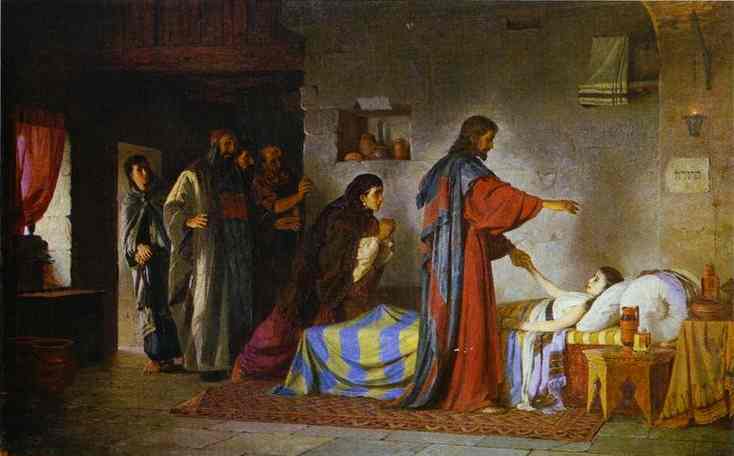
Luke 8: 41-56
“Do not fear; only believe.”
The Gospel calls us to witness a powerful encounter with Jesus, one that speaks directly to our hearts. We see two very different people coming to Him with the same desperate need: Jairus, the respected synagogue leader, and the woman suffering for twelve long years with the flow of blood. They stand at opposite ends of society—one respected, the other rejected. Yet both are united in their longing for healing and new life in Christ.
What a lesson for us! Before God, it does not matter whether we are strong or weak, rich or poor, respected or forgotten. What matters is that we come to Him with faith, with humility, and with hearts open to His mercy.
The Catechism reminds us that “faith is a personal act—the free response of the human person to the initiative of God who reveals Himself” (CCC 166). Jairus and the woman both make this personal act of faith. Jairus comes openly, risking his reputation, falling at the feet of Jesus and begging Him to heal his daughter. The woman comes quietly, humbly, believing that even the hem of His garment will be enough to heal her. One comes boldly; one comes hidden, but both are met with the power and mercy of Christ.
Notice the courage and trust in each approach. Jairus cries out with boldness, while the woman moves quietly through the crowd, almost unnoticed, yet with complete confidence that Christ can heal her. Faith, as we see, takes many forms. Some of us may be like Jairus, boldly lifting our hearts to God in prayer during life’s storms. Others may be like the woman, approaching quietly, uncertain, wounded, yet trusting that even a small gesture of faith can bring healing. Both are paths to the same Christ; both receive His mercy.
The woman’s humility is especially striking. She believed that touching even the hem of Jesus’ garment would heal her. She teaches us an eternal truth: holiness is not fragile, brokenness does not repel God, and suffering does not diminish Him. On the contrary, His mercy flows outward, transforming, restoring, and making us whole. St. Augustine reflects: “The crowd presses, but only she touches. She touches because she believes.” Many were near Jesus that day, but only those with expectant faith received His healing. If such power flowed through His garment, how much more would flow through the sacraments, especially the Eucharist! Do we approach the altar like the crowd, or do we come with longing, ready to receive His healing, grace, and love?
Jairus, too, teaches us something vital. On the way to his home, he receives the heartbreaking news: “Your daughter is dead. Do not trouble the Teacher.” How often do we feel this kind of despair? Yet Jesus responds: “Do not fear; only believe.” Faith does not remove our trials, but it gives us the strength to walk through them. Jairus’ faith is strengthened, leading not only to the healing of his daughter, but to the miracle of her being raised from death.
The Catechism also tells us that Christ’s miracles are “signs that the Kingdom of God is present in Him, attesting that He was the promised Messiah” (CCC 547). Each healing is not just a kindness for the moment, but a revelation of who Jesus is. Jairus experienced this most profoundly when, after hearing the crushing news of his daughter’s death, Jesus spoke the words that echo through the ages: “Do not fear; only believe.” That same voice calls to us in our moments of despair, reminding us of that faith in Christ leads not just to healing, but to resurrection and eternal life.
Healing is not only about relief from suffering—it is an invitation into a deeper relationship with God, but a call also to trust His power and His timing. Both Jairus and the woman asked boldly and humbly—they dared to bring their needs to Christ—and they were met with His abundant mercy.
These encounters reveal something essential about discipleship. Being part of the “crowd” is not enough. The Gospel challenges us: are we merely part of the crowd, or do we come with intention and desire, ready to touch Christ in faith?
We too gather around Jesus every Sunday in the Eucharist. But are we simply part of the crowd, or do we come with longing, ready to touch Him with faith? In every Mass, Christ gives us far more than a hem—He gives us His very Body and Blood. The question is not whether He is here, but whether we truly desire to receive His power, His mercy, His healing in the depths of our souls.
When we come to the Eucharist, do we simply stand in the crowd, or Do we come as Jairus and the woman, seeking healing, transformation, and union with Him?
St. Paul reminds us: we are “His workmanship, created in Christ Jesus for good works, which God prepared beforehand” (Eph 2:10). Each of us has a unique path to holiness. Sometimes it may resemble Jairus’ path—public, respected, tested in trust. Other times, it may resemble the woman’s—quiet, hidden, marked by suffering, yet persistent in faith. But the goal is the same: union with Christ. Both are journeys of faith, and both lead to Jesus if we persevere.
As we approach the altar today, let us bring the intensity of longing and faith that Jairus and the woman had. Let us come not just to be part of the crowd, but to be transformed by the power of Christ’s love and mercy. May we allow His grace to heal the wounds of our hearts, strengthen our faith, and guide us to serve others in His name.
Amen.
What does this mean for us?
- God meets us where we are. Whether our faith is strong like women with hemorrhage or trembling like Jairus’s, the Lord receives us.
- When we humble ourselves and come to Him with trust, His power flows into us—not only to heal our wounds but to raise us to new life.
- Every Sunday, we too are like the crowd around Jesus. The question is: are we just part of the crowd, brushing against Him without noticing, or are we reaching out with faith, like Jairus and the Women, to truly touch Him in the Eucharist?
- At this altar, Christ is here. He comes to us, offering His very Body and Blood. If a touch of His garment could heal, how much more will His own Body and Blood transform us, if we approach with faith and longing?
✍ Fr James Abraham
 Nelson MCBS
Leave a comment