
Atheist Doctor Burns the Bible – But What He Saw in Surgery Moments Later Left Him Speechless
Dr. Adrian Keller was one of the most brilliant surgeons in the city. In his late forties, tall, sharp-eyed, and always immaculately dressed in his white coat, he carried himself with the confidence of a man who had life figured out.
At St. Augustine Hospital, colleagues admired his skill and patients praised his hands, which seemed to turn impossible cases into survival stories. But beneath the admiration lay something darker: Adrian’s pride.
He was not just confident in medicine—he was dismissive of anything beyond it.
“Faith is for the weak,” he often said bluntly in the doctor’s lounge. “When science fails, people invent miracles.”
Raised nominally Christian, Adrian had abandoned religion during medical school. Long nights in anatomy labs had convinced him that life was nothing but biology, cells and chemicals firing at random. By the time he was a senior consultant, he had become a vocal atheist, delighting in mocking believers.
What irritated him most were his Catholic colleagues who prayed before surgeries or wore small crosses. To him, it was superstition creeping into a world of reason. He wanted to prove that faith was useless, even dangerous.
One spring afternoon, after a heated debate in the hospital cafeteria about prayer and science, Adrian decided to make a statement. A young nurse had mentioned praying for a patient’s healing, and Adrian laughed in her face.
“You really believe God heals? Show me proof!” he scoffed.
When she quietly held up her pocket Bible, saying it gave her strength, Adrian’s face hardened. “That book has fooled people long enough.”
Two days later, in the town square, Adrian staged a demonstration. He had gathered students, skeptics, and even curious passersby. Standing on a platform with a Bible in his hand, he addressed the crowd:
“This book claims to heal, to save, to reveal truth. I tell you—it’s nothing but paper and ink, filled with myths and contradictions. Tonight, I burn it to show that science, not superstition, will save humanity.”
Gasps and protests rose from the faithful who had come after hearing rumors. Some prayed silently, others shouted, “Blasphemy!”
Adrian struck a match and set the Bible alight. Flames licked the pages as smoke rose into the evening air. Some onlookers clapped; others wept openly. An elderly woman made the sign of the cross, whispering, “Lord, forgive him. He knows not what he does.”
Adrian smiled coldly as the last ashes crumbled. To him, it was proof that faith was fragile, while science was indestructible.
But heaven was not silent.
Two days later, Adrian was scheduled for a high-stakes operation—a six-hour procedure on a young boy named Daniel, just ten years old. Daniel had a rare and aggressive brain aneurysm. Most doctors had refused to attempt the surgery, but Adrian, proud of his reputation, had agreed.
“This will prove once again that skill, not prayer, saves lives,” he told his colleagues.
The operating room was prepared. The boy’s mother, a devout Catholic, held a rosary in the waiting area, whispering prayers through tears. She had begged Adrian before surgery: “Please, Doctor, may I pray here while you work?”
Adrian smirked. “Pray if you like, but it’s my hands that matter, not your beads.”
The team scrubbed in. The room buzzed with tension—monitors beeping, lights blazing, instruments ready. Adrian stood at the head of the table, steady and confident.
But within two hours, the operation took a disastrous turn.
The aneurysm burst. Blood flooded faster than the suction could clear. The boy’s vitals plummeted. Panic flickered in the eyes of the nurses.
“We’re losing him!” shouted the anesthesiologist.
Adrian worked furiously, clamping, stitching, fighting the torrent. But nothing held. For the first time in years, his hands trembled. Sweat dripped into his mask. His mind raced: If this child dies, my career will collapse. This cannot happen.
The monitor flatlined.
“Code blue!” a nurse cried.
Adrian’s heart pounded. He tried resuscitation, but the body remained limp. Desperation clawed at him. For the first time in decades, he felt powerless.
And then—it happened.
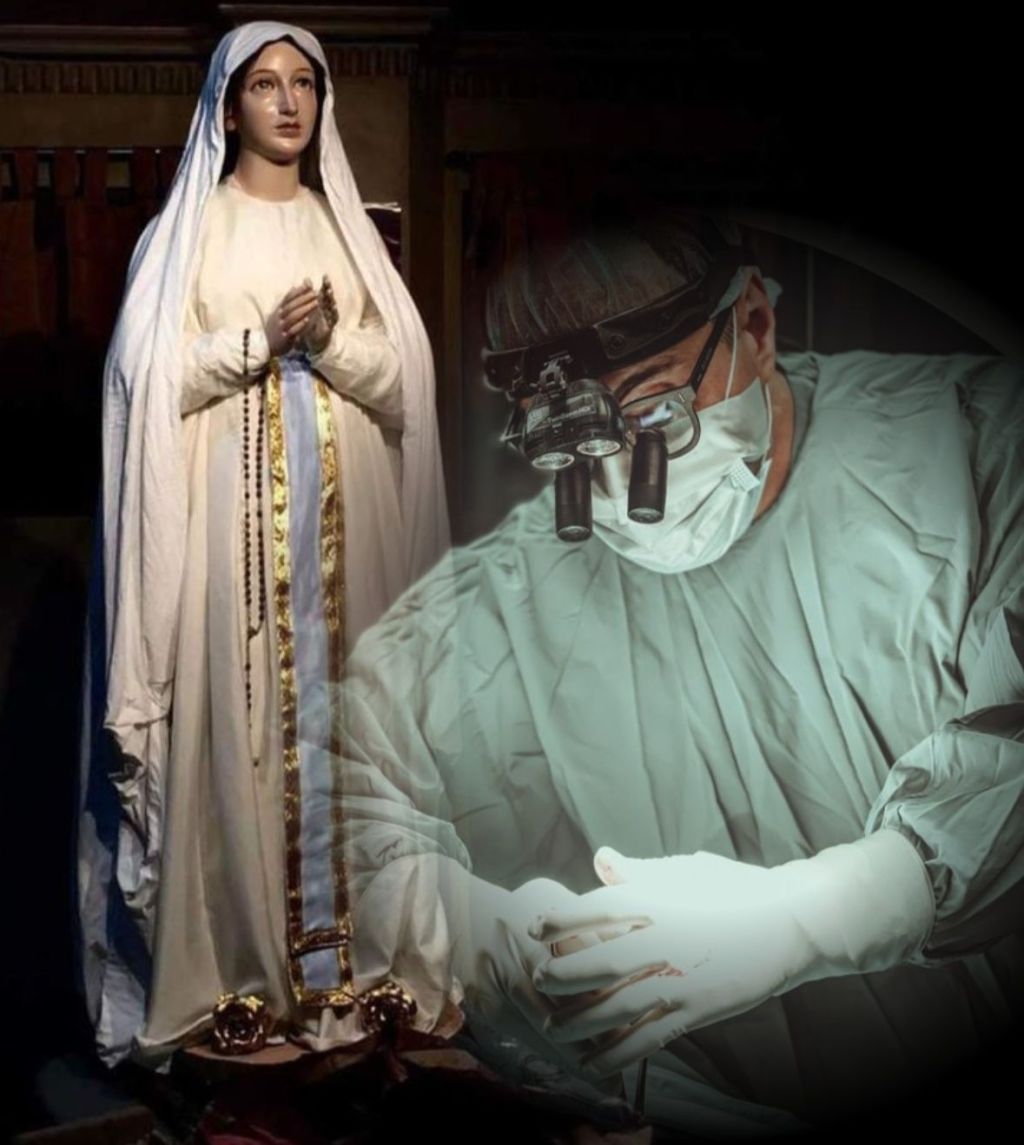
As Adrian pressed his trembling hands against the wound, a light filled the operating room. At first faint, then brighter, it seemed to radiate from nowhere, bathing the surgical table in golden warmth. The entire team froze, eyes wide.
The boy’s body, moments before lifeless, glowed faintly in the light.
And there—just above the table—stood a woman. Dressed in blue and white, her face serene, her eyes filled with compassion. She extended her hands over the boy, as if shielding him.
It was the Virgin Mary.
Adrian’s knees nearly buckled. His rational mind screamed, Hallucination! Stress! But his heart knew otherwise. The room was filled with a peace so deep it silenced every protest in his brain.
The monitors beeped—once, then again. The flatline gave way to rhythm. Daniel’s heart had restarted. His blood pressure stabilized. The bleeding slowed, as if an invisible hand had sealed the wound.
The nurses gasped, some crossing themselves, tears streaming. The anesthesiologist whispered, “Mother of God…”
Adrian stood frozen, scalpel in hand, unable to comprehend. His hands, which minutes ago had failed, were now steady again—but he knew it wasn’t his skill. Something greater was at work.
The surgery continued. Miraculously, the aneurysm held, the bleeding stopped, and the boy stabilized. Hours later, Daniel was wheeled out alive.
His mother rushed forward, clutching her rosary. When she saw her son breathing, she fell to her knees, crying, “Thank you, Mother Mary!”
Adrian’s throat tightened. He wanted to say, It was me. But he couldn’t. Because he knew the truth.
That night, Adrian sat alone in his office, staring at the burned Bible’s ashes still clinging to his coat pocket. His mind replayed the light, the figure, the miracle. He had spent years mocking faith, tearing down Scripture, insulting believers. And yet, in his moment of failure, God had shown mercy.
But pride fought back. It was stress, imagination. Maybe coincidence.
Yet the image of the Virgin would not leave him. Her eyes—gentle, sorrowful, yet forgiving—haunted him. He remembered the elderly woman’s words in the square: “Lord, forgive him.” Could it be that those prayers had shielded him?
For days, he avoided Mass, priests, and believers. But his heart was restless. He began waking at night, hearing echoes of the Rosary in his dreams.
Finally, he could bear it no longer.
One Sunday, dressed in plain clothes, Adrian slipped into the back of St. Augustine’s parish church. The place was filled with families praying, candles flickering before a statue of the Virgin Mary.
When the priest lifted the Host, saying, “Behold the Lamb of God,” Adrian felt a wave of conviction crash over him. He fell to his knees, trembling. Tears, long buried, spilled freely.
After Mass, he approached the priest, barely able to speak. “Father… I mocked God. I burned the Bible. And yet… I saw her. I saw the Virgin in my surgery. She saved that boy. Not me. What must I do?”
The priest placed a hand on his shoulder. “What you must always do—confess, repent, and begin again.”
That week, Adrian made his first confession in over thirty years. He poured out his sins, pride, arrogance, unbelief. And when the words of absolution were spoken, he wept like a child.
From then on, Adrian’s life changed.
He continued practicing medicine, but now he began every surgery with prayer. He kept a rosary in his coat pocket, the very one Daniel’s mother had pressed into his hands as thanks. He no longer mocked faith; instead, he testified to it.
The story spread quickly. Nurses who had been in the room told others what they saw. Patients began asking Adrian to pray with them before operations. His reputation, once for pride, became one of humility and faith.
Daniel, the boy who had survived, grew strong. Every year on the anniversary of his surgery, his family brought flowers to the church, thanking God and Our Lady. Adrian often joined them, kneeling beside the boy he once thought he would lose.
In lectures to medical students, Adrian began to say:
“Medicine saves lives. But never forget—we are not gods. We are hands. Sometimes those hands fail. But God does not fail. And the Virgin Mary intercedes for us, even when we least deserve it.”
At the end of his career, Adrian donated much of his wealth to build a chapel inside the hospital, dedicated to Our Lady of Grace. Above the altar, an inscription read:
“She stood in the operating room. She will stand with us always.”
The story of Dr. Adrian Keller is more than one man’s conversion. It’s a reminder for all of us:
God’s mercy reaches even the hardest hearts. Adrian mocked Him, yet God came anyway.
Mary intercedes for her children. She appeared not for the doctor’s sake, but for the innocent child—and in doing so, saved them both.
Faith and reason are not enemies. Medicine is a gift, but it is incomplete without acknowledging the Divine Healer.
For anyone struggling with doubt, Adrian’s story proves: even in the most sterile, scientific settings, God breaks through. Even in the proudest heart, Mary plants seeds of humility.
He had burned the Bible, mocking God before men. Yet in the silence of the operating room, he saw what science could never explain: the Virgin Mary herself, saving a child’s life.
That sight left him speechless – and changed him forever.
Source:


 Nelson MCBS
Leave a reply to Nusrat Khan Cancel reply