

Introduction
Saint Martin de Porres (1579–1639) is one of the most beloved and revered saints in the Catholic Church, celebrated not only for his extraordinary miracles and profound charity but also for his unwavering commitment to justice, humility, and compassion. Born in Lima, Peru, to a Spanish nobleman and a freed Black woman from Panama, Martin’s life was marked by its challenges: poverty, racial prejudice, and the hardships of being the child of an interracial union. Yet, he transcended these barriers, becoming a radiant beacon of God’s love and mercy to all, regardless of race, status, or creed. Canonized in 1962 by Pope John XXIII and acclaimed as the “Saint of Universal Brotherhood,” Martin de Porres embodies the Church’s radical call to charity, justice, and holistic healing.
Early Life and Challenges
Martin de Porres Velázquez was born in Lima, Peru, on December 9, 1579. His father, Juan de Porres, was a Spanish nobleman and governor of Panama, and his mother, Ana Velásquez, was a Black freedwoman originally from Panama. Because of his mother’s African descent, his parents were prohibited from marrying, and Martin was considered illegitimate—a status carrying great social stigma during colonial times.
Raised in poverty, Martin’s early life was one of hardship and marginalization. He and his younger sister Juana were brought up by their mother in humble circumstances. Despite this, Martin was instilled with deep faith and compassion for others. By age 12, Martin apprenticed as a barber-surgeon, learning not only the art of healing but also the value of service to the sick and poor—a foundation that would shape his whole life.
His Entry into Religious Life
Martin’s longing to devote himself fully to God and serve those most in need led him to the Dominican Order at age 15. Initially, Martin was admitted as a lay helper or oblate because canonical law forbade people “of mixed race” from becoming full members of religious orders in Peru.
Despite this, Martin’s exceptional virtue and selfless service impressed the Dominican community deeply. In 1603, after years of humble labor and spiritual growth, Martin was finally permitted to take vows as a Dominican lay brother—a rare exception that spoke to his profound holiness and the recognition of his gifts by the Dominicans. He would spend the rest of his life at the Convent of the Rosary in Lima, fully dedicated to prayer, work, and service.
Virtues and Spirituality
Martin’s spirituality was marked by:
- Intense prayer and love for the Eucharist: He was known for spending long hours in adoration, frequently lost in contemplation before the Blessed Sacrament, often enveloped in mystical light or seen levitating during prayer.
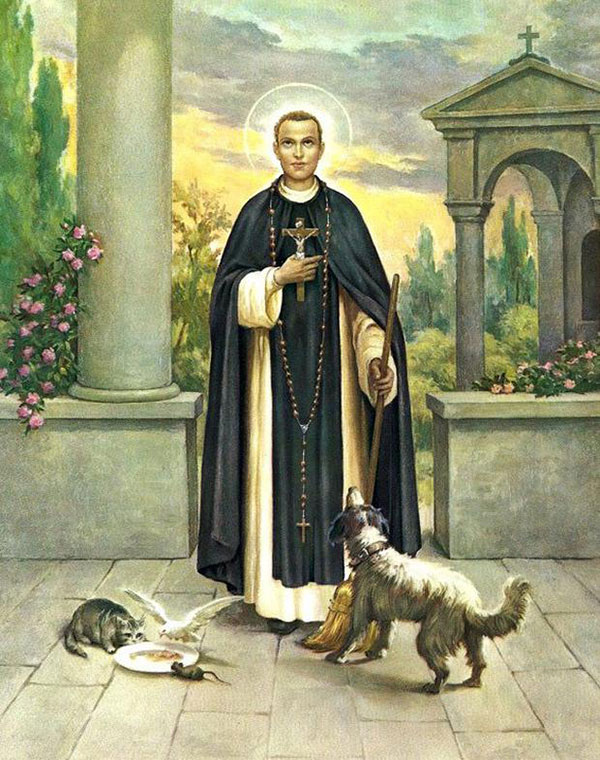
- Extreme humility and penance: Martin performed the most menial tasks—sweeping, laundry, and kitchen work—with great joy and humility. The broom, a symbol often depicted in art, represents his readiness to serve—even the lowest duties were a privilege to him.
- Austerity and fasting: He denied himself all but the barest necessities, refusing meat as an act of penance, and giving away most of his possessions to the poor.
- Universal compassion: Martin’s charity extended beyond humans to animals; he fed stray cats and dogs, cared for wounded creatures, and even advocated kindness to kitchen mice. His boundless compassion reflected his view that all God’s creatures deserved dignity and care.
Service to the Poor and Sick
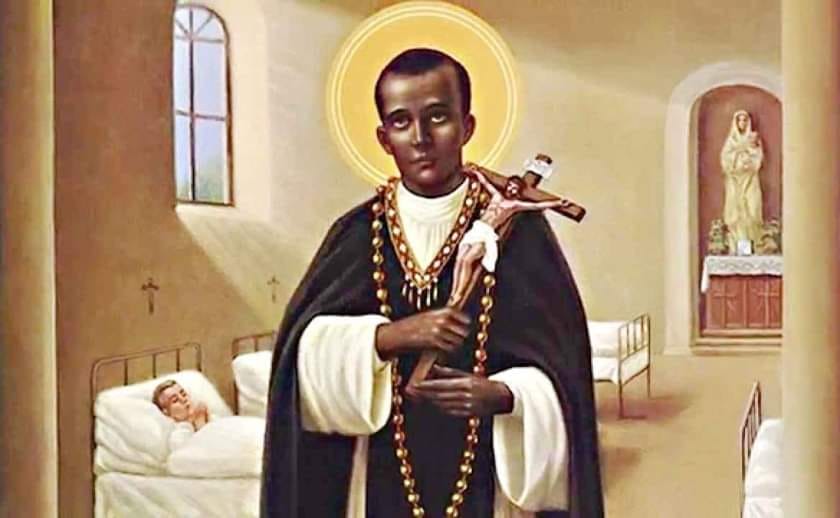
Martin’s apostolate focused on the most destitute and needy of Lima. As an infirmarian, he was renowned for tending the sick with skill, faith, and supernatural love. During epidemics, he risked his own life, passing through locked doors to care for ill friars, regardless of convent rules—famously telling his superiors, “Forgive my error, and please instruct me, for I did not know that the precept of obedience took precedence over that of charity.” His devotion to charity always took priority over institutional regulations, earning him permission to follow mercy wherever it led.
Martin founded a home for orphans, nursed enslaved Africans brought to Peru, and distributed food and clothing to the poor. His practical management of alms enabled the priory to feed monks and the hungry efficiently. Reports of miraculous healings soon spread throughout Lima—those who sought Martin’s intercession received cures, hope, and comfort.
His work was:
- Providing free medical care using his barber-surgeon training.
- Giving alms and distributing food to the poor.
- Raising money for the dowries of poor girls so they might marry with dignity.
- Healing both friars and laypeople, irrespective of social standing or origin.
Miracles and Mystical Gifts
Saint Martin de Porres was revered during his lifetime and after his death for a multitude of miracles:
- Healing powers: Martin cured a wide range of illnesses—from simple wounds to chronic, incurable conditions. His remedies were said to be supernatural, often producing instantaneous recoveries.
- Bi-location and mystical phenomena: Witnesses reported Martin miraculously appearing in locked rooms to tend the sick, or being seen both in Lima and as far away as Africa or Europe—a gift of bi-location accorded to certain saints.
- Multiplication of food: He miraculously multiplied food to feed both the friary and the poor who came for help.
- Levitation: During prayer, Martin was sometimes seen lifted above the ground, surrounded by radiant light.
- Reading souls and wisdom: Martin had the ability to read people’s souls and gave spiritual counsel—even the most learned sought his advice. His humility and wisdom drew countless from all walks of life.
- Communication with animals: He treated animals as fellow creatures of God. Some stories recount him commanding mice to leave the priory quietly or healing injured animals.
After his death, his sanctity was confirmed—the miracles attributed to his intercession multiplied. When his body was exhumed 25 years later, it was found incorrupt and exuded a sweet fragrance.
Friendship and Community Impact
Martin’s friendships shaped the spiritual landscape of Lima, most notably his close relationships with:
- St. Rose of Lima: Another lay Dominican saint, they shared zeal for prayer and service. Their friendship symbolized unity across boundaries of gender and social status, a testimony to God’s love in action.
- St. Juan Macías: Fellow Dominican lay brother, who also led a life of deep charity and humility.
- Wider community: Martin’s love for people transcended walls and borders. Nobles, clergy, slaves, and beggars alike sought his company, counsel, and healing.
Advocacy for Justice and Racial Harmony
Martin de Porres is a powerful patron of racial harmony and social justice. He belonged to and advocated for those often shunned or oppressed because of their race, origin, or poverty. In a colonial society rife with racial discrimination, Martin’s embrace of all people—Spanish, African, Indigenous—was radical and prophetic.
His example foreshadows modern movements for equality and the Church’s ongoing commitment to justice. He remains an icon for social transformation, reminding believers to build communities defined by love and acceptance.
Legacy and Canonization
By the time Martin de Porres died on November 3, 1639, he had become a legend in Lima—the city mourned its humble benefactor. Civil and religious dignitaries served as pallbearers, and reports of miracles abounded, both during his life and after his death.
He was beatified in 1837 by Pope Gregory XVI, and canonized as a saint by Pope John XXIII on May 6, 1962, who presented Martin to the world as the “Saint of Universal Brotherhood.”
Martin’s feast day is celebrated on November 3. He is the patron saint of:
- Mixed race people
- Barbers and public health workers
- Racial harmony and social justice
- The poor and sick
Devotions and Artistic Depictions
Popular devotions to Saint Martin de Porres include the recitation of the Rosary and the Eucharist, both central pillars in Martin’s spiritual life. Novenas and prayers dedicated to him request his intercession for overcoming prejudice, promoting justice, and obtaining healing.
In art, Martin is often depicted holding a broom (symbolizing his humility and service), with animals nearby, or ministering to the sick. His image graces churches, religious institutions, and social justice organizations throughout the world.
Saint Martin de Porres and the Modern Church
Martin de Porres remains uniquely relevant in contemporary times. His life speaks to key Catholic values:
- Radical compassion—A love that knows no bounds and embraces the marginalized and forgotten.
- Justice—A commitment to equity and the dignity of every person.
- Humility in service—Finding God’s presence in the smallest, most humble tasks.
- Healing and reconciliation—Uniting divided communities and healing both physical and spiritual wounds.
His canonization as the “Saint of Universal Brotherhood” urges the Church and all people of good will to imitate his charity, build bridges across racial and social divides, and foster communities of hope and healing.
Conclusion: The Timeless Example of Saint Martin de Porres
Saint Martin de Porres stands as a radiant witness of Gospel values—charity, humility, justice, and acceptance. Born into poverty and prejudice, he rose by faith and love to become a source of comfort and healing for all. Through his miracles, compassionate acts, and mystical gifts, Martin de Porres challenges us today to live out God’s love in practical service, to advocate for justice, and to see the face of Christ in every person—especially the poor, sick, and marginalized.
His enduring legacy calls the Church and the world to embrace universal brotherhood and to remember, as Martin did, that in God’s eyes, every human being is precious, worthy of love, and capable of greatness.
Saint Martin de Porres, pray for us!
Prayer to Saint Martin de Porres
O glorious Saint Martin de Porres,
whose burning charity embraced the poor,
the sick, and all of Creation,
we invoke your aid and intercession.
Teach us through your gentle humility and tireless service
to imitate your virtues,
and to see Christ in every person we meet.
Merciful healer and apostle of unity,
pour out your blessings upon all people—
especially those suffering injustice and discrimination—
and unite us in God’s love.
Guide us on the path of justice, peace, and healing,
so that we may reach the heavenly kingdom
through the merits of our Lord Jesus Christ.
Amen.

 Nelson MCBS
Leave a reply to aparnachillycupcakes Cancel reply