
Today salvation has come to this house…
Luke 19:1-10
The encounter between Jesus and Zacchaeus in Luke 19 is one of the most tender and hopeful moments in the Gospel. It is not simply a story about a short man climbing a tree. It is a story about grace that seeks us, about a heart that begins to awaken, and about what happens when Jesus enters a life.
Zacchaeus is introduced to us as “chief among the publicans” and a wealthy man. In that time, tax collectors were not merely disliked; they were considered traitors and sinners. Zacchaeus was a man who had compromised, a man whose success came at a moral cost. Yet the Gospel does not freeze him in his past. It does not define him only by his failures. That is already good news for us. God never reduces us to our worst decisions. Grace is not obstructed by moral failure when there is openness to encounter.
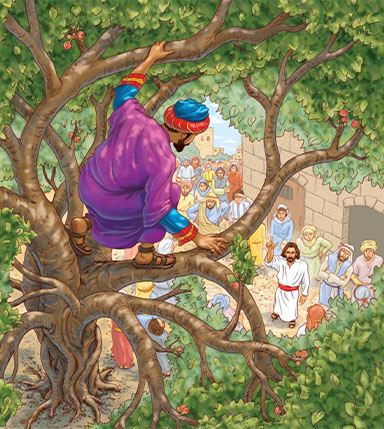
Something has begun to stir in Zacchaeus. We are told that he “wanted to see who Jesus was.” That simple desire is the beginning of salvation. He does not yet confess his sins. He does not yet promise restitution. He simply wants to see Jesus. But even that desire is already grace at work. Grace does not wait for perfect circumstances; it meets readiness.
However, there are obstacles. The Gospel says he was “short in stature,” and there is a crowd in the way. On the surface, it is a physical detail. Spiritually, it speaks to something deeper. Sin can make us small. It narrows our vision. It keeps us from seeing beyond ourselves.
The crowd can be the noise of life: responsibilities, distractions, ambitions, anxieties, old habits, the opinions of others. Sometimes the crowd is our own past, whispering that change is impossible.
St. Cyril of Alexandria spoke of the crowd as intellectual and spiritual confusion, the inner noise that prevents clarity. Zacchaeus refuses to remain stuck behind it. He runs ahead and climbs a sycamore tree.
Zacchaeus does something beautiful and decisive. He runs ahead and climbs a sycamore tree. Imagine this: a wealthy, important official running through the streets and climbing a tree like a child. He risks embarrassment. He risks ridicule. But he prefers to look foolish rather than remain blind. That is the beginning of conversion, it often begins with desire. Sometimes following Christ requires what looks like “holy foolishness.” It requires humility. It requires us to care less about appearances and more about truth.
The Fathers went further. Bede the Venerable saw in the sycamore tree an image of the Cross—
The Fathers of the Church, like Bede the Venerable, saw the sycamore as an image of the Cross, called by some the “foolish fig-tree,” because its name is derived from the Greek sykon (fig) and moros (foolish), symbolize the “foolishness” of the Cross.
As Saint Paul writes, the Cross is a stumbling block and folly to many (cf. 1 Corinthians 1). Zacchaeus climbs what seems foolish in order to gain true sight. In a similar way, we rise above sin by embracing humility, repentance, and the Cross things the world may not admire, but which bring clarity of vision.
To climb the tree is to rise above sin by embracing the Cross. Zacchaeus rises above the crowd by embracing what seems foolish with humility and repentance. Conversion always requires a certain holy foolishness.
But then something even more surprising happens. Zacchaeus wants to see Jesus, but Jesus looks up first.
“Zacchaeus, come down quickly, for today I must stay at your house.”
Jesus calls him by name. He does not wait for Zacchaeus to speak. As Ambrose reflects, the Lord had not yet heard a word of hospitality, but He had already seen the desire in the heart. God sees what others do not see. He sees the longing before the confession, the movement before the reform.
And notice that Jesus does not say, “Clean up your life first.” He says, “I must stay at your house today.” Grace comes first. The presence of Christ produces conversion. When Jesus enters the house, everything begins to change.
Of course, the crowd murmurs. “He has gone to stay with a sinner.” The pattern is familiar. Mercy often scandalizes those who measure holiness by separation rather than by transformation. But Jesus is not afraid of entering a sinner’s home. He came precisely for that reason.
And then Zacchaeus stands and makes a public declaration: “Half of my goods I give to the poor. And if I have defrauded anyone, I restore it fourfold.” This is not a vague emotion. This is concrete repentance. Conversion touches the wallet. It touches relationships. It touches justice. When Christ truly enters a heart, generosity and restitution follow.
Then comes one of the most beautiful lines in the Gospel: “Today salvation has come to this house… For the Son of Man came to seek and to save what was lost.”
Salvation is not an abstract idea. It is Jesus under your roof. It is Christ in your home, in your decisions, in your finances, in your relationships. It is a life reordered around His presence.
This Gospel speaks to us personally.
At times we are “short in stature” spiritually small in faith, weakened by compromise, tired of struggling. At times the crowd feels overwhelming distractions, old patterns, discouragement. But the essential question remains: Do we want to see Jesus?
If that desire is there, even faintly, grace has already begun its work.
Then comes the next step. What must we climb? What attachment must we rise above? What fear of embarrassment must we let go of?
Sometimes it means going to confession. Sometimes it means repairing a relationship. Sometimes it means changing a financial decision, forgiving an old wound, or stepping away from a habit we have tolerated for too long.
As Gregory the Great suggests, we must rise above the sweetness of sin and choose the humility that the world may call foolish. Yet Scripture reminds us: “God’s folly is wiser than men” (1 Corinthians 1:25).
And there is one more gentle lesson here. Zacchaeus climbs up, but when Jesus calls him, he must come down. We climb through repentance, but we remain through humility. We do not stay above others. We come down to welcome Christ into the ordinary spaces of life. Pride can undo even spiritual progress. Humility keeps salvation in the house.
Finally, Jesus calls Zacchaeus “a son of Abraham.” Not because of bloodline, but because of faith. Abraham left everything at God’s word. Zacchaeus leaves everything in Christ’s presence. True belonging to God is shown not by ancestry, but by trust and obedience.
And so, the Gospel leaves us with hope. No one is beyond the reach of grace. No past is so dark that Christ cannot enter. The Son of Man still comes to seek and to save what was lost. He still passes through our personal “Jericho”. He still looks up. He still calls each of us by name.
The question is simple and tender: will we come down quickly and welcome Him with joy?
If we allow Him to enter our house, not just our church attendance, not just our external life, but our financial decisions, our hidden habits, our relationships, then salvation is not something postponed to the future..
If we do, salvation is not “someday.” It is today.
Fr James Abraham


 Nelson MCBS
Leave a comment