

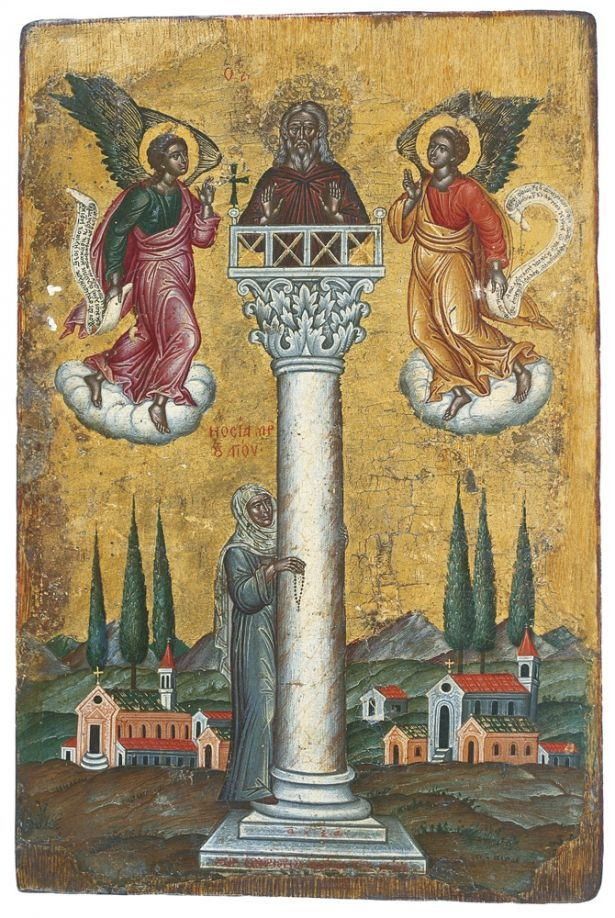
Among the luminous figures of Christian holiness who embody the spirit of Lent, Saint Simeon the Stylite stands as one of the most striking and prophetic witnesses. His life was not merely an exercise in extreme asceticism, but a profound theological statement: that true elevation toward God is achieved only through deep repentance, humility, and interior struggle.
Simeon was born in 389 AD in the village of Sīs (Sisan), on the border of Syria and Cilicia, near present-day Adana. Raised in a simple rural family, he spent his early years tending sheep. This humble beginning placed him in continuity with the biblical tradition of shepherds chosen by God Jacob, Moses, David, and the prophets men formed in silence before being entrusted with souls. From his youth, however, Simeon showed a marked inclination toward solitude and prayer, sensing within himself a call that went beyond the rhythms of ordinary village life.
His mother tongue was Syriac Aramaic, the language of his land and the language spoken by Christ. Later, upon entering monastic life, he learned Greek, the language of administration and theology in the Eastern Roman world. Simeon never received a formal education; Scripture itself became his school. A decisive moment occurred when he heard the Beatitudes read aloud, especially the words: “Blessed are the peacemakers, for they shall be called sons of God.” These words pierced his heart and awakened in him a desire to shepherd souls rather than flocks. When he asked how such blessedness could be attained, he was directed toward the ascetic life and the path of inner spiritual struggle.
Seeking divine guidance, Simeon went to a nearby shrine of the martyrs, where he prostrated himself in prayer. There he experienced a symbolic vision: he was digging a foundation while a voice commanded him to dig ever deeper. Only when the foundation reached sufficient depth was he told that the building could rise securely. This vision became the key to his entire life. Simeon understood that spiritual height is impossible without deep foundations of repentance and self-emptying.
He first entered a monastery in his home region, remaining there for two years, and later spent a decade in the Monastery of Burj al-Sab‘ near Mount Sheikh Barakat. His ascetic practices grew increasingly severe. In 412 AD, at a monastery in Telanissos, he fasted far beyond the common monastic rule sometimes for an entire week causing concern among the superiors. Unable to moderate his zeal, they eventually asked him to leave, fearing that others would attempt to imitate practices beyond their strength.
Withdrawing to a nearby hill, Simeon initially bound himself with a chain as a sign of perseverance. When advised by the Bishop of Antioch that true discipline must be governed by free will rather than physical restraints, he adopted the radical form of asceticism for which he became famous: life upon a pillar. Beginning with a modest height, he gradually ascended higher until the pillar reached approximately sixteen meters. From this elevated place, Simeon preached repentance, reconciliation, and peace, transforming physical immobility into a universal ministry.
His reputation spread rapidly across the Christian world. Pilgrims came from Persia, Armenia, Arabia, Georgia, Thrace, Western Europe, and even the British Isles. Though physically distant from the ground, Simeon was deeply engaged with the sufferings and spiritual needs of humanity. His pillar became a visible sermon: a sign that the Christian life is a continual ascent of the heart toward God.
Central to Simeon’s witness was his imitation of the biblical forty-day fasts of Moses, Elijah, and Christ. For nearly twenty-eight years, he regularly observed forty days without food. Yet even he was reminded that holiness does not lie in the destruction of the body. When his austerity once endangered his life, he was corrected by fellow ascetics and strengthened through the Eucharist. Patriarch Meletius of Antioch praised his zeal while reminding him that sanctification requires harmony between body and soul.
Simeon’s legacy extended far beyond his own lifetime. He became the founder of the stylite tradition, inspiring numerous ascetic men and women alike across centuries and regions, from Syria and Constantinople to Georgia. His life demonstrated that Christian asceticism is not an escape from the world, but a radical form of intercession for it.
In the journey of Lent, Saint Simeon the Stylite remains a powerful guide. His life teaches that the path to resurrection passes through the depth of repentance, that true height is born of humility, and that the Christian is called to become, in every age, a living sign pointing from earth toward heaven.
 joseph Thekkedath Puthenkudy
 Nelson MCBS
Leave a comment