
Introduction: The Significance of Palm Sunday
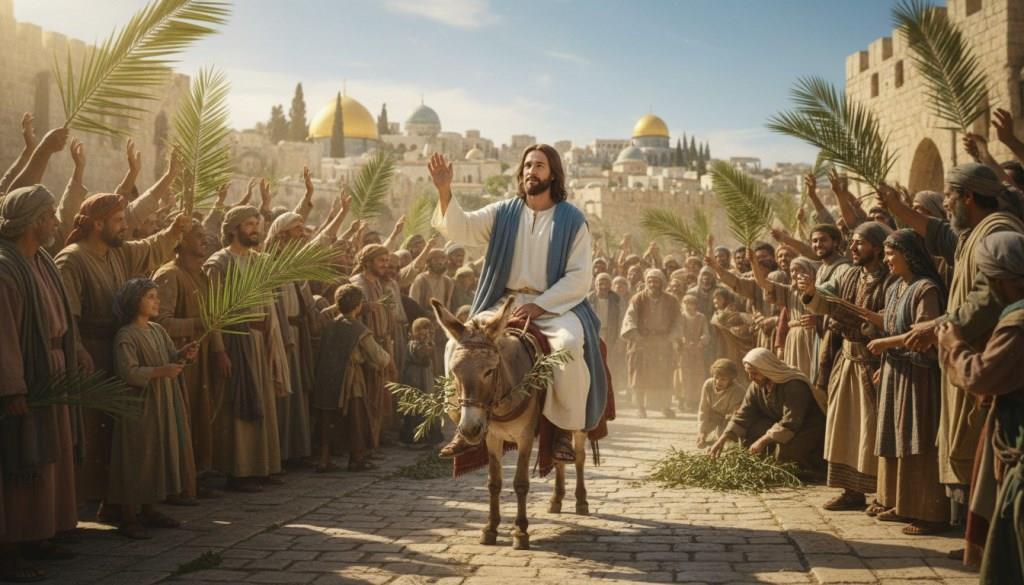
Palm Sunday marks the beginning of Holy Week, the most sacred time in the Christian liturgical calendar. It commemorates Jesus Christ’s triumphant entry into Jerusalem, an event that is both joyful and deeply prophetic. The crowds welcomed Him with palm branches and shouts of “Hosanna!”—a cry of praise and a plea for salvation. Yet, this moment of celebration was shadowed by the knowledge of the suffering and sacrifice that awaited Jesus.
As we gather today, waving our palms and singing “Hosanna,” we are invited to enter into the mystery of Christ’s passion, to walk with Him from triumph to trial, from glory to the cross, and ultimately to resurrection. This journey is not only historical but profoundly personal and transformative.
Part I: The Triumphal Entry — A Story of Humility and Kingship
The Biblical Account
The Gospel narratives (Matthew 21:1-11, Mark 11:1-11, Luke 19:28-44, John 12:12-19) describe Jesus’ entry into Jerusalem riding on a donkey, fulfilling the prophecy of Zechariah 9:9:
“Rejoice greatly, O daughter of Zion! Shout aloud, O daughter of Jerusalem! Behold, your king is coming to you; righteous and having salvation is he, humble and mounted on a donkey, on a colt, the foal of a donkey.”
This act was a deliberate declaration of Jesus’ kingship, but not the kind of kingship the people expected. Instead of a conquering warrior on a horse, Jesus chose humility and peace, signaling a kingdom not of this world.
Story of St. Francis of Assisi and the Donkey
St. Francis of Assisi, known for his radical humility and love for all creation, once reflected deeply on this image of Christ on a donkey. He saw in the donkey a symbol of meekness and service. Legend tells us that St. Francis would often ride a donkey himself, embracing the humility of Christ’s kingship.
One day, when asked why he chose such a humble beast, Francis replied, “The Lord chose the donkey to show us that true greatness lies not in power or prestige but in humble service and love.”
This story reminds us that the path to true glory is through humility, a lesson that Palm Sunday powerfully teaches.
Part II: The Crowd’s Acclamation — A Lesson in Faith and Expectation
The Cry of “Hosanna”
The crowd’s shout of “Hosanna” means “Save us now!” It was both a cry of praise and a plea for deliverance. The people hoped Jesus would free them from Roman oppression and restore the kingdom of Israel.
Yet, many did not understand the nature of the salvation Jesus came to bring. His kingdom was not political but spiritual, a kingdom of justice, mercy, and peace.
Story of Blessed John Henry Newman
Blessed John Henry Newman, a great theologian and convert to Catholicism, once wrote about the tension between human expectation and divine reality. He noted that often, like the crowd on Palm Sunday, we want God to act according to our desires rather than His divine plan.
Newman said, “God’s ways are not our ways; His timing is perfect even when it challenges our hopes.”
This invites us to trust in God’s plan, even when it unfolds in unexpected ways.
Part III: The Prophecy of Suffering — The Cross Behind the Palms
Jesus Foretells His Passion
In the midst of the celebration, Jesus wept over Jerusalem (Luke 19:41-44), foreseeing the city’s rejection of Him and the suffering that would come. The palms waved in joy would soon be overshadowed by the cross.
Story of St. Therese of Lisieux: The Little Flower’s Offering
St. Therese of Lisieux, known as the “Little Flower,” embraced the hidden suffering in her life as a way to unite with Christ’s passion. She wrote, “I will spend my heaven doing good on earth.” Her life teaches us that suffering, when united with Christ, becomes a source of grace and transformation.
Her story encourages us to see beyond the immediate joy of Palm Sunday to the redemptive power of the cross.
Part IV: The Fathers of the Church on Palm Sunday
St. Augustine on the King of Peace
St. Augustine reflected on Jesus’ entry as the coming of the “King of Peace.” He wrote:
“Behold the King comes, humble and riding on a donkey, not to destroy but to save. He comes to bring peace to the hearts of men, peace that the world cannot give.”
Augustine’s insight helps us understand that Christ’s kingship is about inner peace and reconciliation.
St. John Chrysostom on the Crowd’s Response
St. John Chrysostom, known for his eloquent preaching, commented on the crowd’s enthusiasm:
“The people shouted ‘Hosanna’ with joy, but soon they would cry ‘Crucify Him.’ This shows how fickle human hearts can be, yet God’s love remains steadfast.”
This reminds us to examine our own faithfulness and commitment.
Part V: Living the Palm Sunday Message Today
The Call to Humility and Service
Palm Sunday challenges us to embrace humility in our own lives. Like Christ, we are called to serve others, especially the poor and marginalized.
Story of Mother Teresa
Mother Teresa of Calcutta exemplified this call. She once said:
“Not all of us can do great things. But we can do small things with great love.”
Her life is a living sermon on the meaning of Palm Sunday — that true greatness is found in love and service.
The Invitation to Hope and Trust
In times of trial, Palm Sunday reminds us to trust in God’s plan. The crowd’s hope was fulfilled not in earthly power but in eternal salvation.
Quote from St. Pope John Paul II
St. John Paul II said:
“Do not be afraid to open your hearts to Christ. He is the King who brings true freedom and peace.”
Conclusion: Entering Holy Week with Faith and Joy
As we wave our palms today, let us remember that we are invited to follow Christ not only in His triumph but also in His suffering and resurrection. Palm Sunday is a call to live with humble hearts, hopeful spirits, and faithful trust.
May the stories of the saints and the wisdom of the Church Fathers inspire us to walk this holy journey with courage and love, proclaiming with the crowd:
“Hosanna! Blessed is He who comes in the name of the Lord!”
 Nelson MCBS
Leave a comment