

Table of Contents
- Introduction: The Silence of Calvary
- Part I: The Scandal and Wisdom of the Cross
- Biblical Foundations of the Passion
- The Teaching of the Church Fathers: Cosmic Victory
- Part II: Entering the Mystery of Christ’s Sufferings
- Physical and Emotional Agony
- The Loneliness of the Cross and Modern Isolation
- Part III: Transformative Stories of the Cross
- The Power of Forgiveness: A Modern Calvary
- The Grain of Wheat: Modern Martyrs
- Part IV: The Seven Last Words as a Blueprint for Living
- Forgiveness, Mercy, and Relationship
- Abandonment and Completion
- Part V: Wisdom from the Saints on Suffering
- Turning Pain into Love
- Part VI: Practical Lessons for Today’s Life
- Carrying Daily Crosses
- Being Simon of Cyrene to Others
- The Emptying of Self in a Culture of Noise
- Conclusion: From the Darkness to the Dawn
Introduction: The Silence of Calvary
Dear brothers and sisters in Christ,
We gather today on the most solemn, mysterious, and paradoxically “good” day in the Christian calendar. Today, the Church does not celebrate the Eucharist in its usual form. The bells are silent. The altars are stripped bare. The tabernacle stands open and empty, a stark visual representation of a world without the visible presence of its Savior.
On this day, we are invited not to rush into noise, but to stand at the foot of the Cross. In our modern world, we are terrified of silence. We fill every quiet moment with digital noise, scrolling, background music, and busyness. We do this because silence forces us to confront ourselves—our wounds, our mortality, our failures, and our regrets. Yet today, the Church forces us into a holy silence.
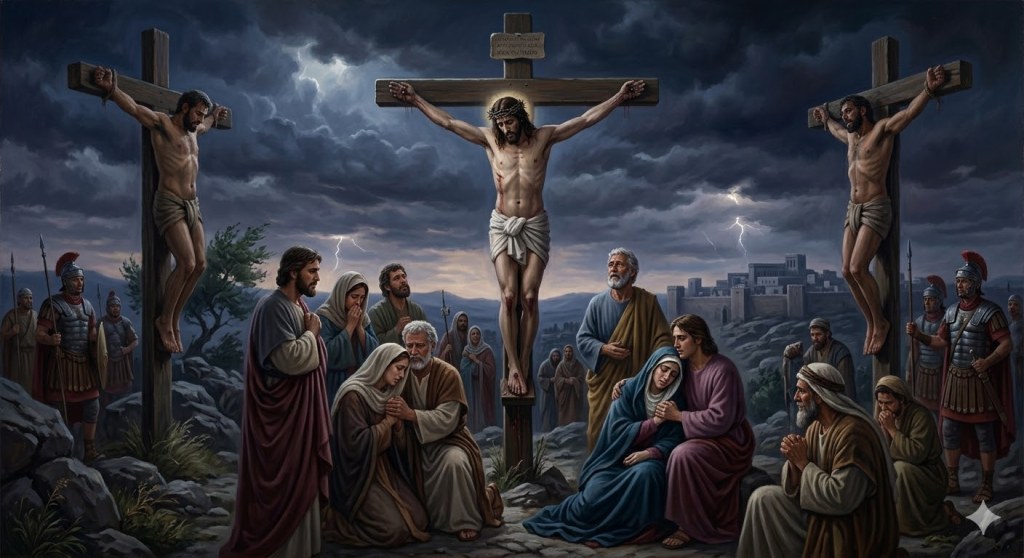
As we look upon the wood of the Cross, we see a man beaten, mocked, stripped, and executed in the most humiliating manner known to the ancient world. To the casual observer in first-century Jerusalem, this was the end of a failed political and messianic movement. It was a tragedy. It was a defeat.
But through the eyes of faith, we know that what transpired on Calvary was not a tragedy, but a triumph. It was not a defeat, but a rescue mission.
Why do we call this Friday “Good”? It is Good because it reveals the exact lengths to which God is willing to go to win back your heart. It is Good because it proves that there is no dark abyss of human suffering, no pit of despair, and no shadow of death where God has not walked before us. On the Cross, Jesus Christ absorbed the full weight of human sin, hatred, and death, and He neutralized it with infinite love.
As we meditate today, we will travel through the Scriptures, listen to the profound insights of the Fathers of the Church and the Saints, hear inspiring stories of how the Cross still changes lives today, and extract practical, daily lessons for how we are to live as Crucified and Resurrected Christians in the twenty-first century.
Let us fix our eyes on Jesus, the author and perfecter of our faith, who for the joy set before Him endured the cross, scorning its shame, and sat down at the right hand of the throne of God (Hebrews 12:2).
Part I: The Scandal and Wisdom of the Cross
Biblical Foundations of the Passion
To understand Good Friday, we must understand that the Cross was not a backup plan. It was not a historical accident. It was the ultimate fulfillment of God’s redemptive arc, promised since the dawn of time.
Immediately after the Fall of Man in the Garden of Eden, God promised the Protoevangelium—the First Gospel. In Genesis 3:15, God tells the serpent that the seed of the woman would crush his head, though the serpent would strike his heel. On Calvary, that prophecy is fulfilled. Christ’s heel is pierced by the nails of the Roman soldiers, but in that very act of self-sacrificial vulnerability, He crushes the head of the ancient enemy, Satan.
Centuries before Christ was born, the prophets saw this day. The prophet Isaiah, writing some seven hundred years before the birth of Christ, gives us the most vivid description of the Passion in what we call the “Fourth Servant Song” (Isaiah 52:13–53:12). In words that seem to have been written by an eyewitness at the foot of the Cross, Isaiah writes:
“He was despised and rejected by mankind, a man of suffering, and familiar with pain. Like one from whom people hide their faces he was despised, and we held him in low esteem. Surely he took up our pain and bore our suffering, yet we considered him punished by God, stricken by him, and afflicted. But he was pierced for our transgressions, he was crushed for our iniquities; the punishment that brought us peace was on him, and by his wounds we are healed.” (Isaiah 53:3–5)
When we read Isaiah 53, we are forced to ask: How could a prophet describe Roman crucifixion centuries before it was even invented by the Persians and adopted by the Romans? It is because the Cross is the centerpiece of history.
In the New Testament, St. Paul confronts the sheer difficulty of the Cross. In the ancient world, the cross was a symbol of absolute terror and shame. Roman citizens were legally exempt from it because it was considered too degrading. For the Jews, anyone hung on a tree was cursed by God (Deuteronomy 21:23).
St. Paul writes to the Corinthians:
“For the message of the cross is foolishness to those who are perishing, but to us who are being saved it is the power of God… Jews demand signs and Greeks look for wisdom, but we preach Christ crucified: a stumbling block to Jews and foolishness to Gentiles, but to those whom God has called, both Jews and Greeks, Christ the power of God and the wisdom of God.” (1 Corinthians 1:18, 22–24)
The Cross turns the wisdom of the world upside down. The world believes that power is found in domination, wealth, and asserting one’s will. The Cross reveals that true power is found in self-emptying, humility, and love. The world believes that greatness is found in being served; Christ reveals that greatness is found in serving and laying down one’s life.
The Teaching of the Church Fathers: Cosmic Victory
The Fathers of the Church—the great theologians and bishops of the early centuries—spent their lives plumb-lining the depths of the Cross. They did not see the Cross merely as a courtroom transaction where Jesus took our punishment. They saw it as a cosmic battle where Christ invaded the territory of death and disarmed the powers of darkness.
St. John Chrysostom, the great “Golden-Mouthed” preacher of Constantinople, spoke of the victory of the Cross with breathtaking eloquence. He writes:
“I see the King, and I see the Cross. I see the Sun of Righteousness, and I see the wood of shame. But do not look at the wood; look at the King who hangs upon it. By this Cross, death was killed, the curse was destroyed, the tyranny of the devil was brought to an end. Our swords were not bloodied, we were not in agony, we were not wounded, we did not even see the battle, and yet we obtain the victory! His was the fight, ours the crown.”
Chrysostom reminds us that on the Cross, Christ fought a battle for us that we could never fight for ourselves. He took the weapon of the enemy—death—and turned it against the enemy.
St. Augustine of Hippo, one of the greatest minds in Western history, saw the Cross as a trap set for the devil. He used the famous image of the mousetrap:
“The devil jumped for joy when Christ died; and by the very death of Christ the devil was overcome, as if he had swallowed the bait in the mousetrap. He rejoiced in Christ’s death, believing himself to be the conqueror. But that which caused his joy was his own undoing. The Cross of the Lord was the devil’s mousetrap; the bait by which he was caught was the Lord’s death.”
The devil thought that by killing the Son of God, he would win. He did not realize that by killing the Author of Life, he was inviting Life into the realm of the dead, thereby exploding the gates of hell from the inside out.
St. Athanasius of Alexandria, the great defender of the divinity of Christ, wrote in his masterpiece On the Incarnation about why Christ had to die on a Cross lifted up in the air. He argued that Christ died in the air to cleanse the atmosphere from the principalities and powers of the air (Ephesians 2:2) and to stretch out His hands to unite the whole cosmos.
The Fathers often interpreted the four dimensions of the Cross—height, depth, width, and breadth—as symbols of Christ’s universal love. The vertical beam reaches up to the heavens and down into the depths of the earth, bridging the gap between God and man. The horizontal beam stretches out to the east and the west, embracing all of humanity.
As St. Gregory of Nyssa wrote, the Cross is a cosmic seal. There is nowhere you can go where the love of the Crucified Christ does not reach. If you ascend to the heavens, He is there. If you make your bed in the depths, He is there.
Part II: Entering the Mystery of Christ’s Sufferings
To appreciate the “Goodness” of Good Friday, we must not sanitize the Passion. We must not let the Cross become just a piece of jewelry we wear around our necks, forgotten and decorative. We must look at the raw, agonizing reality of what our Lord endured.
Physical and Emotional Agony
The Passion did not begin on the Cross; it began in the Garden of Gethsemane. There, in the darkness of the olive grove, Christ experienced psychological and emotional agony so intense that He sweated drops of blood (Luke 22:44). This medical condition, known as hematidrosis, occurs under conditions of extreme emotional stress, where the capillary blood vessels that feed the sweat glands rupture.
Why was Jesus so terrified? It was not merely physical death. Countless Christian martyrs would later go to their deaths singing and rejoicing. Jesus was in agony because He, the sinless Lamb of God, was about to take upon Himself the crushing weight of all human sin. He was about to experience the terrifying spiritual consequence of sin: felt separation from the Father.
Then came the betrayal by Judas, one of His chosen twelve. He was abandoned by His disciples, who fled into the night. He was subjected to a sham trial before the Sanhedrin, where He was slapped, spit upon, and mocked. He was dragged before Pontius Pilate and Herod, a pawn in a political game.
Then came the scourging at the pillar. Roman scourging was not a simple lashing. It was done with a flagrum, a whip of leather thongs embedded with shards of bone and lead. It tore the flesh from the back, exposing muscle and bone. Many prisoners died from the scourging alone.
Then, the crowning with thorns. The Roman soldiers, bored and cruel, wove a crown of long, sharp Judean thorns and hammered it into His scalp, mockingly bowing before Him. They draped a purple rag over His bleeding shoulders and placed a reed in His hand, only to take the reed and beat Him over the head with it.
Finally, He was forced to carry His own instrument of execution, the heavy wooden crossbeam, through the narrow, crowded streets of Jerusalem up to the hill of Golgotha, the Place of the Skull.
At Golgotha, spikes were driven through His wrists and feet. To breathe on a cross, a victim had to push up on the nail in their feet to relieve the pressure on their chest and lungs. Every breath was a choice to endure excruciating pain. It was a slow, agonizing process of asphyxiation and heart failure.
The Loneliness of the Cross and Modern Isolation
Yet, as horrific as the physical pain was, the emotional and spiritual pain was arguably greater. Good Friday is the ultimate story of human rejection and abandonment.
- The Crowds: The very same people who, just five days earlier on Palm Sunday, shouted “Hosanna in the highest!” were now screaming “Crucify Him! Release Barabbas!”
- His Friends: Peter, the rock on whom the Church was to be built, denied Him three times by a charcoal fire, swearing he never knew the man. The rest of the Apostles, save for John, were nowhere to be found, hiding behind locked doors in fear.
- The Religious Leaders: The priests and scholars who should have recognized the Messiah were the ones orchestrating His death.
- The Political Leaders: Pilate, knowing Jesus was innocent, washed his hands of the matter to keep his political career safe.
Jesus experienced total, absolute isolation.
How deeply this speaks to our modern world! Today, we are living through what psychologists call a “loneliness epidemic.” Despite being more technologically connected than ever before, millions of people feel utterly alone, misunderstood, and abandoned.
If you have ever been betrayed by a spouse, a business partner, or a close friend, look at the Cross. Jesus knows how that feels. He was betrayed with a kiss.
If you have ever felt like a victim of injustice, of a system that favors the powerful over the innocent, look at the Cross. Jesus was condemned by a corrupt system.
If you are suffering from a chronic physical illness that makes every breath a struggle, look at the Cross. Jesus understands physical agony.
If you are battling depression, anxiety, or the feeling that God has forgotten you, look at the Cross and hear Jesus cry out, “My God, my God, why have you forsaken me?” (Matthew 27:46).
The Cross means that God is not a distant deity watching our suffering from the comfort of a heavenly throne. Our God is a God with scars. He climbed down into our mud, our blood, our tears, and our pain. On Good Friday, we learn that we never suffer alone. In your darkest hour, Christ is there, because He has been there before you.
Part III: Transformative Stories of the Cross
The Cross is not just a historical event to be analyzed; it is a living power that transforms lives. Let us look at a few stories—both ancient and modern—that show how the shadow of the Cross brings light into the darkest places of human history.
The Power of Forgiveness: A Modern Calvary
In the late twentieth century, the nation of Rwanda was torn apart by a horrific genocide. In just one hundred days, nearly one million people were slaughtered, often by their own neighbors, friends, and fellow churchgoers. The wounds were deep, and when the violence ended, the nation was left with a terrifying question: How do we live together now? How can a woman live next door to the man who murdered her children?
A Catholic woman named Denise lost her husband and her children in the genocide. For years, she was paralyzed by grief and hatred. The man who had led the attack on her home was a neighbor named Jean-Paul.
Years later, Jean-Paul was released from prison after completing his sentence and participating in a traditional truth-and-reconciliation process. He returned to the village. Denise saw him every day. The hatred in her heart was a heavy, suffocating poison. She felt like she was dying inside.
One Good Friday, Denise went to her local parish for the Veneration of the Cross. As she knelt before the crucifix, she looked at the figure of Jesus. She heard the words of Christ in her heart: “Father, forgive them, for they know not what they do.”
Denise realized that her hatred was not bringing her family back; it was only killing her soul. She realized that Christ had died for Jean-Paul just as much as He had died for her.
With a heart pounding in her chest, she left the church, walked to Jean-Paul’s house, and knocked on the door. When he opened it, he was terrified, expecting her to scream at him or threaten him. Instead, Denise looked at him and said, “Jean-Paul, today is Good Friday. Christ died for my sins, and He died for yours. I want you to know that I forgive you.”
Jean-Paul fell to his knees on the dirt floor and wept. That act of radical, Good Friday forgiveness broke the power of the enemy in that village. Today, Denise and Jean-Paul work together in a ministry of reconciliation.
Where did Denise find the strength to do that? Not in herself. No human being can do that on their own strength. She drew it from the Cross. She realized that if the Son of God could forgive His executioners while they were still driving the nails into His hands, then by His grace, she could forgive her neighbor.
The Ultimate Sacrifice: St. Maximilian Kolbe
Another profound story of the Cross in modern history takes us to the Auschwitz concentration camp during World War II. In July 1941, a prisoner escaped from the camp. In retaliation, the Nazi commandant ordered that ten men from the same cellblock be chosen at random to be starved to death in the underground starvation bunker.
As the commandant walked down the line pointing at men, he pointed to a Polish sergeant named Franciszek Gajowniczek. The man broke down in tears, crying out, “My wife! My children! What will become of them?”
From the back of the line, a frail, middle-aged man stepped forward. It was Father Maximilian Kolbe, a Franciscan priest. He calmly walked up to the commandant, removed his cap, and said, “I wish to die in the place of this man.”
The commandant was stunned. In Auschwitz, nobody volunteered for anything, let alone death. “Who are you?” the commandant asked.
“I am a Catholic priest,” Kolbe replied.
The commandant accepted the trade. Father Kolbe was thrown into the dark starvation bunker with the nine other men. Usually, the starvation bunker was filled with the sounds of screaming, cursing, and despair as men went mad with hunger and thirst. But under Father Kolbe’s leadership, the bunker was transformed into a chapel. The prisoners sang hymns, prayed the Rosary, and praised God.
One by one, the men died. After two weeks, only Kolbe and three others were still alive, though unconscious. The Nazis, needing the cell, decided to end their lives with an injection of carbolic acid. When the executioner entered the cell, Father Kolbe, conscious for a moment, simply lifted his left arm to receive the needle, with a look of peace on his face.
Franciszek Gajowniczek survived Auschwitz. He lived to be ninety-five years old, and for the rest of his life, he traveled the world telling the story of the man who died so that he could live.
This is the ultimate reflection of Good Friday. Jesus Christ looked at you, looked at me, and said to the Father, “I wish to die in the place of this one.” We are all Franciszek Gajowniczek. We have been spared from eternal death because someone stepped forward and took our place.
Part IV: The Seven Last Words as a Blueprint for Living
As Jesus hung on the Cross for three hours, He uttered seven short phrases. These “Seven Last Words” are not just random statements of a dying man. They are a theological and spiritual blueprint for how we are to live as Christians. They address every dimension of the human experience.
1. The Word of Forgiveness
“Father, forgive them, for they know not what they do.” (Luke 23:34)
Jesus does not wait for His executioners to apologize. He does not wait for them to recognize their fault. While they are actively mocking Him and casting lots for His clothing, He intercedes for them.
How often do we withhold forgiveness until the other person “earns” it? We say, “I’ll forgive them when they admit they were wrong and apologize.” If Jesus had operated by that logic, none of us would be saved. True Christian forgiveness is unconditional. It is a decision of the will to release the person from the debt they owe you, giving it over to God. As the saying goes, “Unforgiveness is like drinking poison and waiting for the other person to die.” On the Cross, Christ gives us the antidote to the poison of bitterness.
2. The Word of Mercy
“Truly, I say to you, today you will be with me in Paradise.” (Luke 23:43)
Jesus was crucified between two thieves. One mocked Him. The other, known to tradition as St. Dismas, the Good Thief, looked at Jesus and saw a King. He said, “Jesus, remember me when you come into your kingdom.”
What a magnificent confession of faith! Dismas did not see Jesus performing miracles, healing the sick, or walking on water. He saw a man bleeding, dying, and rejected, and yet he believed Jesus was a King.
Jesus’ response is immediate. He does not say, “Well, Dismas, you’ve lived a terrible life. If you spend twenty years doing penance, maybe I’ll consider it.” He says, “Today you will be with me in Paradise.” It is the first canonization in history, and it is a thief!
This tells us that it is never too late to turn to God. No matter how wasted you think your life has been, no matter how many mistakes you have made, if you turn to Jesus with a sincere heart, His mercy is ready to wash you clean in a single instant.
3. The Word of Relationship
“Woman, behold, your son… Behold, your mother.” (John 19:26–27)
Even in His ultimate agony, Jesus is thinking of others. He looks down and sees His mother, Mary, and His beloved disciple, John. In the ancient world, a widow without a son was in a desperate economic and social position. Jesus entrusts Mary to John, and John to Mary.
But this is not just family maintenance. In this moment, Jesus gives Mary to the whole Church. John represents all of us. Standing at the foot of the Cross, we are all entrusted to the spiritual motherhood of Mary. We are reminded that Christianity is not an individualistic religion. It is a family. We are called to bear one another’s burdens and care for the vulnerable among us.
4. The Word of Abandonment
“My God, my God, why have you forsaken me?” (Matthew 27:46; Mark 15:34)
This is perhaps the most difficult of the seven words. Did God the Father actually abandon the Son? No. The Trinity cannot be broken.
Jesus is quoting the opening line of Psalm 22. In the ancient Jewish tradition, when you quoted the first line of a Psalm, you were invoking the entire Psalm. If you read Psalm 22, it begins in dark despair, describing a man whose hands and feet are pierced and whose bones can be counted. But by the end of the Psalm, it shifts to a magnificent song of praise and victory, prophesying that all the ends of the earth will turn to the Lord.
By praying Psalm 22, Jesus is expressing the peak of human agony, but He is also expressing absolute confidence that God will have the final victory. It gives us permission to honest with God in our grief. It tells us that it is not a sin to cry out to God and ask “Why?” God can handle our anger, our confusion, and our tears.
5. The Word of Physical Distress
“I thirst.” (John 19:28)
This is the shortest of the seven words, yet it is incredibly profound.
First, it proves the absolute humanity of Christ. Jesus was not a phantom or a ghost; He was a flesh-and-blood man who experienced dehydration, exhaustion, and physical craving.
But the Fathers of the Church saw a deeper, spiritual thirst. On the Cross, Jesus was thirsting for souls. He was thirsting for you. As Mother Teresa of Calcutta wrote, this was the driving force of her life. In every chapel of the Missionaries of Charity around the world, next to the crucifix, are written the words, “I Thirst.” Mother Teresa taught that Jesus thirsts for our love, our presence, and our prayer. Do we thirst for Him as He thirsts for us?
6. The Word of Triumph
“It is finished.” (John 19:30)
In the Greek original, this is a single word: Tetelestai.
In the ancient world, tetelestai was used in several ways.
- A merchant would use it when a debt was paid in full. He would write tetelestai across the bill.
- A servant would use it when completing a difficult task assigned by his master.
- A priest would use it after inspecting a sacrificial lamb and finding it without blemish.
When Jesus cries out Tetelestai, He is not saying, “I am finished. I give up.” He is crying out in victory. He is saying, “The debt of humanity’s sin is paid in full! The work of redemption assigned to me by my Father is completed! The ultimate sacrificial Lamb has been offered!”
It is the greatest cry of victory in human history. The work is done. You cannot add to the work of Christ on the Cross; you can only receive it in gratitude.
7. The Word of Trust
“Father, into your hands I commit my spirit.” (Luke 23:46)
This was the traditional bedtime prayer that Jewish mothers taught their children. As the darkness falls, Christ goes to sleep with the absolute trust of a child in the arms of His Father. It is the ultimate expression of surrender.
Can we say this in our daily lives? Can we let go of our need to control our future, our finances, our children’s lives, our health, and say, “Father, into your hands I commit my spirit”? Surrender to God is not a sign of weakness; it is the ultimate sign of spiritual maturity.
Part V: Wisdom from the Saints on Suffering
Throughout the two thousand years of Church history, the Saints have been those who lived in the shadow of the Cross and allowed it to transform their suffering into grace. Let us listen to their wisdom.
St. Francis of Assisi was a man who so intensely meditated on the Passion of Christ that he eventually received the stigmata—the physical wounds of Christ in his own hands, feet, and side. Francis understood that to love Christ means to share in His sufferings. He wrote:
“In the Cross is salvation, in the Cross is life, in the Cross is protection from enemies, in the Cross is infusion of heavenly sweetness, in the Cross is strength of mind, in the Cross joy of spirit, in the Cross the height of virtue, in the Cross the perfection of sanctity.”
St. Rose of Lima, the first canonized saint of the Americas, understood that suffering is the ladder to heaven. She wrote:
“Apart from the Cross, there is no other ladder by which we may get to heaven. Let everyone know that grace follows tribulation. Let them know that without the burden of afflictions it is impossible to reach the height of grace.”
This is a hard teaching for our modern world. We live in a culture that worships comfort. We believe that the ultimate goal of life is to eliminate all pain, friction, and discomfort. When suffering comes our way, we assume something has gone terribly wrong.
But the Saints remind us that in a fallen world, suffering is inevitable. The question is not if we will suffer, but how we will suffer. We can suffer bitterly, shaking our fists at God, or we can suffer redemptively, uniting our pain to the Cross of Christ.
St. Paul writes in Colossians 1:24: “Now I rejoice in my sufferings for your sake, and in my flesh I am filling up what is lacking in the afflictions of Christ on behalf of his body, which is the church.”
Is there something lacking in the sacrifice of Jesus? No! It is perfect. What is “lacking” is our participation in it. Christ invites us to join our daily headaches, our heartbreaks, our disappointments, and our physical pains to His Cross for the salvation of the world. When you unite your suffering to Christ, it is no longer wasted pain; it becomes productive, redemptive, and holy.
St. John of the Cross, the great Spanish mystic, wrote about the “Dark Night of the Soul.” He taught that when God feels distant, when we feel crucified by spiritual dryness, God is actually doing His deepest work in us. He is purging us of our attachment to the consolations of God so that we might love the God of consolations for His own sake.
And let us look at St. Thérèse of Lisieux, the Little Flower. She died of tuberculosis at the young age of twenty-four. Tuberculosis in the nineteenth century was a slow, suffocating, agonizing death. Yet Thérèse did not complain. She saw her illness as an opportunity to offer “little flowers” of love to Jesus. She taught that we do not need to do great, heroic things. We just need to do small things with great love. Taking a bitter medicine without complaining, smiling at someone who irritates us, bearing with a physical ailment patiently—these are the modern daily crucifixions that make us saints.
Part VI: Practical Lessons for Today’s Life
Good Friday is not just a historical commemoration. It is a mirror held up to our daily lives. How are we to live out the mystery of the Cross today, in 2026, in a world full of noise, stress, and anxiety? Here are several practical lessons we can take from Calvary into our homes, workplaces, and communities.
1. Naming and Carrying Our Daily Crosses
Jesus said, “If anyone would come after me, let him deny himself, take up his cross daily, and follow me” (Luke 9:23).
Notice that Jesus says to take it up daily. This means that the cross is not just a major catastrophic event like a terminal illness or a bankruptcy. The daily cross is often mundane.
- It is the traffic jam when you are already late for an important meeting.
- It is the coworker who takes credit for your work.
- It is the toddler who spills juice on the carpet you just cleaned.
- It is the exhaustion at the end of a long workday when your family still needs your attention.
How do we react to these daily crosses? Do we complain, mutter, and vent our anger on social media? Or do we take a deep breath, look up to heaven, and say, “Jesus, I offer this irritation to You”?
To carry your cross daily means to accept the reality of the present moment without resentment. It means refusing to let external circumstances rob you of your inner peace.
2. Being a Simon of Cyrene
When Jesus was stumbling up the hill of Golgotha, His physical strength gave out. The Roman soldiers grabbed a bystander named Simon of Cyrene and forced him to help Jesus carry the Cross (Luke 23:26).
Scripture tells us that Simon was just passing by, coming in from the fields. He didn’t want to help. He was tired from his own workday. He didn’t want to be associated with a condemned criminal. He was forced into it.
Yet, as he walked shoulder to shoulder with Jesus, feeling the splinters of the wood and seeing the love in Jesus’ eyes, tradition tells us that Simon was converted. His sons, Alexander and Rufus, became prominent leaders in the early Church (Mark 15:21). What started as a heavy burden became the greatest blessing of his life.
Today, we are called to be Simon of Cyrene for others. Our world is full of people carrying crushing crosses.
- The elderly neighbor who lives alone and just needs someone to listen to her stories.
- The single mother who is working two jobs and is exhausted.
- The friend going through a divorce or a diagnosis.
When we step in to help someone else carry their burden, we are literally helping Christ carry His. Jesus said, “Whatever you did for one of the least of these brothers and sisters of mine, you did for me” (Matthew 25:40). Let us look for the people in our lives whose knees are buckling under the weight of their crosses, and let us put our shoulder to their beam.
3. Rejecting the Culture of Outrage and Practicing Silence
As we saw earlier, Jesus was silent before His accusers. When He was insulted, He did not insult in return. When He suffered, He made no threats (1 Peter 2:23).
Compare this to our modern culture. We live in a culture of outrage. If someone insults us, our immediate reaction is to insult them back, ten times harder. We take to the internet to cancel people, to destroy reputations, to win arguments. We believe that the one who shouts the loudest and gets the most retweets is the winner.
Good Friday offers a different way. It offers the power of holy silence. Sometimes, the most Christian thing you can do is to hold your tongue. When you are falsely accused, you don’t always need to defend yourself. Let your character defend you. Let God defend you. When someone attacks you on social media, you don’t need to clap back. Choose silence. Choose prayer. Silence takes much more strength than shouting.
4. Examination of Conscience: The Judas Within Us
On Good Friday, it is easy to point fingers at the villains of the Passion narrative. We look at Judas and think, How could he betray Jesus for thirty pieces of silver? We look at Peter and think, How could he deny Jesus? We look at Pilate and think, How could he be so cowardly?
But if we are honest, we must look in the mirror. There is a little bit of Judas, Peter, and Pilate in all of us.
- The Judas within us: Judas traded Jesus for money. How often do we trade our Christian integrity for material gain? How often do we cheat on our taxes, lie in business, or cut corners because we love money more than we love God? Judas began by stealing small amounts from the common purse. Sin always starts small. It starts with a small compromise of conscience, and if left unchecked, it grows into full-blown betrayal.
- The Peter within us: Peter denied Jesus because of peer pressure. He didn’t want the servant girls to laugh at him. How often do we deny Jesus because of peer pressure? Are we afraid to make the Sign of the Cross and pray in a restaurant? Do we stay silent at the water cooler when people are mocking Christian morality or gossiping because we want to fit in?
- The Pilate within us: Pilate knew what was right, but he did nothing because he wanted to please the crowd. How often do we compromise our moral principles to keep the peace, to keep our jobs, or to remain popular?
Good Friday is a day for a deep, honest examination of conscience. It is a day to say, “Lord, it was my sins that drove the nails into Your hands. It was my gossip, my greed, my lust, my pride that crushed You.”
The wonderful news is that recognizing our guilt is the first step to freedom. When we bring our sins to the foot of the Cross, they are washed away.
Fr. Raniero Cantalamessa, the Preacher to the Papal Household, once gave a homily where he spoke about the Good Thief and the Sacrament of Reconciliation. He said:
“This is what happens in a good confession: you take off your dirty rags, your sins, you receive the bath of mercy, and you rise clothed in the garments of salvation.”
Do not take your secrets to the grave. Do not let shame keep you away from God. Bring your wounds to the Wounded Healer.
Conclusion: From the Darkness to the Dawn
Dear brothers and sisters, as we draw this homily to a close, let us sit for a moment in the darkness of this day.
In a short while, we will approach the sanctuary to venerate the Cross. We will kneel before it, kiss it, or touch it. When you do so, do not do it as a mere habit. Do it as a physical act of love and gratitude. Touch the wood of the Cross and say, “Thank You, Jesus. Thank You for loving me this much.”
Let us remember that while we sit in the sorrow of Good Friday, we are an Easter people. We know the end of the story. Unlike the disciples on that first Good Friday who wept in absolute despair, believing all was lost, we look at the Cross through the lens of the Empty Tomb.
We know that Sunday is coming. We know that life defeats death. We know that light shatters the darkness.
The Cross teaches us that there is no Friday in your life that God cannot turn into an Easter Sunday.
- There is no grief so heavy that He cannot bring joy out of it.
- There is no failure so absolute that He cannot redeem it.
- There is no grave so tightly sealed that He cannot roll the stone away.
Today, let us lay down our heavy burdens at the foot of the Cross. Let us lay down our anxiety, our grief, our broken relationships, and our sins. Let us trust that the One who did not spare His own Son will surely, along with Him, give us all things (Romans 8:32).
May the Holy Cross of Jesus Christ be our comfort, our hope, and our victory, both now and forever.
Amen.
 Nelson MCBS
Leave a comment