
Homily for Holy Saturday (The Easter Vigil Eve)
Part I: The Liturgy of Absence
1. The Desolate Altar Brothers and sisters, we stand today in a suspended moment. Look around your parish. This is not the church you are accustomed to. It is stripped, empty, and functionally dead. The sanctuary lamp, which usually burns with the constant reminder of Christ’s presence, is extinguished. The tabernacle is open, its emptiness a visual scream. The statues are veiled; the bells are silenced; the waters of the baptismal font have been drained.
This is the day of the Great Silence.
We often view Holy Saturday as merely a theological pause button—the inconvenient waiting period between the traumatic shock of Good Friday and the anticipated explosion of joy at the Easter Vigil. We are naturally oriented toward resolution. We want the victory. But the Church, in her wisdom, forces us to halt. She demands that we sit with the loss, that we inhabit the silence. This day is not a void; it is a landscape of profound spiritual work, and it is a mirror of the human experience that we frequently try to ignore.
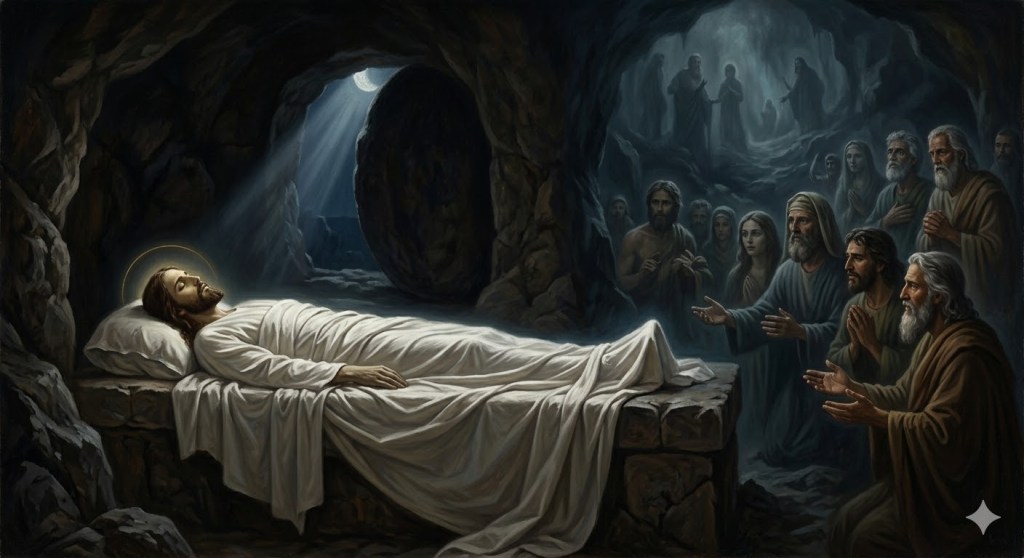
2. The Shock of Mortality For the Apostles, this Saturday was not a quiet day of reflection. It was a day of absolute, crushing terror and despair. They did not know the end of the story. They had seen their Master, the one they believed was the Messiah, betrayed, tortured, spat upon, and nailed to a tree like a common criminal. They had watched him die. They had helped to lower his cold body, wrap it in linen, and roll a heavy stone to seal him away.
On this day, the followers of Jesus were hiding in fear behind locked doors. They were confronting the grim reality that death, it appeared, had won. Their hopes were not just postponed; they were executed. The silent tomb was the definitive final period at the end of what they thought was the story of salvation. This Saturday is the liturgical commemoration of that absolute hopelessness. We must allow ourselves to feel the weight of it, or the resurrection will never truly be more than a theological concept.
Part II: Voices from the Great Tradition: The Theology of Descent
The Church Fathers and the Saints knew that Holy Saturday was not a passive day for God. It was perhaps the most active moment in history, but an action that was hidden beneath the cloak of apparent defeat.
3. Christ’s Descent into Sheol (Hades) In the Apostles’ Creed, we profess a startling and easily misunderstood line: Jesus “descended into hell.” This does not mean the hell of the damned (Gehenna). It refers to the Hebrew concept of Sheol, or the Greek Hades—the “abode of the dead,” the shadowy underworld where all humanity, righteous and unrighteous alike, awaited salvation before Christ.
On Holy Saturday, God is asleep in the flesh, but His divine nature is awake and active. The ancient and powerful Homily for Holy Saturday captures this perfectly:
“Something strange is happening—there is a great silence on earth today, a great silence and stillness. The whole earth keeps silence because its King is asleep. The earth trembled and is still because God has fallen asleep in the flesh and he has raised up all who have slept since the world began. God has died in the flesh and hell trembles with fear.”
This ancient homily describes Christ entering the dark realm like a triumphant conqueror, not a victim. He is not being punished in Hades; He is liberating it. The homily goes on to describe Jesus taking our first parent, Adam, by the hand, saying: “I command you: Awake, sleeper, I have not made you to be held a prisoner in hell. Rise, let us leave this place.”
This is the great work of Saturday: Jesus shattering the very gates of death from the inside out, making sure that death itself is no longer a dead-end, but a passageway to the Father.
4. St. Catherine of Siena and the Bridge of the Soul St. Catherine of Siena, in her Dialogue, speaks extensively about Christ as the “Bridge” that connects humanity to God. She teaches that through His suffering and death, He paved a path that we could traverse. On Holy Saturday, that bridge is finalized and tested.
She relates that the soul’s path to God must often “pass through the fog of the unknown.” We are not always given light. Sometimes, to test our love, God hides His presence. Holy Saturday is the supreme instance of God “hiding” His glory so that faith can truly mature. Catherine argues that it is easy to love God when we feel His consolation, but true virtue is forged in the silence, when we wait for Him even when we cannot see Him.
She writes that during this deep stillness, “The Lord manifests Himself as much or as little as He knows the person can receive.” The silence is not a punishment, but a preparation. The empty tomb of our heart is being expanded so that it can hold the infinite joy of the resurrection.
Part III: The Biblical Pattern of Waiting
5. Scriptural Foundations: Patient Hope Holy Saturday is the fulfillment of many of the deepest prayers of the Old Testament. We are reminded of the posture of Israel, waiting for centuries for a Messiah while enduring exile and silence.
- Psalm 130:5-6: “I wait for the Lord, my soul waits, and in his word I hope; my soul waits for the Lord more than watchmen for the morning, more than watchmen for the morning.” This psalm is the song of the watchman, standing in the pre-dawn darkness. He knows the sun will rise, but he still must endure the night. Holy Saturday is that night.
- Lamentations 3:25-26: “The Lord is good to those who wait for him, to the soul that seeks him. It is good that one should wait quietly for the salvation of the Lord.” Notice the word “quietly.” The prophet does not say “wait anxiously” or “wait complainingly.” The Saturday stillness is an opportunity for peaceful surrender to God’s perfect timing.
- 1 Peter 3:18-19: The apostle Peter gives us the key to what Jesus was doing: “For Christ also suffered once for sins, the righteous for the unrighteous, to bring you to God. He was put to death in the body but made alive in the Spirit. After being made alive, he went and made proclamation to the imprisoned spirits.” This is the scriptural foundation for the Descent into Hell. While His body lay still, His spirit was proclaiming freedom to those who had died before Him.
6. The Sabbath Rest of Creation There is also a profound parallel between Holy Saturday and the creation account in Genesis. In Genesis 2:2, we read that on the seventh day—the Sabbath—God “rested from all the work he had done.”
On Holy Saturday, the re-creation of the cosmos is complete. Christ has said “It is finished” on the cross, accomplishing the work of redemption. Now, on the new seventh day, He rests. This is the ultimate Sabbath, where the Word of God lies still, having finished His work of love, allowing the new creation to solidify beneath the surface before the sunrise of the eighth day (Sunday).
Part IV: A Story of Inspiration: The Mystery of the Chrysalis
We need analogies to understand the purpose of this apparent stagnation. We can look to the powerful and subtle mechanics of nature. Consider the butterfly.
7. Stagnation is Not Absence We all know the stages: the hungry caterpillar, the chrysalis (or cocoon), and then the butterfly. But we often speed past the middle stage. When the caterpillar forms its chrysalis, it looks like it has entered a tomb. The caterpillar is gone. What is inside is not just a caterpillar waiting to sprout wings. Inside that silent, brown shell, the caterpillar’s body is almost completely liquefied. The enzymes responsible for its original form have broken it down.
For weeks, it is just a pouch of dormant, cellular material. If you were to crack it open during that time, you would find nothing but stillness and apparently dead, mushy fluid.
But if you are a patient observer, you realize that something extraordinary is happening in that silent “tomb.” Within that fluid are special, tiny cells called “imaginal discs,” which had been dormant in the caterpillar. Now, in the stillness, in the total absence of the old form, these discs use the nutrient-rich fluid to construct the wings, antennae, legs, and delicate organs of the butterfly. The breakdown of the old life is the absolute necessary prerequisite for the construction of the new.
8. Holy Saturday as Our Chrysalis This is the spiritual power of Holy Saturday. When our life feels dissolved, when our certainty is liquefied, and we find ourselves in the “tomb” of circumstances—a serious illness, the loss of a relationship, the death of a dream, or a profound crisis of faith—we naturally assume that God has abandoned us. We see only the silent chrysalis, the dark tomb, and the mess of our own destruction.
But Holy Saturday teaches us that the silence is the chrysalis. It is the necessary stillness where God’s “imaginal discs”—His transformative grace—can work most effectively. He is breaking down what needs to die so that he can build what must live. We are not just caterpillars getting wings; we are sinners becoming saints. And that process must sometimes pass through the complete silence of Sheol.
Part V: Practical Application: The Ministry of Presence and Trust
So, how do we live “Holy Saturday” in our actual lives? It is not just a liturgical anniversary; it is a spiritual template for navigating the difficult middle of our stories.
9. The Discipline of Patient Silence The most difficult spiritual discipline is often waiting. We are an “on-demand” society. We want immediate answers to our prayers, and if God is silent, we quickly fill that void with noise, activity, or despair.
Practice intentional Holy Saturday waiting. Spend 15 minutes today in absolute silence. Do not ask God to solve problems. Do not seek feelings of consolation. Simply offer Him the silence of your own “tomb.” The empty tomb of your heart is an invitation for Him to enter and fill it. Trust that He is active in that space, even if you feel nothing. The greatest work often happens beneath the surface. Water the soil of the Chinese bamboo, as mentioned earlier, believing that the roots are growing even when the dirt is empty.
10. Accompanying Others in Their Saturday Holy Saturday is the quintessential day of the mourner. Mary, the apostles, and the other disciples were grieving. When you see someone in your life who is enduring a “Saturday” experience—whether they have lost a loved one, are facing a scary diagnosis, or are trapped in addiction—they do not need theological explanations or quick fixes.
They need your presence. They need you to sit with them in the silence. The greatest comfort we can offer is to “watch and pray” with them. By sitting quietly with a friend in their darkness, you mirror Christ’s presence to the souls in Sheol. Your silent solidarity is a powerful sign that they are not alone. You represent the Church, which keeps vigil with those who mourn.
11. Trusting the God of the Unknown Finally, we must learn the lesson of St. Catherine of Siena: to trust God even in the fog. Holy Saturday asks the question: “Do you believe God is God only when He is visible and triumphant?”
This day is our opportunity to answer, “No, I believe in God even when He is dead.” We believe that the silence is not failure; it is preparation. We believe that the cross of Good Friday was not the end. The heavy stone over the tomb is not final.
We wait with the Church. We wait in the Great Silence, not with anxiety, but with patient expectation. For we know that the silence is necessary, the darkness is finite, and the stone will be rolled away. When that happens, the joy will be all the more explosive because we have inhabited the quiet, and we have allowed the chrysalis to do its work.
 Nelson MCBS
Leave a comment