
1. Catholic Study Guide: 5 Pillars of Interpretation
If you are reading the Book of Revelation, keep these five principles in mind to stay grounded in the Church’s Tradition:
- The Liturgical Key: Always ask, “How does this look like the Mass?” (Altars, incense, robes, and the Lamb).
- The Old Testament Lens: Almost every symbol (the Ark, the Temple, the 144,000) is a “fulfillment” of a promise made to Israel.
- The Already/Not Yet: Christ has already won the victory (The Resurrection), but the full effects of that victory are not yet fully visible in the world.
- The Virgin Mary: Look for her in Chapter 12 as the “New Ark” who brings the Savior into a world at war with the Dragon.
- A Book of Hope: Revelation was written to comfort the persecuted, not to terrify the faithful. Its final word is always “Victory.”
2. Key Catholic Terms in Revelation
| Term | Catholic Definition & Significance |
| Apocalypse | From the Greek apokalypsis, meaning “Unveiling.” It is the lifting of the veil between Heaven and Earth. |
| Acedia | Spiritual lukewarmness. Specifically addressed in the letter to Laodicea; it is the “sickness” of being neither hot nor cold. |
| Beatific Vision | Seeing God “face to face” in the New Jerusalem. It is the ultimate goal of the Christian life (Rev 22:4). |
| Eschatology | The study of the “Last Things” (Death, Judgment, Heaven, and Hell). |
| Gematria | The Jewish practice of assigning numerical value to names (e.g., 666 for Nero Caesar). |
| Maranatha | An Aramaic phrase meaning “Come, Lord Jesus!” The final prayer of the Bible (Rev 22:20). |
| Parousia | The Second Coming of Christ in glory at the end of time. |
| The Marriage Supper | The eternal banquet in Heaven, which is made present on earth during every Holy Sacrifice of the Mass. |
| Typology | The study of how Old Testament people/objects (types) foreshadow New Testament realities (e.g., The Ark of the Covenant as a “type” of Mary). |
3. Notable “Sevens” in Revelation
The number seven represents perfection or completion in Hebrew thought.
- 7 Letters: To the Universal Church.
- 7 Seals: The unveiling of God’s plan for history.
- 7 Trumpets: Ecological and social warnings to repent.
- 7 Bowls (Vials): The fullness of God’s justice against unrepentant evil.
- 7 New Things: In the final chapters (New Heaven, New Earth, New Jerusalem, etc.).
4. Short Summary of the “Storyline”
- Opening (Ch. 1-3): Jesus visits His Church on earth and calls them to repent and endure.
- The Heavenly Court (Ch. 4-5): A vision of the Mass in Heaven; only the Lamb can open the scroll of history.
- The Trials (Ch. 6-11): Seals, Trumpets, and the struggle of the Church to witness to a hostile world.
- The Cosmic War (Ch. 12-14): The Dragon attacks the Woman and her Child; the Beasts demand worship.
- The Harvest & Fall (Ch. 15-20): God’s justice is poured out; “Babylon” (the world system) falls.
- The Wedding (Ch. 21-22): Heaven and Earth are joined; God wipes away every tear.
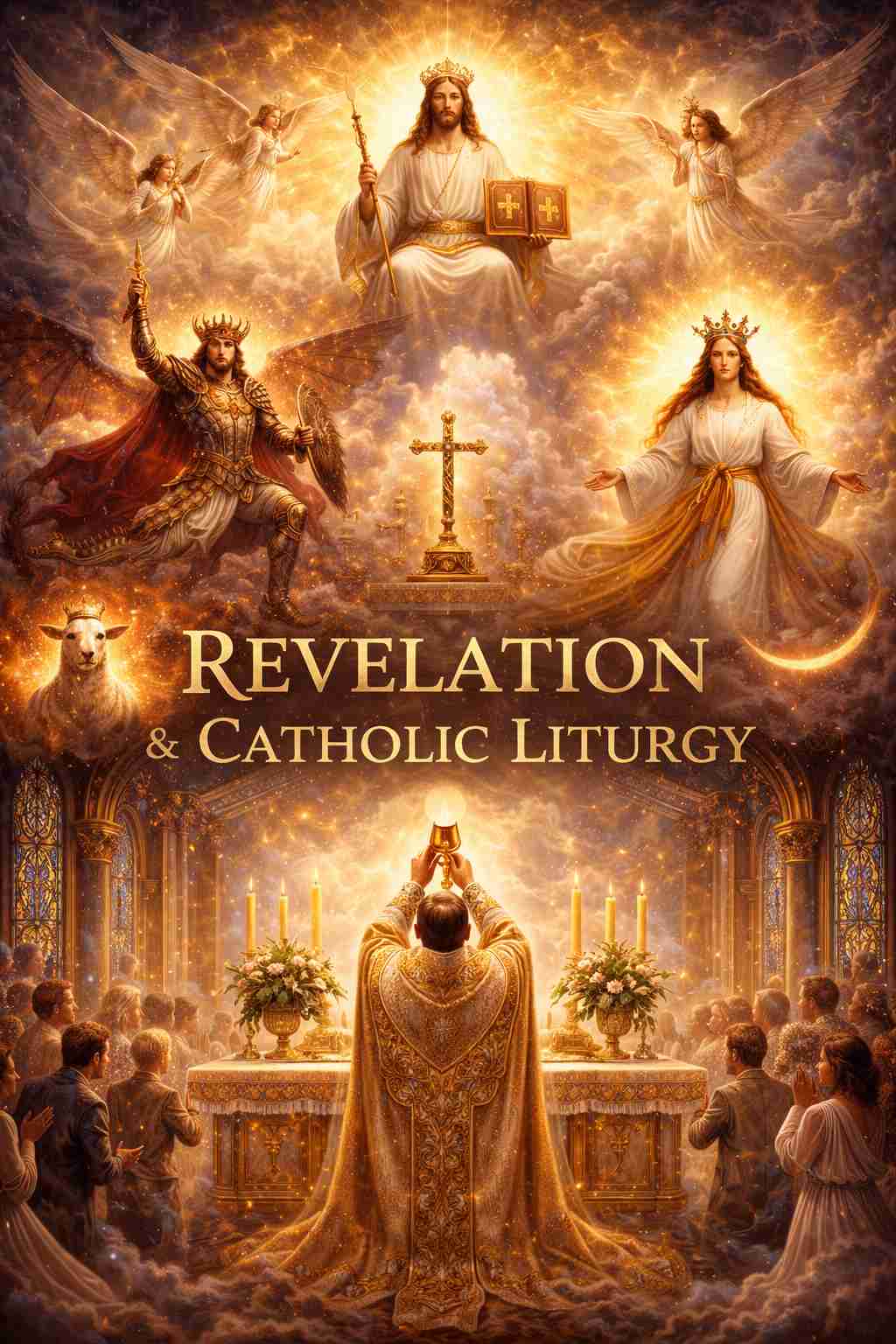
Entering the Divine Mystery: Revelation and the Catholic Liturgy
The Book of Revelation is more present in the Catholic Mass than perhaps any other book of the Bible. When you attend Mass, you are not just hearing words from the Apocalypse; you are actually stepping into the vision John described.
Here is a guide to the specific verses from Revelation that form the backbone of the Catholic Liturgy.
1. The Opening Rite: The “Holy, Holy, Holy”
In every Mass, during the Preface before the Eucharistic Prayer, the congregation sings the Sanctus. This is taken directly from the heavenly liturgy John witnessed.
- Revelation 4:8: “And the four living creatures… day and night they never cease to say, ‘Holy, holy, holy, is the Lord God Almighty, who was and is and is to come!’”
- Liturgy Connection: We join our voices with the angels and saints, acknowledging that the sanctuary of the parish has become the throne room of Heaven.
2. The Penitential Act: The “Lord Have Mercy”
Before the letters to the seven churches, Jesus appears to John and calls the churches to repentance.
- Revelation 3:19: “Those whom I love, I reprove and chasten; so be zealous and repent.”
- Liturgy Connection: The Kyrie Eleison (Lord Have Mercy) at the beginning of Mass reflects the same “self-examination” Jesus demands of the seven churches in Chapters 2 and 3.
3. The Gloria: The Song of Victory
The Gloria is a compilation of various biblical hymns, many of which echo the songs of the “Great Multitude” in Revelation.
- Revelation 15:3-4: “Great and wonderful are your deeds, O Lord God the Almighty! Just and true are your ways, O King of the ages! … For you alone are holy.”
- Liturgy Connection: We sing this to celebrate the victory of the Lamb over sin, echoing the heavenly choir’s praise of God’s “mighty deeds.”
4. The Liturgy of the Eucharist: The Lamb of God
The most explicit connection occurs right before Communion. The priest holds up the Host and says: “Behold the Lamb of God… Blessed are those called to the supper of the Lamb.”
- Revelation 5:6: “And between the throne and the four living creatures and among the elders, I saw a Lamb standing, as though it had been slain…”
- Revelation 19:9: “And the angel said to me, ‘Write this: Blessed are those who are invited to the marriage supper of the Lamb.’”
- Liturgy Connection: In the Catholic view, the Eucharist is the Marriage Supper of the Lamb. We are invited to consume the Lamb who was slain but now stands alive.
5. The Incense and the Altar
While not a specific “spoken” verse, the physical environment of the Mass is mandated by the imagery of Revelation.
- Revelation 8:3-4: “And another angel came and stood at the altar with a golden censer; and he was given much incense to mingle with the prayers of all the saints upon the golden altar before the throne.”
- Liturgy Connection: The use of incense in a High Mass is a biblical sign that our prayers are rising to God’s throne, exactly as John saw in his vision.
6. The Concluding Blessing: The “Amen”
The word “Amen” appears more in Revelation than in any other New Testament book, often as a thunderous response to God’s glory.
- Revelation 7:12: “Amen! Blessing and glory and wisdom and thanksgiving and honor and power and might be to our God for ever and ever! Amen.”
- Liturgy Connection: The “Great Amen” at the end of the Eucharistic Prayer is the most important “Amen” of the Mass, where the congregation ratifies the entire sacrifice offered to the Father.
Summary Checklist: What to look for at Mass
| Liturgical Action | Revelation Verse |
| Priest’s Robes | Rev 1:13 (Christ in a long robe with a golden sash). |
| Candles on the Altar | Rev 1:12 (The seven golden lampstands). |
| The “Gloria” | Rev 15:3 (The Song of the Lamb). |
| The “Holy, Holy, Holy” | Rev 4:8 (The song of the four living creatures). |
| The “Lamb of God” | Rev 5:6 (The Lamb standing as if slain). |
| The “Amen” | Rev 22:21 (The final word of the Apocalypse). |
 Nelson MCBS
Leave a comment