
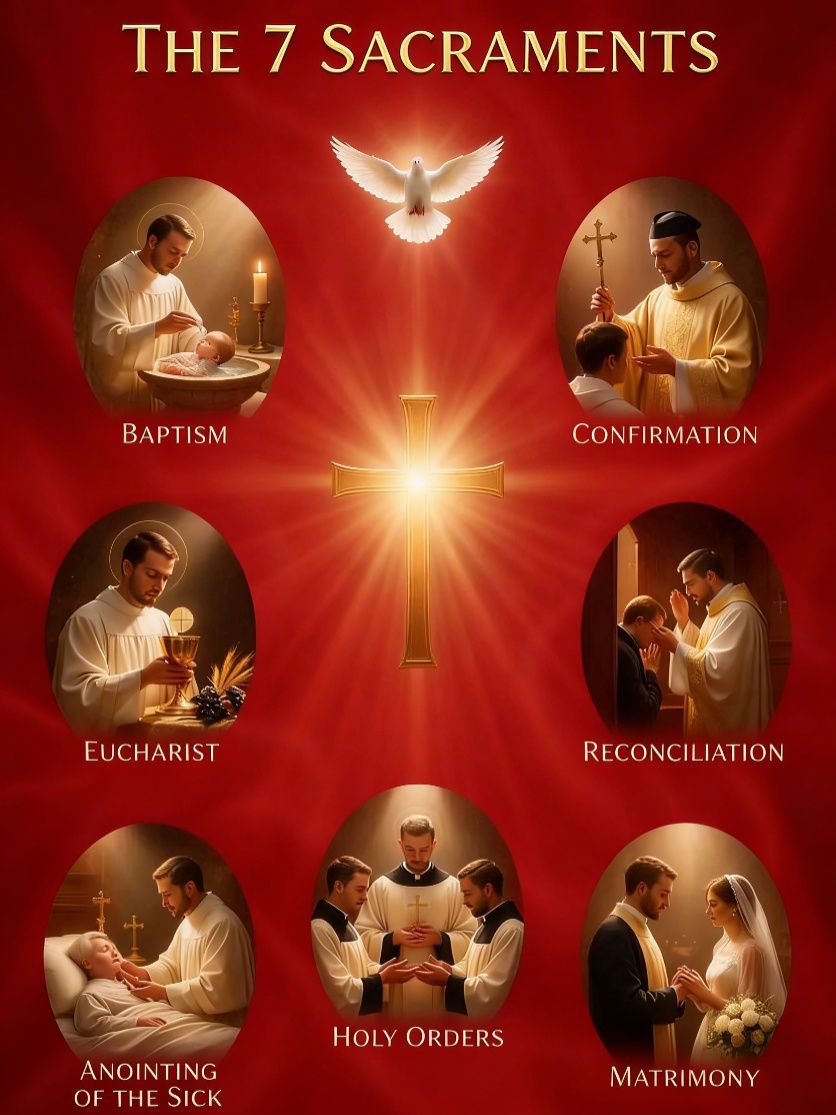
7 Sacraments
1. Baptism
The first and foundational sacrament of initiation. Through water and the words “I baptize you in the name of the Father, and of the Son, and of the Holy Spirit,” a person is cleansed from original sin (and any personal sin, if an adult), becomes a child of God, and is welcomed into the Catholic Church and the family of believers.
Symbolism:
Water (purification and new life), white garment (purity), candle (light of Christ).
Key purpose:
Marks the beginning of life in Christ.
2. Confirmation
The second sacrament of initiation, often received during adolescence or adulthood. The bishop (or delegated priest) anoints the person with sacred chrism oil and lays hands on them, calling down the Holy Spirit. It deepens the grace received at Baptism and “confirms” the person’s faith and commitment to live as a witness of Christ.
Symbolism:
Chrism oil (seal of the Spirit), laying on of hands, the sign of the cross on the forehead.
Key purpose:
Empowers believers to live out their faith and share the Gospel.
3. Eucharist (Holy Communion)
The central and most important sacrament, also part of initiation. During Mass, bread and wine are transformed—through the power of God—into the Body and Blood of Christ (a belief called transubstantiation). Receiving the Eucharist unites believers with Jesus and with one another in the Church.
Symbolism:
Bread and wine, representing Christ’s sacrifice and the spiritual food He gives us.
Key purpose:
Nourishes our soul, strengthens our bond with God and the community, and makes present Christ’s sacrifice on the cross.
4. Reconciliation (Confession / Penance)
The sacrament of healing and forgiveness. Believers confess their sins to a priest, express sorrow, and receive absolution (forgiveness) from God through the priest. It restores our relationship with God and the Church after we have sinned.
Symbolism:
The act of confession, words of absolution, the sign of the cross.
Key purpose:
Grants God’s mercy, heals spiritual wounds, and helps us grow in holiness.
5. Anointing of the Sick
Another sacrament of healing, given to those who are seriously ill, facing surgery, or near death. A priest anoints the person with blessed oil and prays over them, asking God for physical strength, spiritual comfort, forgiveness of sins, and peace.
Symbolism:
Oil of the Sick, laying on of hands, prayers for healing.
Key purpose:
Brings God’s comfort and grace in times of suffering, and prepares the soul for eternal life if needed.
6. Holy Orders
The sacrament of service and ministry, through which men are ordained as deacons, priests, or bishops. They receive a special outpouring of the Holy Spirit to serve the Church: preaching the Gospel, celebrating the sacraments, and guiding the community.
Symbolism:
Laying on of hands, prayer of consecration, sacred vestments.
Key purpose:
Sets apart men to act as Christ’s representatives and serve the spiritual needs of the faithful.
7. Matrimony (Marriage)
A covenant between a man and a woman, who freely give themselves to each other for life, forming a family and reflecting God’s love for His people. Through this sacrament, couples receive grace to love one another faithfully, raise children in the faith, and serve the community.
Symbolism:
Exchange of vows, wedding rings (sign of commitment), joining of hands.
Key purpose:
Establishes a sacred bond, builds up the family as the “domestic church,” and witnesses to God’s love in the world.
Source: Catechists of St. Francis Xavier
Leave a Reply