
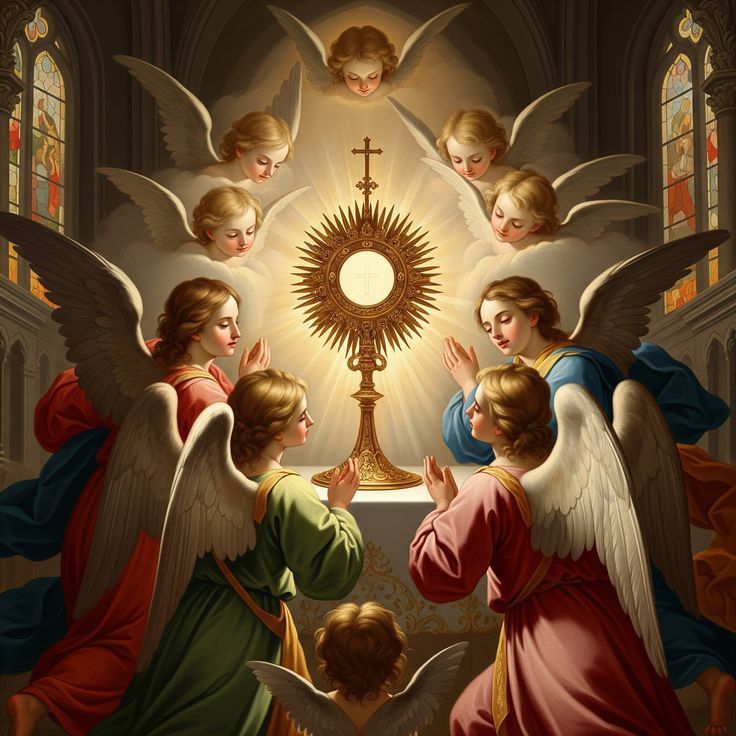
St. Ignatius of Antioch and His Teachings on the Eucharist
A Martyr’s Witness to the Real Presence of Christ
Introduction: A Voice from the Dawn of Christianity
In the early years of Christianity, when the memory of the Apostles was still fresh and the Church was finding its identity amid persecution and doctrinal confusion, a powerful voice emerged—clear, uncompromising, and deeply Eucharistic. That voice belonged to St. Ignatius of Antioch.
Ignatius does not speak to us as a distant theologian removed from the struggles of life. He writes as a bishop, a pastor, a disciple of the Apostles, and ultimately, as a martyr on the road to death. His words carry a rare authority—formed not only by doctrine but by sacrifice.
Among the many themes present in his writings, one shines with particular clarity: the Eucharist as the true Body and Blood of Jesus Christ. Long before theological formulas were defined in councils, Ignatius boldly proclaims what the Church believed from the beginning—that in the Eucharist, Christ is truly present.
This article explores the life of Ignatius, the historical context in which he wrote, and most importantly, his profound teaching on the Eucharist—a teaching that continues to shape Catholic faith and devotion even today.
1. The Life and Apostolic Roots of Ignatius
Antioch was one of the most vibrant centers of early Christianity. It was here that followers of Jesus were first called “Christians,” and it was here that Ignatius served as bishop.
Tradition holds that Ignatius was a disciple of St. John the Apostle. If this is true, then Ignatius stands as a direct link between the Apostolic age and the developing Church. His theology, therefore, is not speculative—it is inherited.
During the reign of Emperor Trajan, persecution of Christians intensified. Ignatius was arrested and sentenced to death. Rather than being executed locally, he was transported to Rome, likely to be thrown to wild beasts in a public spectacle.
It is during this journey—guarded by soldiers, uncertain of his fate—that Ignatius writes his famous letters. These letters, addressed to Christian communities in cities like Ephesus, Magnesia, Tralles, Rome, Philadelphia, and Smyrna, as well as to St. Polycarp, are among the earliest Christian writings outside the New Testament.
They are urgent, passionate, and filled with theological clarity—especially regarding the Eucharist.
2. The Historical Context: Faith Under Pressure
To fully appreciate Ignatius’ teaching, we must understand the challenges faced by the early Church.
Christianity was still a minority religion, often misunderstood and frequently persecuted. But external persecution was not the only threat. Internal doctrinal confusion also posed serious dangers.
One of the most significant heresies of the time was Docetism—the belief that Christ only appeared to have a human body but did not truly become flesh. This idea undermined the very foundation of Christianity:
- If Christ did not truly become human,
- then He did not truly suffer,
- and if He did not truly suffer,
- then redemption itself is called into question.
For Ignatius, this was not a minor theological disagreement—it was a direct attack on the heart of the Gospel.
And it is precisely here that the Eucharist becomes central.
3. The Eucharist as the Flesh of Christ
In one of his most direct and powerful statements, Ignatius writes in his Letter to the Smyrnaeans:
“They abstain from the Eucharist and from prayer, because they do not confess that the Eucharist is the flesh of our Savior Jesus Christ…”
This sentence is revolutionary in its clarity.
Ignatius does not say the Eucharist represents Christ.
He does not say it is a symbol of Christ.
He says it is the flesh of Jesus Christ.
This teaching rests on three essential convictions:
a. Continuity with the Incarnation
The same Christ who was born of Mary, who suffered on the cross, and who rose from the dead is present in the Eucharist.
b. Reality, Not Symbolism
For Ignatius, the Eucharist is not merely a memorial. It is a real participation in Christ Himself.
c. Faith as Recognition
To deny the Eucharist is to fail to recognize the truth of Christ’s incarnation.
Ignatius’ language is striking because it reflects what the Church would later define more precisely—but the belief is already fully present.
4. The Eucharist as the “Medicine of Immortality”
Perhaps the most famous phrase associated with Ignatius comes from his Letter to the Ephesians:
“The Eucharist is the medicine of immortality, the antidote against death, and everlasting life in Jesus Christ.”
This description opens a deeply spiritual understanding of the Eucharist.
a. Healing the Human Condition
Human beings are marked by sin, weakness, and mortality. The Eucharist, for Ignatius, is not merely a sign of grace—it is grace itself given as nourishment.
b. Antidote to Death
Death entered the world through sin, but Christ conquered death through His resurrection. The Eucharist allows believers to participate in that victory.
c. Foretaste of Eternal Life
Each reception of the Eucharist is a glimpse of heaven—a participation in the eternal life promised by Christ.
This imagery is both pastoral and mystical. It speaks not only to the mind but to the deepest longing of the human heart.
5. The Eucharist and the Unity of the Church
Ignatius repeatedly emphasizes that the Eucharist cannot be separated from the unity of the Church.
He insists that the Eucharist must be celebrated:
- In communion with the bishop
- Within the visible community of believers
- As an expression of unity in Christ
He writes:
“Where the bishop appears, there let the people be; just as where Jesus Christ is, there is the Catholic Church.”
This statement is one of the earliest uses of the term “Catholic Church.”
For Ignatius:
- The Eucharist is not a private act
- It is not an individual experience
- It is the act of the whole Church
To receive the Eucharist is to be united not only with Christ, but with His Body—the Church.
6. The Eucharist as Sacrifice
Although Ignatius does not use later technical language, his writings strongly imply a sacrificial understanding of the Eucharist.
The connection is clear:
- Christ offered His body on the cross
- That same body is given in the Eucharist
- Therefore, the Eucharist makes present the sacrifice of Christ
This is why Ignatius sees the Eucharist as central to Christian life. It is not just nourishment—it is participation in the saving act of Christ.
7. A Martyr’s Desire: Hunger for the Bread of God
Ignatius’ teaching becomes even more powerful when we consider his personal situation.
He is on his way to martyrdom.
He knows that he will soon die.
And yet, he writes:
“I desire the bread of God, which is the flesh of Jesus Christ…”
This is not poetic language—it is a confession of faith.
Ignatius longs for the Eucharist even as he prepares to give his own life. In a profound sense, his martyrdom becomes Eucharistic:
- Christ gives His body
- Ignatius offers his life
- Both are acts of love and surrender
He even describes himself as “God’s wheat,” to be ground by the teeth of wild beasts so that he may become “pure bread for Christ.”
This imagery reveals a deep spiritual truth:
the Eucharist shapes the life of the believer into the pattern of Christ’s self-giving love.
8. Confronting Error: A Defense of Eucharistic Faith
Ignatius’ strong language is not accidental—it is directed against real threats.
Those who denied the reality of Christ’s flesh also denied the reality of the Eucharist. Ignatius sees this as a dangerous distortion of the Gospel.
His response is firm:
- True faith recognizes Christ in the Eucharist
- False teaching leads people away from it
- Separation from the Eucharist means separation from life
This clarity is striking, especially in an age often uncomfortable with definitive statements.
Ignatius does not seek compromise. He seeks truth.
9. Continuity with Later Church Teaching
What makes Ignatius particularly important is how closely his teaching aligns with later doctrinal developments.
Centuries later, the Church would articulate the doctrine of the Real Presence and the concept of transubstantiation. While Ignatius does not use these terms, his belief is unmistakably the same:
- The Eucharist is truly Christ
- It is not merely symbolic
- It is the source of life and unity
This continuity shows that Eucharistic faith was not a later invention—it was present from the beginning.
10. Relevance for the Modern Church
Ignatius’ teaching is not only historically important—it is spiritually urgent for today.
a. Recovering Reverence
In a world where the sacred is often treated casually, Ignatius calls us back to awe and reverence.
b. Deepening Faith
His words challenge superficial understandings of the Eucharist and invite deeper belief.
c. Living Eucharistically
To receive the Eucharist is to become like Christ—self-giving, loving, and united with others.
d. Strength in Suffering
Ignatius shows us that the Eucharist is strength for trials, not escape from them.
Conclusion: A Witness That Still Speaks
St. Ignatius of Antioch stands at the crossroads of history—between the Apostles and the developing Church, between persecution and proclamation, between life and martyrdom.
His voice is clear:
- The Eucharist is the flesh of Christ
- It is the medicine of immortality
- It is the source of unity
- It is the center of Christian life
He does not argue from theory—he speaks from faith, from tradition, and ultimately, from sacrifice.
In an age of confusion and doubt, Ignatius invites us to return to the heart of the mystery—to approach the Eucharist not as a symbol to be analyzed, but as a reality to be received with faith.
And in doing so, we discover what he knew so well:
that in the Eucharist, we encounter not just a sign of Christ—but Christ Himself.
Leave a Reply