
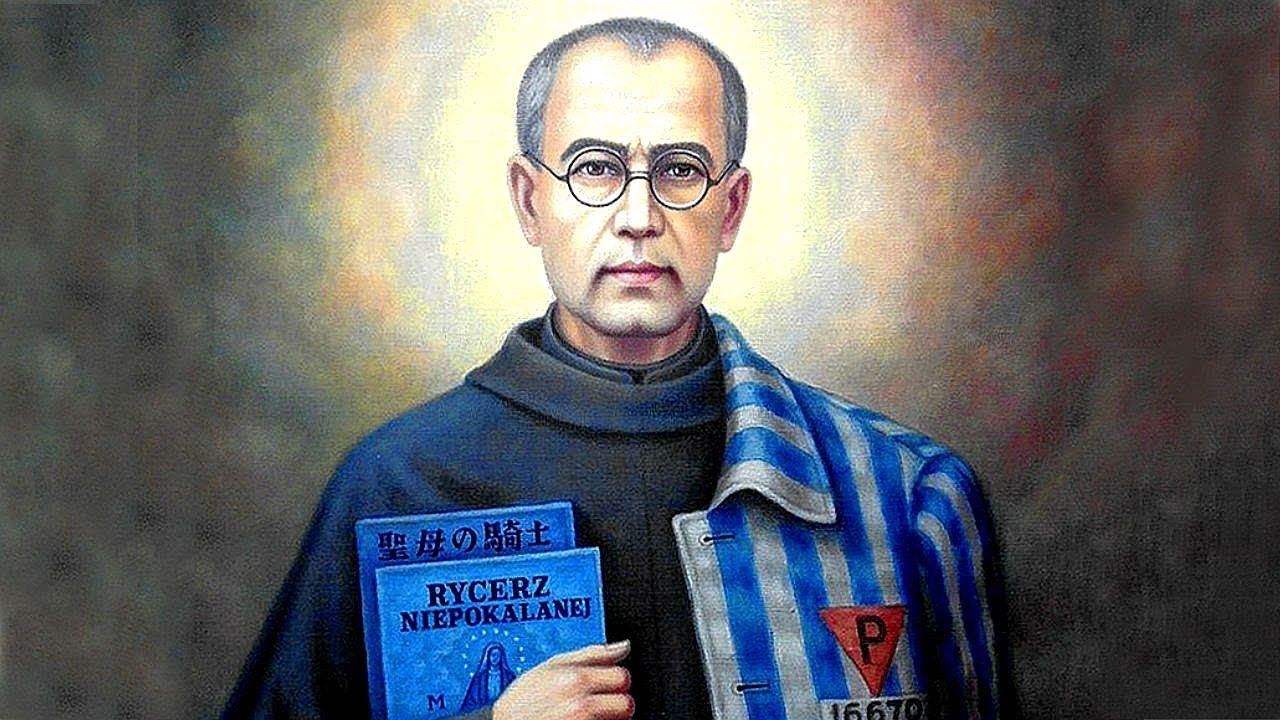
“Greater love has no one than this: to lay down one’s life for one’s friends.” (John 15:13)
Among the countless saints of the twentieth century, few shine as brightly as Saint Maximilian Kolbe. His life stands as one of the greatest modern examples of Christian love, Marian devotion, missionary zeal, and heroic sacrifice. In the darkness of one of history’s most terrible places—the Nazi concentration camp of Auschwitz—he revealed the power of Christ’s love by voluntarily offering his life in exchange for another prisoner.
His witness demonstrates that even in the midst of hatred, cruelty, and death, love remains stronger than evil. For this reason, he is remembered not merely as a martyr but as the “Martyr of Charity,” a saint whose life continues to inspire millions across the world.
Early Life
Saint Maximilian Kolbe was born as Raymund Kolbe on January 8, 1894, in Zduńska Wola, Poland, which at the time was under Russian occupation. He was the second of five sons born to Julius Kolbe and Maria Dąbrowska, a deeply religious Catholic family. From an early age, Raymund displayed remarkable intelligence, sensitivity, and a deep love for prayer. (Vatican News)
A defining moment in his childhood occurred when he was about twelve years old. After being corrected by his mother for mischievous behavior, he prayed fervently before an image of the Blessed Virgin Mary, asking what would become of him.
According to his own testimony, Mary appeared holding two crowns:
- a white crown, symbolizing purity,
- a red crown, symbolizing martyrdom.
She asked whether he was willing to accept them. Raymund answered that he accepted both.
This mystical experience shaped the entire course of his life, preparing him for a future marked by holiness and heroic sacrifice. (Vatican News)
Joining the Franciscans
In 1907, Raymund entered the Conventual Franciscan minor seminary together with his older brother Francis. Three years later he entered the novitiate and received the religious name Maximilian.
He made his solemn vows in 1914 and later added the name Maria, expressing his profound love for the Blessed Virgin.
His theological studies took him to Rome, where he earned doctorates in philosophy and theology. Even during his student years, he was known for exceptional academic ability, deep spirituality, and an unwavering commitment to defending the Catholic faith. (Wikipedia)
Founder of the Militia of the Immaculata
While studying in Rome, Maximilian witnessed increasing hostility toward Christianity and the Church.
In response, in 1917 he founded the Militia Immaculatae (Militia of the Immaculate).
Its mission was simple yet profound:
- to lead all people to Christ through Mary,
- to promote holiness,
- to combat evil through prayer,
- to evangelize using every legitimate means available.
He believed that complete consecration to Mary was the quickest path to Jesus.
His famous motto became:
“Never be afraid of loving the Blessed Virgin too much. You can never love her more than Jesus did.”
The movement spread rapidly across Europe and later throughout the world, remaining active today. (Vatican News)
A Pioneer of Catholic Media
Father Kolbe understood that modern communication could become a powerful tool for evangelization.
Rather than limiting his ministry to preaching, he embraced the latest technology of his time.
He founded the magazine Knight of the Immaculate (Rycerz Niepokalanej), which eventually reached nearly one million readers.
Soon he established:
- publishing houses,
- printing presses,
- radio broadcasting,
- newspapers,
- Catholic literature distribution.
His monastery at Niepokalanów (“City of the Immaculate”), founded near Warsaw in 1927, became one of the largest Franciscan monasteries in the world, housing hundreds of friars dedicated to evangelization and Marian devotion. (Vatican News)
Missionary to Japan
Saint Maximilian’s missionary vision extended far beyond Europe.
In 1930, he traveled to Japan despite knowing almost nothing of the language.
Against enormous odds, he established:
- a Franciscan monastery,
- a seminary,
- a publishing house,
- a Japanese edition of the Knight of the Immaculate.
Remarkably, he built the monastery in Nagasaki on a hillside that many considered unsuitable.
Years later, when the atomic bomb devastated Nagasaki in 1945, the monastery survived because of its location—a fact many have regarded as providential. (Vatican News)
He also spent time in India and dreamed of establishing Marian missionary centers throughout Asia.
The Outbreak of World War II
When World War II began in 1939, Father Kolbe returned to Poland.
The Nazis occupied the country with extraordinary brutality.
Despite grave danger, he transformed the monastery into a refuge for thousands of displaced persons, including approximately 2,000 Jews, offering them food, shelter, and protection. He also continued publishing writings that defended human dignity and condemned hatred and violence. (Vatican News)
Arrest by the Nazis
Because of his religious activities and refusal to cooperate with the occupying forces, Father Kolbe was arrested by the German Gestapo.
On May 28, 1941, he was transferred to the Auschwitz concentration camp.
His prisoner number was 16670.
Even in the camp, he continued his priestly ministry.
He:
- comforted fellow prisoners,
- secretly heard confessions,
- encouraged hope,
- shared food despite his own hunger,
- forgave his persecutors.
Prisoners later testified that simply seeing Father Kolbe strengthened their courage.
The Greatest Act of Charity
In July 1941, a prisoner escaped from Auschwitz.
As punishment, the camp authorities selected ten prisoners to die by starvation.
One of them, Franciszek Gajowniczek, cried out:
“My wife! My children!”
At that moment, Father Kolbe stepped forward.
He calmly removed his cap and addressed the Nazi officer.
“I am a Catholic priest. I wish to die in place of that man.”
To everyone’s astonishment, the officer accepted.
Father Kolbe entered the starvation bunker while the husband and father was spared.
It remains one of the most extraordinary acts of self-sacrificial love in modern history. (Vatican News)
The Starvation Bunker
Witnesses later recalled that the bunker became unlike any other.
Instead of screams and despair, they heard:
- hymns,
- prayers,
- the Rosary,
- songs to the Blessed Virgin Mary.
Father Kolbe encouraged the dying prisoners until only he remained alive after about two weeks without food or water.
The guards, needing the cell for other prisoners, ended his life with a lethal injection of carbolic acid on August 14, 1941, the vigil of the Solemnity of the Assumption of Mary.
He calmly raised his arm to receive the injection, completing the offering of his life. (Vatican News)
Beatification and Canonization
The Church soon recognized the extraordinary holiness of Father Kolbe.
- Declared Servant of God: 1955
- Declared Venerable: 1969
- Beatified: October 17, 1971, by Pope Paul VI
- Canonized: October 10, 1982, by Pope John Paul II
During the canonization ceremony, the man whose life Kolbe had saved—Franciszek Gajowniczek—was present in St. Peter’s Square, a moving testament to the saint’s sacrifice.
Pope John Paul II proclaimed Maximilian Kolbe not only a martyr but a “Martyr of Charity,” emphasizing that he freely gave his life out of Christian love. (Wikipedia)
Patron Saint
Saint Maximilian Kolbe is the patron saint of:
- Prisoners
- Families
- Journalists
- Amateur radio operators
- Drug addicts
- The pro-life movement
- People struggling with addiction
His feast day is celebrated each year on August 14. (Catholic Online)
Spiritual Legacy
Saint Maximilian taught that true holiness is found in complete self-giving.
Some of his most memorable sayings include:
“Only love creates.”
“Hatred is not a creative force. Only love is creative.”
“Prayer changes the world.”
“If angels could be jealous of men, they would be so for one reason: Holy Communion.”
His spirituality combined:
- profound Marian devotion,
- complete trust in Divine Providence,
- missionary zeal,
- fearless courage,
- total self-sacrifice.
Lessons from Saint Maximilian Kolbe
His life offers enduring lessons for Christians today:
1. Love is stronger than hatred
Even amid the horrors of Auschwitz, Kolbe responded to violence not with revenge but with love, proving that charity can triumph over evil.
2. Mary always leads to Christ
His lifelong devotion to the Blessed Virgin deepened—not diminished—his love for Jesus, illustrating authentic Marian spirituality.
3. Every Christian is a missionary
Kolbe embraced every available means of communication—print, radio, and publishing—to proclaim the Gospel. His example challenges today’s believers to use modern media responsibly for evangelization.
4. Holiness demands sacrifice
Kolbe’s supreme act of offering his life reminds us that authentic Christian discipleship is rooted in self-giving love.
5. Hope survives even in darkness
His peaceful witness in Auschwitz demonstrates that no suffering can extinguish the light of Christ for those who trust in God.
Conclusion
Saint Maximilian Kolbe stands among the greatest witnesses of Christian charity in modern history. Priest, missionary, publisher, Marian apostle, and martyr, he transformed every stage of his life into an offering to God. His voluntary sacrifice in Auschwitz remains a timeless embodiment of Christ’s words: “Greater love has no one than this: to lay down one’s life for one’s friends.”
In an age often marked by selfishness, violence, and division, Saint Maximilian Kolbe reminds us that genuine love is stronger than hatred, hope is stronger than despair, and faith is stronger than fear. His extraordinary witness continues to inspire the faithful to live courageously, to trust completely in God through the intercession of the Blessed Virgin Mary, and to serve others with selfless generosity.
“Saint Maximilian Kolbe, Martyr of Charity and Apostle of the Immaculate, pray for us.”
Leave a Reply