
“Standing by the cross of Jesus were His mother, and His mother’s sister, Mary the wife of Clopas, and Mary Magdalene.” (John 19:25)
Introduction
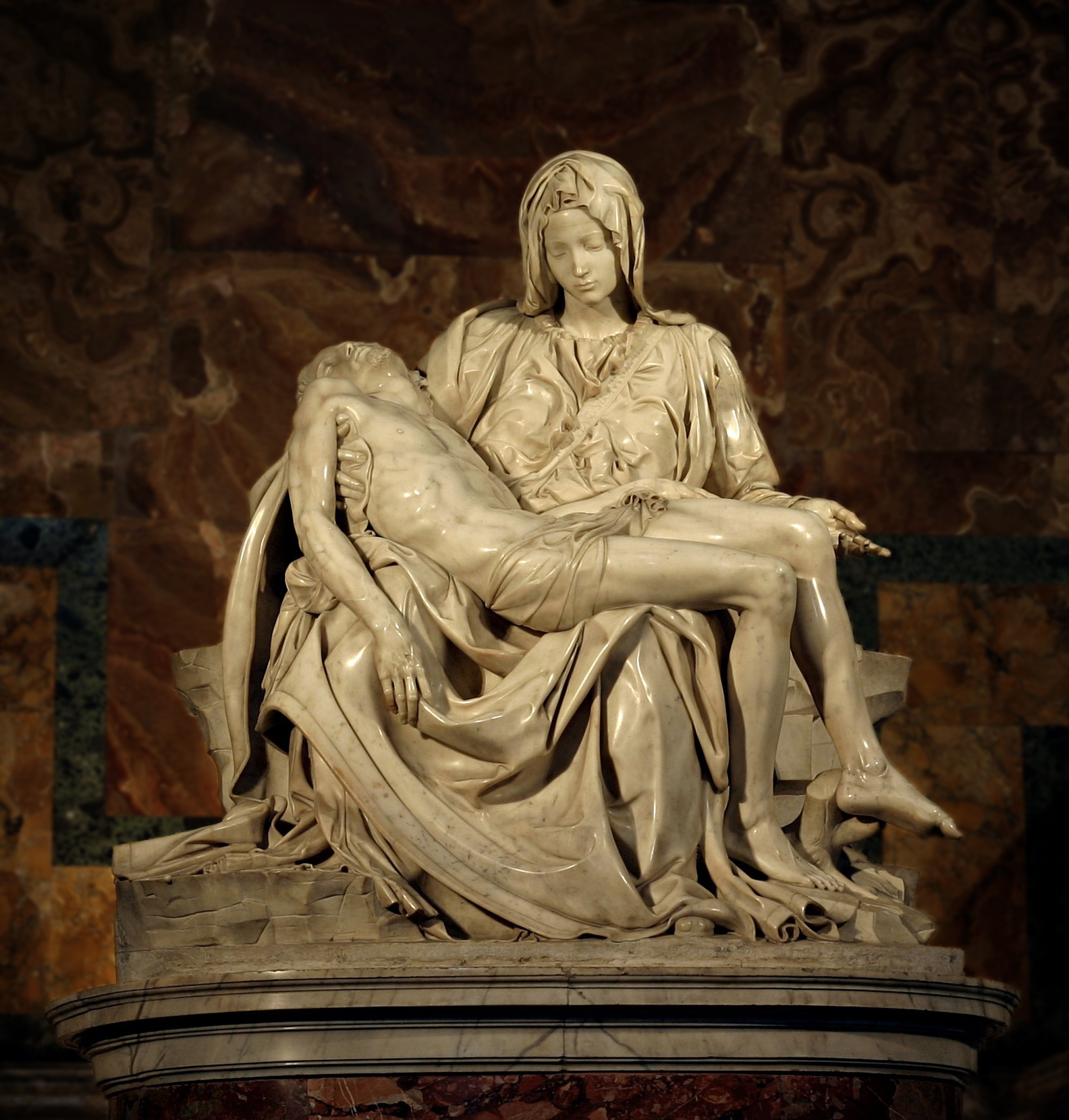
Few works of art have captured the mystery of Christ’s Passion with as much tenderness, beauty, and theological depth as The Pietà, Michelangelo Buonarroti’s celebrated marble sculpture housed in St. Peter’s Basilica in Vatican City. Created when the artist was only twenty-four years old, the sculpture has become one of the greatest masterpieces in the history of Western art and one of the most profound visual meditations on the suffering, love, and hope at the heart of Christianity.
The word Pietà comes from the Italian term meaning “pity,” “compassion,” or “mercy.” In Christian art, it refers to the moment when the Blessed Virgin Mary cradles the lifeless body of her Son, Jesus Christ, after He has been taken down from the Cross. Although this scene is not described explicitly in the Gospels, it has been contemplated for centuries in Christian devotion as an expression of a mother’s sorrow and God’s redeeming love.
Michelangelo’s Pietà is more than a sculpture. It is a silent sermon in marble—a work that invites believers to contemplate the mystery of the Cross, the love of Christ, and the steadfast faith of the Mother of God.
The Biblical Background
The Gospels tell us that after Jesus died on the Cross, His body was entrusted to Joseph of Arimathea, a respected member of the Jewish council who had become a disciple of Jesus. With the assistance of Nicodemus, Joseph received permission from Pontius Pilate to remove Christ’s body from the Cross and prepare it for burial (John 19:38–42).
Although Scripture does not explicitly state that Mary held her Son’s body before it was placed in the tomb, the Gospel of John tells us that she remained faithfully at the foot of the Cross until the end (John 19:25–27). From this biblical foundation grew a rich tradition in Christian art and spirituality depicting Mary receiving the body of Jesus in her arms.
The Pietà therefore represents a moment of profound silence between the Crucifixion and the Burial—a sacred pause in which the Mother contemplates the sacrifice of her Son.
Michelangelo: The Young Genius
Michelangelo Buonarroti (1475–1564) was one of the towering figures of the Italian Renaissance. A sculptor, painter, architect, and poet, he regarded sculpture as the highest form of artistic expression, believing that the figure already existed within the marble and that the artist merely revealed it.
In 1498, the French Cardinal Jean de Bilhères commissioned Michelangelo to create a sculpture for his funeral chapel in Old St. Peter’s Basilica. The young artist accepted the challenge and completed the work in less than two years.
When the sculpture was unveiled in 1499, it astonished Rome. Viewers marveled at its extraordinary realism, delicate craftsmanship, and spiritual beauty. It established Michelangelo’s reputation as one of the greatest sculptors of his age.
Description of the Sculpture
Carved from a single block of flawless Carrara marble, the sculpture stands approximately 1.74 meters (5 feet 8 inches) high and nearly 2 meters (6 feet 6 inches) wide.
At its center sits the Virgin Mary, clothed in flowing robes, supporting the lifeless body of Jesus across her lap.
Christ’s head falls gently backward.
His right arm hangs downward.
The wounds of the Crucifixion remain visible but are not exaggerated.
Mary gazes quietly upon her Son—not with dramatic despair but with profound serenity and acceptance.
One hand supports Christ’s body.
The other extends outward in a gesture that seems both to present Him to the world and to surrender Him to the Father’s will.
The entire composition forms a stable triangular shape, a hallmark of Renaissance art that symbolizes harmony, balance, and spiritual perfection.
Mary’s Youthful Appearance
One of the first features noticed by viewers is Mary’s youthful face.
At the time of Christ’s Crucifixion, Mary would likely have been around fifty years old. Yet Michelangelo portrays her as a young woman.
Why?
The answer lies in theology rather than historical realism.
Michelangelo wished to express Mary’s perpetual purity and spiritual beauty. Her youthful appearance symbolizes the incorruptibility of grace and the holiness of the woman chosen to become the Mother of God.
The Renaissance artist and biographer Giorgio Vasari explained that Michelangelo believed purity preserves beauty. Mary’s youthful face reflects not physical age but the eternal freshness of a soul completely united with God.
Thus, Mary is portrayed not merely as an aging mother but as the ever-virgin Mother of the Redeemer.
The Peaceful Face of Christ
Despite the agony of the Passion, Jesus’ face appears calm.
There is no distortion of pain.
No expression of terror.
Instead, Christ seems to rest peacefully.
Michelangelo emphasizes that Christ’s suffering has fulfilled its purpose.
His mission is complete.
Death has not defeated Him.
Rather, He has freely embraced death in obedience to the Father.
This peaceful expression foreshadows the Resurrection.
The body appears lifeless, yet it retains dignity, beauty, and quiet majesty.
The sculpture reminds believers that the Cross is not the end of Christ’s story.
The Sorrow of Mary
Unlike many later depictions of the Pietà, Michelangelo’s Mary does not cry out in anguish.
Her grief is profound but composed.
She accepts God’s mysterious plan with humble faith.
This reflects the Gospel portrait of Mary.
From the Annunciation to Calvary, she repeatedly responds with trust.
Her words at the Annunciation—
“Behold, I am the servant of the Lord.”
find their ultimate fulfillment beneath the Cross.
Mary’s sorrow is therefore not hopeless despair.
It is the sorrow of faith.
She mourns the death of her Son while remaining confident in God’s promises.
For this reason, the Church honors her as Our Lady of Sorrows, whose heart was pierced in fulfillment of Simeon’s prophecy:
“A sword will pierce your own soul also.” (Luke 2:35)
Theological Symbolism
The Pietà communicates profound theological truths.
Christ, the Perfect Sacrifice
The lifeless body of Jesus recalls the sacrificial lamb offered in the Old Testament.
Just as the Passover lamb brought deliverance to Israel, Christ becomes the Lamb of God who takes away the sins of the world.
His body rests in Mary’s arms as the perfect offering for humanity’s redemption.
Mary, the New Eve
Christian tradition often compares Mary with Eve.
The first Eve participated in humanity’s fall through disobedience.
Mary cooperates in God’s plan of salvation through faithful obedience.
Standing beneath the Cross, she shares spiritually in Christ’s sacrifice.
She becomes the Mother of all who receive the gift of new life in Christ.
Compassion
The very title Pietà means compassion.
Mary enters fully into the suffering of her Son.
She does not remove His pain.
She remains with Him.
This teaches Christians the meaning of authentic compassion—to accompany those who suffer with love, patience, and hope.
Michelangelo’s Technical Brilliance
Art historians continue to marvel at Michelangelo’s mastery.
The marble appears almost soft.
The folds of Mary’s garments flow naturally.
The muscles and veins of Christ’s body display remarkable anatomical accuracy.
Different textures—skin, cloth, hair, and flesh—are rendered with astonishing realism despite all being carved from a single block of stone.
The sculpture is polished to such perfection that it reflects light with extraordinary softness, giving the marble an almost living quality.
Michelangelo reportedly considered this his finest work.
It remains the only sculpture he ever signed.
After hearing visitors attribute it to another artist, he secretly carved his name across the sash running over Mary’s breast:
“Michelangelo Buonarroti of Florence made this.”
He later regretted this moment of youthful pride and never signed another work.
The Pietà in Christian Devotion
For centuries, pilgrims have traveled to St. Peter’s Basilica to pray before the Pietà.
Many do not simply admire it as a work of art.
They encounter it as an aid to prayer.
The sculpture invites meditation on:
- Christ’s sacrificial love.
- The compassion of Mary.
- The sorrow caused by sin.
- The hope of the Resurrection.
- God’s victory over death.
It has inspired countless prayers, hymns, sermons, paintings, poems, and spiritual reflections.
The 1972 Attack
On 21 May 1972, the Pietà was severely damaged when a disturbed man attacked it with a hammer while shouting that he was Jesus Christ.
The assault broke Mary’s left arm, damaged her face, and chipped parts of the sculpture.
The Vatican undertook an extraordinary restoration using tiny fragments of marble collected from the floor by visitors and staff.
Today the sculpture has been restored to its original beauty and is protected behind bulletproof glass.
The attack reminded the world not only of the sculpture’s immense artistic value but also of its profound religious significance.
Lessons for Christians Today
The Pietà continues to speak powerfully to modern believers.
It teaches that true love is willing to sacrifice.
It reminds us that suffering, when united with Christ, is never meaningless.
Mary shows us how to remain faithful even when God’s plans are difficult to understand.
Christ’s peaceful body proclaims that death does not have the final word.
The sculpture also challenges us to cultivate compassion.
Like Mary, Christians are called to accompany those who suffer—not always with answers, but with faithful presence and loving hearts.
The Pietà in Holy Week
The Pietà holds a special place during Holy Week, particularly on Good Friday and Holy Saturday.
Good Friday recalls the death of Christ on the Cross.
Holy Saturday is the day of silence, when the Church waits in hope before the joy of Easter.
The Pietà beautifully captures this moment of waiting.
It stands between sorrow and glory.
Between death and resurrection.
Between the Cross and the empty tomb.
In this way, it reminds believers that even in life’s darkest moments, God is preparing the dawn of new life.
Conclusion
Michelangelo’s Pietà is far more than a masterpiece of Renaissance sculpture. It is a profound expression of Christian faith carved in marble—a timeless reflection on love, sacrifice, compassion, and hope.
In the gentle embrace of the Virgin Mary, the broken body of Christ becomes the supreme revelation of God’s love for humanity. Mary’s quiet sorrow teaches believers how to trust God amid suffering, while Christ’s peaceful repose points beyond death to the promise of the Resurrection.
More than five centuries after its creation, the Pietà continues to inspire artists, theologians, pilgrims, and ordinary believers alike. It reminds us that the Cross is not the end of the Christian story. Beyond the sorrow of Calvary lies the triumph of Easter, and beyond every faithful act of love shines the hope of eternal life.
As we contemplate the Pietà, we are invited to stand with Mary beneath the Cross, to gaze upon the sacrifice of Christ with gratitude, and to echo the words of the centurion:
“Truly this was the Son of God.” (Matthew 27:54)
In that silent encounter between Mother and Son, the Church continues to discover the deepest meaning of compassion, redemption, and the unfailing love of God.
Leave a Reply