
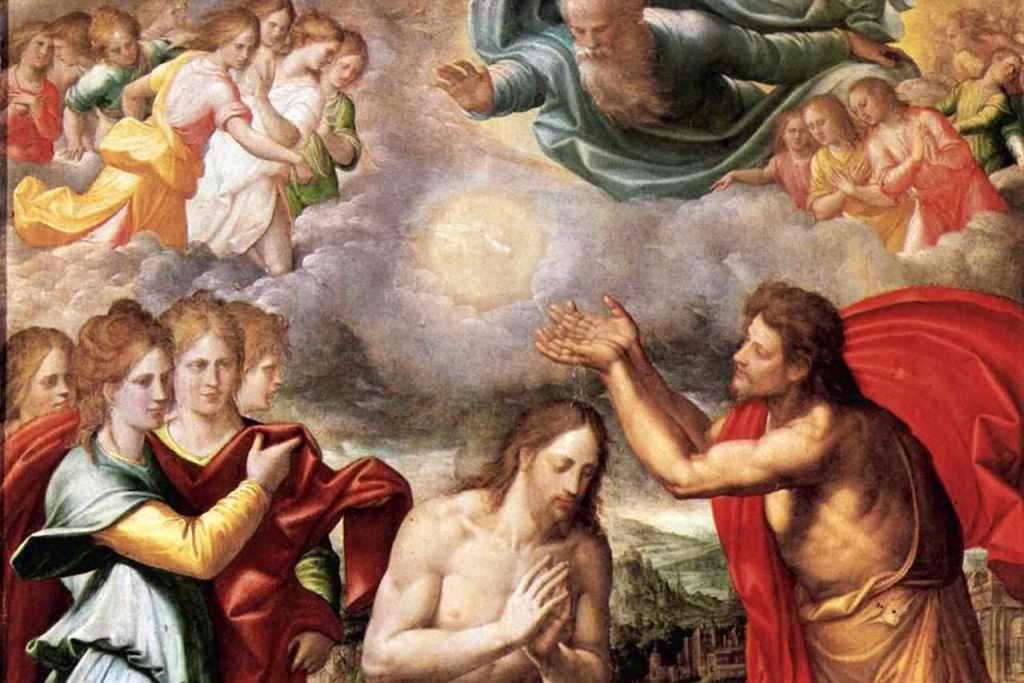
Today we celebrate the Baptism of our Lord Jesus Christ, a feast that reveals the very heart of God’s mercy and love. The Church leads us to the banks of the Jordan River—a place already sacred in the memory of Israel. God had acted there before with power and wonder, but those mighty deeds were only a preparation. At Jordan, something entirely new takes place. Christ steps into the waters, heaven is opened, the Spirit descends, and the voice of the Father is heard. In this moment, the true meaning of Baptism is revealed—not merely as a ritual of repentance, but as the doorway to salvation and divine sonship.
The Gospel tells us that Jesus came “from Galilee to Jordan.” Even these names are rich with meaning. Galilee signifies “transmigration”—a passage from one state to another. Jordan means “descent,” a lowering of oneself. Anyone who comes to Baptism, therefore, must first undergo a true interior transformation: leaving behind vice and turning toward virtue, and humbling oneself before God as one enters the waters. No one comes to Baptism without conversion, and no one is reborn without humility. To approach Baptism is to embrace both movements—the passage from sin to grace, and the descent into humble surrender before God. Jesus, who has no need of cleansing, enters the waters not to be purified, but to sanctify them, transforming them into a source of new life for all who will follow Him.
Jesus came to John to be baptized, though John protested: “I have need to be baptized by You, and do You come to me?” Yet Christ insisted.
St. Gregory of Nazianzus proclaims: “Christ is baptized, not to be cleansed, but to sanctify the waters, to bury the old Adam in the water, and to make the Jordan a channel of grace for all humanity. In His Spirit and flesh, He consecrates us by Spirit and water.” Even John, the Forerunner, recognized the greatness of this act: the One he had proclaimed from the womb now stood before him in the flesh, inaugurating the new era of salvation.
When Jesus rose from the waters, He carried the world with Him. He opened the heavens, which Adam had closed by sin, and the Spirit descended upon Him like a dove, while the Father’s voice declared His identity. The gentle form of the Dove reminds us that the Spirit’s power cannot be measured by human standards. Just as the Kingdom of Heaven may seem small, it contains all things. Christ—the Lamb, the Pearl, the Drop—is infinitely greater than any earthly measure or adversary.
So, St. Cyril of Jerusalem instructs the newly baptized: “Do not think this is plain water. It is grace-filled water, receiving its power from the Spirit.” Every Baptism is mystically connected to Jordan. The Jordan was not merely water; it was a battleground. Scripture speaks of the ancient dragon lurking in its depths—a symbol of sin, evil, and death (Job 40:18). Christ descended into those waters to confront and defeat that enemy.
The Life Himself entered the realm of death so that death might lose its power forever. Having bound the strong one in the waters, Christ emerged victorious, so that all who are baptized might share in His triumph and proclaim with confidence: “O death, where is your sting?” (1 Corinthians 15:55) The sting of death is drawn out in Baptism.
When we descend into the waters, we carry our sins with us. But when we rise, sealed by the Holy Spirit, we are no longer held captive. Buried with Christ in the waters, we are raised with Him to walk in the newness of life. As Saint Paul teaches: “If we have been united with Him in the likeness of His death, we shall also be united with Him in His resurrection” (Romans 6:5). Baptism is not only forgiveness; it is participation in the Paschal Mystery itself.
Baptism does more than restore, it strengthens. Just as Christ, after His Baptism, went forth to confront temptation, so the baptized are clothed in spiritual armor. Having received grace, we are empowered to resist evil, to live courageously, and to proclaim the Gospel with confidence. Baptism marks the beginning of a new life—not a life of passivity, but one of victory, mission, and faithful witness in Christ.
Baptism is a call to live differently. Grace does not merely cleanse us; it transforms us. Those who are baptized are called to leave behind sin, selfishness, and deceit, and to take up a life of righteousness, marked by honesty, generosity, humility, and love. Our lives must bear visible witness to the new life we have received. Just as Zacchaeus showed his repentance by restoring what he had unjustly taken, so our daily choices must reflect the change that grace brings about within us.
Baptism, therefore, is more than cleansing; it is spiritual rebirth. Just as a newborn enters life in innocence, so the baptized soul is regenerated—washed of sin and raised to new life in God. Water, simple and ordinary, becomes a sacred instrument through which God recreates us and makes us His own.
From the moment Christ descended into the Jordan, all water destined for Baptism was sanctified. The Jordan became a channel of grace, the place where humanity begins its renewal. What occurred once in salvation history is now made universally effective through the Church. Christ’s single saving act extends across time and space: water, blessed by His presence, now has the power to wash away sin.
Because Christ entered the Jordan, Baptism truly accomplishes what it signifies: sins are forgiven, the old life is buried, and a new creation begins. As St. Cyril of Jerusalem reminds us: “At one and the same moment you died and were born; the saving water became both your tomb and your mother.” Just as Israel passed through the Jordan into the Promised Land, we pass through the waters into life in Christ—adopted as sons and daughters of the Father, temples of the Holy Spirit, and members of Christ’s Body.
As we celebrate His Baptism, we are called to share in His purification. The Fathers speak of different kinds of Baptism throughout salvation history. Moses baptized in water, in the cloud, and in the sea—types of the spiritual reality that was to come. John baptized with water unto repentance. Christ baptizes in the Spirit, the perfect and eternal Baptism.
Beyond this, there is also the Baptism of Martyrdom, which Christ Himself endured—the most august of all, untainted by sin. And there is the Baptism of tears and repentance, through which the penitent imitates the humility of the Ninevites or the Publican, crying out for mercy and receiving God’s grace.
In all of these, one truth remains: Christ is the source of every baptism. By Him, the waters are sanctified, sins are drowned, and we rise to new life. Through Baptism—whether by water, Spirit, suffering, or tears—we are united to His life, death, and resurrection, and set on the path of holiness, mission, and communion with God. (Gregory of Nazianzus, Oration 39)
Today, standing at the Jordan, the Church invites us to remember who Christ is and who we have become in Him. The heavens that opened over Him have opened over us. The Spirit who descended upon Him now dwells within us. The Father who proclaimed His Son now calls us beloved.
May this feast renew our baptismal grace, deepen our humility, and strengthen our resolve to let Christ increase in our lives until we cross the final river and enter the fullness of God’s Kingdom.
✍ Fr James Abraham
 Nelson MCBS
Leave a comment