

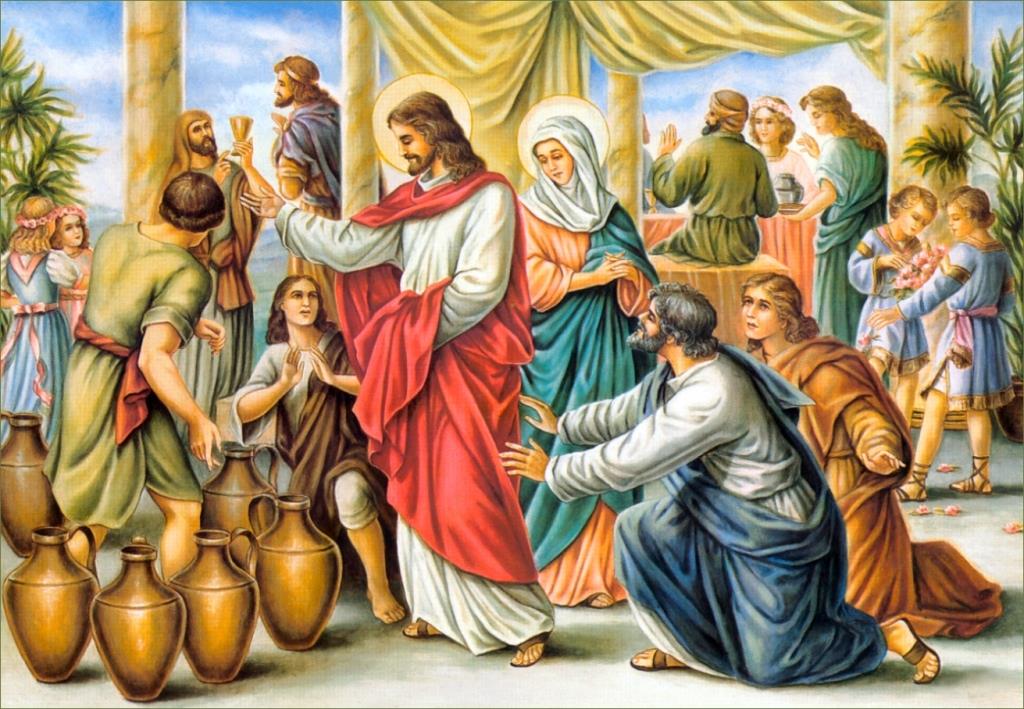
The Gospel today brings us to a wedding feast in Cana of Galilee, where Jesus performs His first public sign by turning water into wine. At first glance, it seems like a simple and beautiful miracle: an act of compassion for a young couple whose celebration is about to end in quiet embarrassment. Yet the Church invites us to look more deeply.
Christ did not come to a wedding only in Cana, He came into this world for a wedding. For Christ has a bride. The Apostle Paul says, “I have espoused you to one husband, to present you as a chaste virgin to Christ.” That bride is the Church redeemed, loved, and claimed by Him. Christ came not as a distant guest, but as the bridegroom.
St. Augustine gives us a striking insight. He says that the miracle at Cana should not surprise us too much, because the same Lord who turned water into wine in those jars does something similar every year. Rain falls, nourishes the vines, and becomes wine. We do not call that a miracle not because God is absent, but because it happens so often that we no longer notice.
The problem is not that God has stopped working miracles. The problem is that we have stopped paying attention. God is constantly at work—in creation, in life, in grace.
The same Word who created heaven and earth is the Word who stood at that wedding feast. If He made all things, why should we marvel that He changed water into wine? The real question is not how He did it, but why He did it.
Jesus did this miracle not to impress us, but to restore us. His presence at the wedding is already full of meaning. Marriage, joy, and communion are signs of God’s plan for humanity. The miracle reveals that Christ has come to transform human life from within.
The miracle at Cana, then, is not only about something that happened long ago. It is about what Christ continues to do today.
At the wedding at Cana, Mary notices a problem the wine has run out and brings it to Jesus. His words may sound surprising: “Woman, what have I to do with you? My hour is not yet come.” At first, it seems like a refusal, yet immediately afterward, He performs the miracle.
These words are not a rejection of His mother, nor a lack of respect. Rather, they reveal a profound mystery. His hour refers to the appointed moment of His full revelation—His Passion, Resurrection, and glory. Jesus reminds us that God acts according to divine wisdom and perfect timing. Salvation unfolds step by step, not in haste or confusion, but in order. Grace is given when hearts are ready to receive it.
At the same time, Jesus teaches us that miracles are not performed for display, but for faith. The wedding guests were not yet aware of their need. The lack of wine has not yet touched them. Faith grows most fruitfully when a person recognizes their own emptiness and cries out for help.
When that hour finally comes on Calvary, Jesus again calls His mother “Woman” and entrusts her to the beloved disciple. The hour that had not yet come at Cana arrives at the Cross. There, the true Bridegroom gives His own blood for His Bride, the Church. No earthly bridegroom gives his life for his bride, but Christ does. He gives not gold or silver, but Himself.
And so, When Christ comes to the wedding at Cana, He comes to sanctify marriage, to restore joy, and to reveal His love for His Bride, the Church. He freed her from slavery to sin, poured out the Holy Spirit as a pledge of His love, and justified her by His Resurrection. He did not merely promise love; He sealed it with His life.
This is why Cana matters to us. It is not only about jars of water long ago. It is about what Christ desires to do in every heart. He takes what is plain and transforms it. He takes what is empty and fills it. He takes what is weak and makes it strong.
But for this transformation to occur, we must first bring what we have, even if it seems insignificant. We must recognize our needs. We must fill the jars. And we must obey His word.
The miracle itself is carefully arranged. Jesus asks the servants to fill six stone jars with water jars meant for ritual purification, never intended for wine. Only then does He act.
Why does He not simply create wine out of nothing? Because He invites human cooperation. God works through what is placed into His hands. Ordinary water, offered in obedience, becomes extraordinary wine. Human faithfulness becomes the channel of divine power. Jesus often works through ordinary things and ordinary people, turning them into instruments of His grace.
This miracle points to the transformation Christ brings into our lives. Just as water was turned into the best wine, so too can He change what is weak, cold, or unstable in us into something rich with meaning, strength, joy, and purpose. Many of us are like water uncertain, distracted, enslaved to fleeting pleasures.
Jesus desires to transform such lives into wine. We were water, and He made us wine. We were ordinary, weak, and foolish, and by His grace, Christ makes us wise. He pours into us the invisible wine of faith, His mercy, and His divine life.
And the wine He gives is not just sufficient it is the best. This reveals something essential about Christ: His grace does not simply restore; it perfects. His work does not merely repair; it surpasses. Where He heals, He heals fully. Where He transforms, He transforms completely.
Jesus works most powerfully in our lives when we realize that we are out of wine—out of love, out of strength, out of energy, out of ideas, even out of hope. It is precisely in the weakness of our emptiness that God’s power reaches perfection within us.
This is why the most important act of faith in life is to place our lives and our emptiness completely into the hands of Jesus. We do not need to pretend that everything is full or perfect. We only need to bring what we have. And then, like Mary at Cana, we must trust and obey. Her advice remains the simplest and most powerful rule of discipleship: “Do whatever He tells you” (John 2:5).
We need new wine, yet all we seem to have is water—many who are baptized, but too few who are truly filled with the Spirit. We carry the name of Christian, but often lack the joy, courage, and fire that should flow from a living faith.
So, with Mary, we turn to Jesus and confess our need: “We have no more wine.” We do not always know what to say or what to do. We simply bring our emptiness to Him. And Mary, the Mother of faith, speaks again to the Church in every age with words that never lose their power: “Do whatever He tells you.”
When we do, Christ will transform our emptiness into abundance, our weakness into strength, and our ordinary lives into the wine of His Kingdom.
✍ Fr James Abraham
 Nelson MCBS
Leave a comment