

From Darkness to Discipleship | Mathew 4:12-23
The Gospel opens with an important truth about the way God works in our world: Jesus does not wait for calm, convenient, or perfect conditions to begin His mission. He begins when John the Baptist is imprisoned, when voices of truth are silenced, when darkness seems to gain ground. And it is precisely in that moment that Jesus steps forward and proclaims:
“Repent, for the kingdom of heaven is at hand.”
God does not wait for the world to be ready. He enters history at its breaking points. Even today, Christ begins His work not when life is peaceful, but when it is restless, divided, and wounded.
Before He begins to preach, Jesus withdraws into the desert. There He confronts hunger, ambition, and pride the same temptations that still challenge us: consumerism, the craving for power, the lure of self-glorification. Only after confronting and overcoming these does He begin His ministry of repentance.
This reminds us that true renewal whether personal or social cannot happen without an interior conversion, a turning of the heart toward God.
After overcoming every temptation, the devil departs from Jesus for a time. He then returns to Galilee in the power of the Spirit (Luke 4:14). But His mission there is not immediately embraced. The people of Nazareth reject Him. They misunderstand Him. They even try to drive Him out, even to the point of trying to hurl Him down from the brow of the hill.
Matthew simply says, “He left Nazareth and went to Capernaum.”
Luke tells us why Jesus left Nazareth: He was rejected, misunderstood, and even threatened with death by His own people. Matthew shows what God does with that rejection: He transforms it into fulfillment.
What seems like failure, what feels like being driven away, becomes the path through which God’s plan shines. The anger and closed hearts of Nazareth become the doorway through which the light of Isaiah’s prophecy shines upon Galilee. The anger and closed hearts of Nazareth open the way for the light of the Gospel to reach Galilee.
When hearts are closed, Christ does not abandon His mission; He carries it forward. In this way, even rejection serves God’s plan, and even being driven away becomes a step toward the salvation of many.
Galilee, a land often looked down upon, religiously mixed and culturally suspect, becomes the cradle of Christ’s mission. God chooses the margins, not the center; the wounded, not the privileged. Even today, the Gospel grows not where faith is easy or comfortable, but where hearts are searching among the broken, the doubting, the forgotten.
As St. Jerome reminds us, this is God’s saving logic: where sin abounded, grace abounded all the more. Where the Law had been forgotten, grace now abounds. From this borderland between Jew and Gentile, Christ begins a mission meant for all.
Capernaum, set by the sea in the land of Zebulun and Naphtali, was once the first region to fall into darkness through exile; (cf. 2 Kings 15:29) now it becomes the first to receive the light of the Gospel.
As Isaiah foretold: “The people who walked in darkness have seen a great light; upon those who dwelt in the land of gloom, a light has shone” (Isaiah 9:1–2).
The darkness Isaiah speaks of is not simply the night, but the shadow of sin, error, and spiritual blindness. Even those careful with the Law still walked in darkness because the fullness of God’s revelation had not yet come. Into that darkness, Christ the true Light shines, not to condemn, but to awaken, to call to repentance, and to lead from the shadows into the fullness of life.
This light calls each of us to discipleship. Discipleship begins the moment we respond to that light not after full understanding, not after seeing miracles, but in faith that His word can transform our hearts and enable us to bring others toward Him.
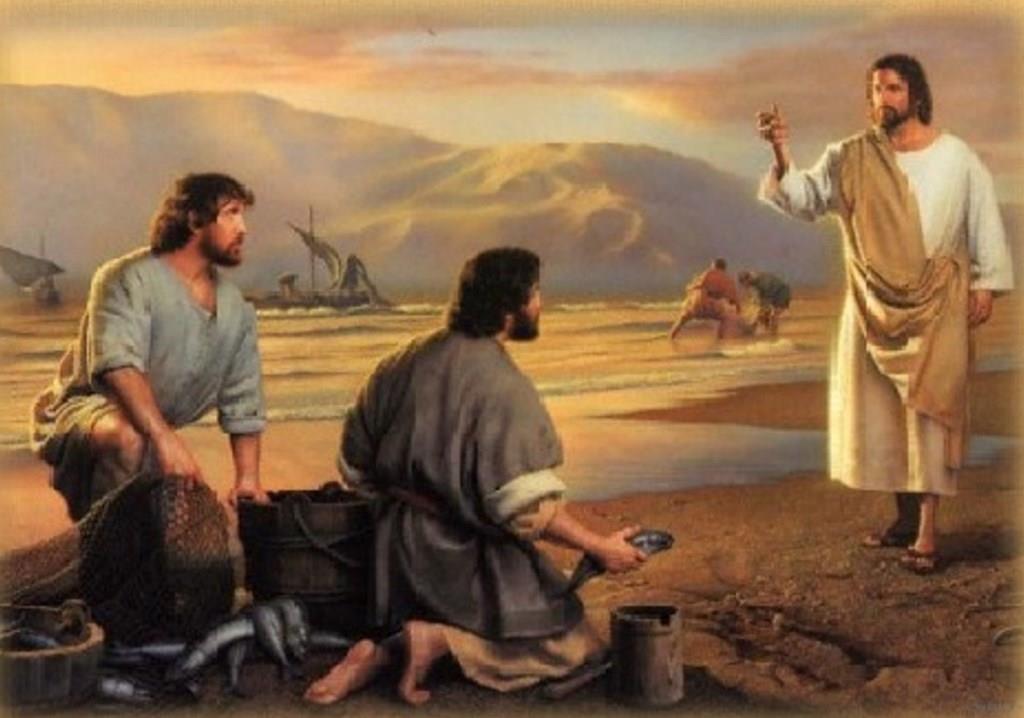
Just as Peter and Andrew were drawn from their ordinary work at the Sea of Galilee, so too we are called to leave behind distractions, comforts, and preoccupations and follow Him.
The Gospel of John tells us that Peter and Andrew had already met Jesus earlier. They had even spent time with Him and heard His teaching. Yet here, we see a second, deeper call this time, they respond without hesitation.
God often calls us repeatedly. Sometimes we hear Him, but life or fear makes us hesitate. God patiently calls us again, giving us new opportunities to follow Him fully. Our task is to recognize His voice and respond.
They believed Jesus’ promise even before seeing any signs or wonders: “I will make you fishers of men.” Their faith was in His word, not in immediate proof.
God often asks us to trust Him before we see results before situations change or problems are solved.
Like Peter and Andrew, we are called to take the first step in faith, trusting that God’s word is always true.
Like Peter and Andrew, let us leave our “nets”, our comforts, distractions, and doubts and follow Jesus wholeheartedly. He does not just call us to leave behind work or possessions; He calls us to a life of purpose, a life that will transform others.
Christ still calls. And often, His call comes while we are busy with the ordinary tasks of life.
Faith requires action. We cannot wait for the “perfect moment” or for all obstacles to be removed.
The Gospels show us that Jesus does not remain where hearts are closed but goes where the light can spread further.
Obedience precedes understanding. We may not see the whole plan, but our trust allows God to work through us.
So when Jesus says to each of us, “Follow Me,” may we, like Peter and Andrew, leave behind whatever holds us back, trust His word, and step into the extraordinary life He has prepared for us.
✍ Fr James Abraham


 Nelson MCBS
Leave a comment