

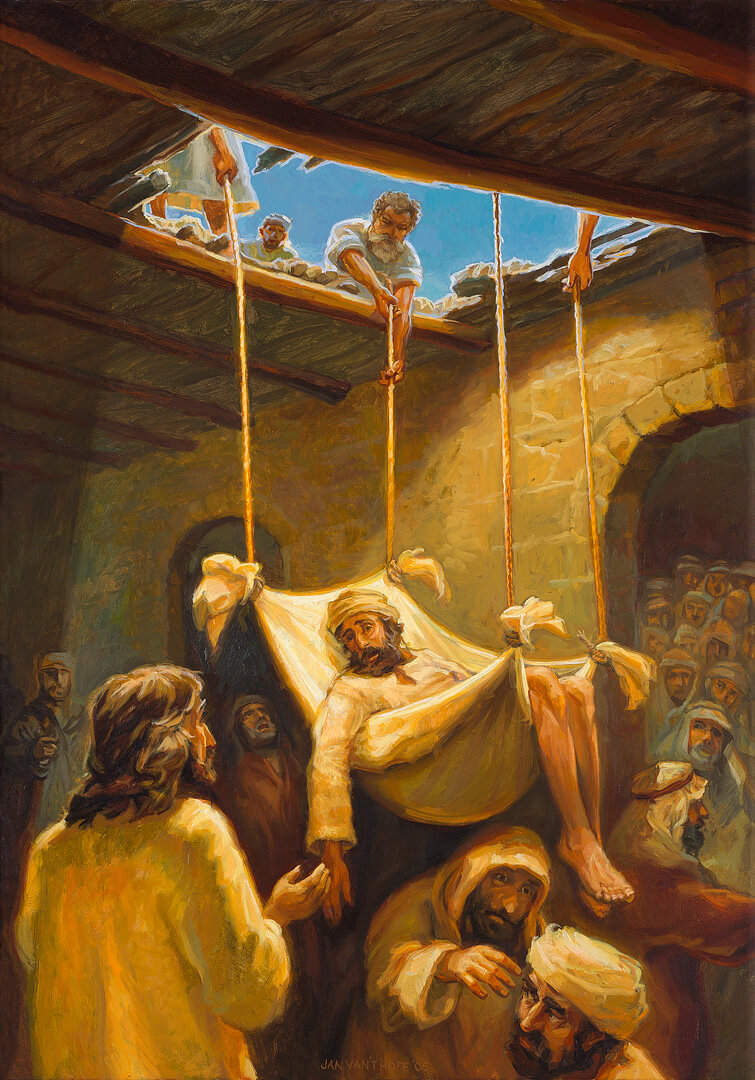
“When Jesus Saw Their Faith”
(Mark 2: 1 -12)
Today’s Gospel places before us a deeply moving scene. A man is paralyzed unable to walk, unable even to enter the house where Jesus is teaching. Yet he is not alone. He is carried by friends whose faith refuses to give up. When the doorway is blocked by the crowd, they do not turn back. They climb the roof, open it, and lower him before Jesus.
Then we hear one of the most striking lines in the Gospel: “When Jesus saw their faith…” (Mk 2:5). Faith here is not just something believed in the heart; it is something visible, something lived. It is faith that acts, faith that perseveres, faith that brings another person into the presence of Christ.
It is their faith, the faith of the friends that moves Jesus to act. This reminds us of a great truth: sometimes God responds to the faith of one person for the sake of another. We are not saved in isolation. Our prayers, our sacrifices, our perseverance can open the door for someone else to encounter the Lord. Never underestimate the power of intercessory faith.
At the same time, the paralytic himself shows faith. He allows himself to be carried. Healing always involves trust. God never forces healing upon us; we must be willing to be brought, willing to surrender, willing to place ourselves before Him.
Faith begins with a longing for Jesus. And it grows when we deliberately place ourselves where Jesus is found: in prayer, in the Word of God, and especially in the sacraments, above all, the Holy Eucharist. If we rarely seek the Lord, faith weakens. If we pursue Him faithfully, faith deepens and matures.
When Jesus finally speaks, His first words may surprise us: “Son, your sins are forgiven.”
Before the body is healed, the soul is restored. The man’s paralysis is a visible sign of a deeper bondage. Christ addresses the root before the symptom. In Jesus, healing is always holistic – body, mind, and soul.
The scribes, however, begin to murmur: “Who but God alone can forgive sins?” Their problem is not a lack of intelligence, but a closed heart. They cling to the letter of the law and miss the living God standing before them.
How often do we struggle with the same temptation? How often do we doubt God’s work because it comes in a way we did not expect? We try to measure God by our rules, our categories, our sense of what is “possible.”
Some in Jesus’ time recognized His power but refused to accept Him as the Messiah. Others accepted Him as the Messiah but denied His divinity. Yet Jesus leaves no room for confusion. He knows the thoughts of their hearts. He forgives sins. He heals with authority. His words and works reveal the truth: He is truly God among us.
This Gospel teaches us something very personal and very important. Christ does not remain on the surface of our lives. He sees us completely. No thought, no fear, no sin is hidden from Him. And yet, this is the Good News He loves us completely. Even before we can articulate our need, He offers forgiveness and restoration.
God often works in ways that overturn human expectations. What appears small or ordinary may reveal a profound divine reality. In Christ, a word of mercy, a touch, a forgiveness becomes a window into God’s saving power.
So, when we come to Him in prayer, in confession, in trust, we come to a God who knows us fully and loves us fully. Like the friends of the paralytic, faith opens the way. And Christ lifts the burden of sin, restores our dignity, and renews our lives.
Still, even after the healing, some continue to doubt. It is always easier to question than to believe. The scribes ask themselves whether Jesus truly has the authority He claims.
Jesus responds not only with words, but with action: “That you may know that the Son of Man has authority on earth to forgive sins…” He heals the paralytic. The visible miracle confirms the invisible one. The healing of the body reveals the healing of the soul.
Then comes the command: “Rise, pick up your mat, and go home.” This is not merely physical recovery. It is empowerment. When Christ forgives, He also strengthens. He does not simply remove guilt; He gives us grace to live differently, to walk in obedience, to begin again.
As St. John Chrysostom teaches, Jesus heals the soul first because that is His deepest purpose and then heals the body to remove all doubt. The man rises immediately, carrying the very mat that once carried him. Divine grace works without delay.
Yet what captures the crowd’s attention. They marvel at what they can see. They rejoice in the healed body, but many miss the greater miracle: a forgiven heart.
How often do we do the same? We rejoice when circumstances change, when suffering is relieved, but we overlook the quiet, transforming work God is doing within our souls.
The paralytic is not only a man from the Gospel. He is also a mirror of our own spiritual condition. At times we desire holiness, but feel weighed down by habits, distractions, or spiritual laziness. The “crowd” blocks our path. The roof must be opened, our minds lifted above earthly concerns, so that the soul may be laid humbly before Christ.
When the man takes up his bed, it signifies more than movement. It represents mastery: the soul now governs the body, grace directs desire, life is reordered toward goodness. Carrying the bed home is like returning to paradise restored, renewed, living with an awareness of God’s mercy.
Once sin is forgiven, vision becomes clearer. Freed from paralysis, we are able to act, to love, to walk in God’s ways.
This Gospel is our story. We are the ones on the mat. We are the friends who carry. We are the doubters who struggle. And we are the healed who are sent forth.
Christ still says to us: Rise.
He forgives. He heals. He strengthens.
And He sends us home renewed in body, soul, and purpose to live fully in Him.
✍️ Fr James Abraham
 Nelson MCBS
Leave a comment