

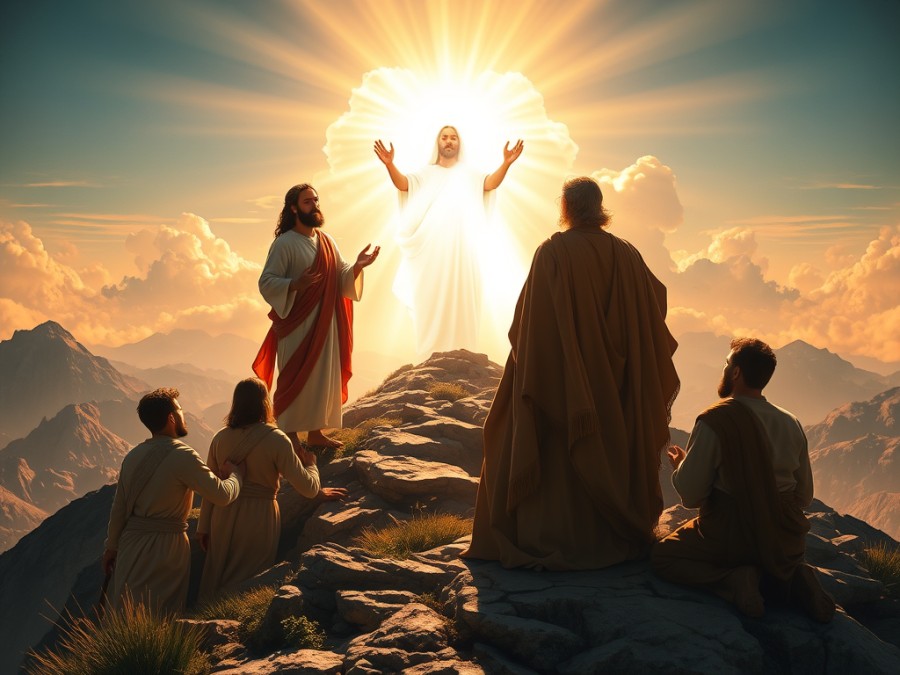
“From the Mountain of Glory to the Valley of the Cross” | Matthew 17:1-9
On the Second Sunday of Lent, the Church gently takes us by the hand and leads us up a high mountain. The Gospel of the Transfiguration places before us a mystery of light in the middle of our Lenten journey.
“Jesus took Peter, James, and John his brother and led them up a high mountain by themselves… And He was transfigured before them.”
Moses and Elijah appeared, speaking with Him. Overwhelmed, Peter wanted to build three tents. Then a bright cloud overshadowed them, and a voice declared: “This is my beloved Son, in whom I am well pleased; listen to Him.”
The disciples fell to the ground in fear. And then Jesus did something very tender—He came and touched them. “Rise, and do not be afraid.” When they lifted their eyes, they saw Jesus alone.
Lent can sometimes feel heavy. We speak of sacrifice, repentance, discipline. But today the Church shows us light. She reminds us that the goal of Lent is not sorrow, it is transformation.
In Scripture, the mountain is always a place of encounter with God. Moses met God on Sinai. Elijah heard the still, small voice on Horeb.
Now the disciples are led to another mountain—traditionally identified with Mount Tabor—to encounter the glory of Christ.
The mountain symbolizes nearness to God — a lifting of the heart above the noise of daily life.
Lent is our ascent. It is not a season of gloom, but a season of drawing closer.
We fast, we pray, we give alms not to punish ourselves, but to loosen the grip of what distracts us.
Before revealing His glory, Jesus first leads the disciples away from the crowds. Sometimes we must step back in order to see clearly.
Jesus leads them up. They do not climb alone. He takes them.
That is Lent. It is not something we do for God. It is something we allow God to do in us.
If we want to see the Lord more clearly, we must allow Him to lead us into moments of silence, prayer, and detachment from constant noise.
The mountain is not only a place; it is a decision, the daily choice to rise above lesser things so that we may behold the beauty of Christ and be transformed by it.
The Gospel says this happens “after six days.”
Because just before this, the disciples had just heard Him speak about His coming Passion. He told the disciples that He must suffer and die. They were confused and troubled.
The Transfiguration is not separate from the Cross; it is given because of it. It strengthens them for what is to come.
Before they see Him disfigured on Calvary, they are allowed to glimpse His glory.
The tradition often sees symbolic meaning here. Six days recall the six days of creation. Before beholding the glory of the new creation in Christ, one must pass through the labor of the old.
Only after a believer has “passed the six days” – symbolizing works of repentance, discipline, or earthly toil – can they ascend spiritually and truly see Christ’s divine nature.
After a period of purification and faithful perseverance the soul begins to witness Christ transfigured within the heart.
When Jesus is transfigured, Moses and Elijah stand beside Him, representing the Law and the Prophets the whole hope of Israel. Everything in the Old Covenant points to Christ.
According to the Gospel of Gospel of Luke, they speak with Him about His “exodus” to be accomplished in Jerusalem. Even in glory, the Cross is central.
Lent teaches us the same rhythm. Glory does not mean bypassing suffering. It means passing through it with faith.
We do not escape the Cross; we interpret it in light of glory. The Law points to it. The Prophets announce it. Christ accomplishes it.
For us, that is essential. In Lent we meditate on Christ’s suffering. But we must never forget who it is that suffers.
The One who will be disfigured on Calvary is the same One who is transfigured in glory. The Cross is not defeat; it is love poured out.
Peter wants to remain on the mountain. “Lord, it is good for us to be here; If you wish, let us make three tents.”
How often we feel the same in moments of deep prayer, beautiful liturgies, or spiritual clarity. We want to hold on to them. But Jesus does not allow them to stay. The mountain prepares them for the valley.
The Church, too, cannot remain on Tabor. She must walk toward Jerusalem.
And then comes one of the most beautiful lines in the Gospel: “When they raised their eyes, they saw no one else but Jesus alone.” The cloud fades. Moses and Elijah disappear. The extraordinary signs pass. Jesus remains.
This is the heart of mature faith. Consolations come and go. Feelings rise and fall. But Jesus remains. His Word remains. His presence remains.
Lent slowly simplifies our vision until we see Jesus alone.
So the Transfiguration becomes a roadmap for us: It is not only something that happened on a mountain long ago. It is something God desires to do within us.
When we rise above lesser things, when we give space to prayer and repentance, Christ reveals Himself more fully in our lives.
He has not changed but we are changed by beholding Him.
As we continue this Lenten journey, the message is simple and tender:
Climb the mountain through prayer and sacrifice.
Contemplate the glory of Christ, even as you prepare to walk with Him to the Cross.
Do not cling to consolations.
Listen to the beloved Son.
Rise from fear when He touches you.
Fix your eyes on Jesus alone.
Soon we will walk with Him toward Jerusalem. We will stand at the foot of the Cross.
But today, the Church allows us to glimpse the end of the story. The One who will be disfigured on Calvary is the same One who is transfigured in glory.
And the Father still speaks to us this Lent, not with thunder, but with loving clarity:
“This is my beloved Son… listen to Him.
🪶Fr James Abraham
 Nelson MCBS
Leave a comment