

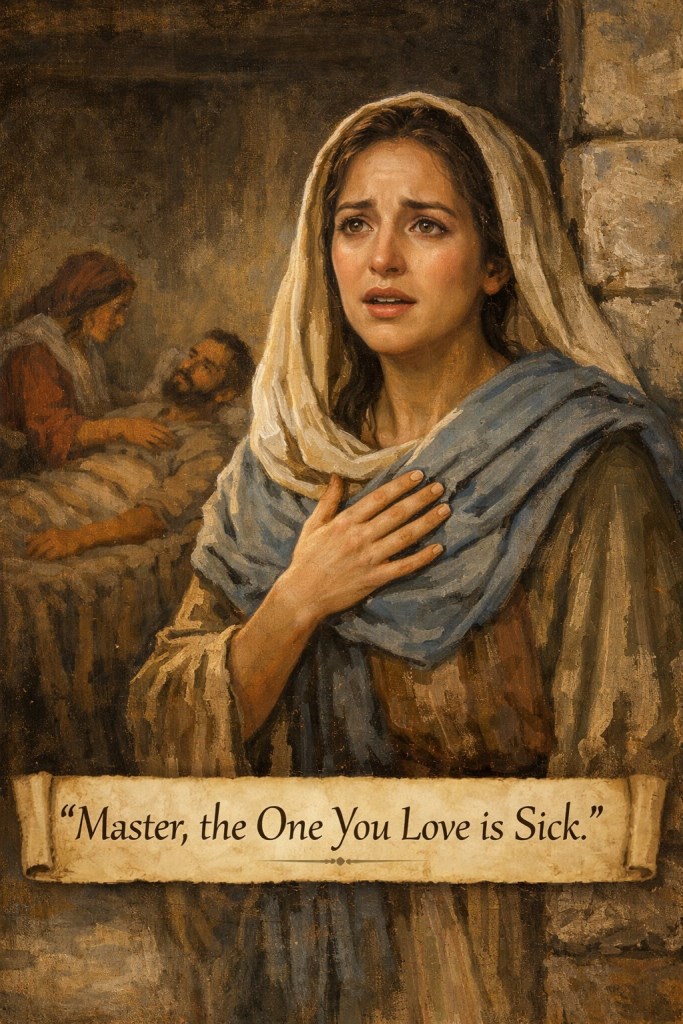
“Master, the One You Love is Sick” John 11:1-45
Today’s Gospel brings us into one of the most tender and human moments in all of Scripture, the story of Lazarus. It begins with a simple message, almost like a whisper of the heart:
“Master, the one you love is sick.”
In these few words, we hear both faith and pain.
There is something very beautiful about this prayer. It is not long. It is not complicated. It simply places a need before the Lord. And if we are honest, this is the kind of prayer many of us have prayed:
“Lord, my family is struggling…”
“Lord, I am afraid…”
“Lord, I need you…”
This Gospel meets us exactly in those moments where faith and confusion come together.
We believe that God loves us. And yet, there are moments in life when that belief is tested. Lazarus was not a stranger to Jesus; he was a dear friend, someone deeply loved. And still, he became sick. Still, he died.
This reality can trouble our hearts, because it does not fit easily with our expectations. We naturally begin to ask:
If God loves us, why do we suffer?
Why do good people go through pain?
Why does God seem silent when we need Him most?
The Gospel does not ignore these questions or dismiss them. It allows them to exist. But it gently invites us to face them with honesty and faith and leads us to a deeper understanding: God’s love does not mean a life without suffering. Even those closest to Him walk through trials. But those trials are never empty. They are never meaningless. Somehow, in ways we may not immediately see, God is at work.
One of the hardest parts of this story is that Jesus does not come right away when He hears about Lazarus. He waits. And often, that waiting is more painful than the suffering itself.
Many of us know this experience personally, we pray, we hope, we ask for help, and yet nothing seems to change.
But this Gospel reminds us of something very important: God’s delay is not God’s denial. Jesus does not delay because He does not care. He delays because He sees the whole picture, something greater than we can see at the moment. What looks like an ending to us, God may already be transforming into a new beginning. What feels like loss in our lives, He can turn into grace.
Martha and Mary give us a beautiful example of faith. They simply say, “Lord, the one you love is sick.” They do not try to control the situation nor do they tell Jesus what He should do. They entrust everything to Him.
This is the heart of faith: not many words, not perfect expressions, but a deep confidence in the love of Christ. True faith means entrusting our lives to Him completely, even when His ways are beyond our understanding, and even when His timing is not our own.
And when Jesus finally arrives, something very moving happens. Before He performs any miracle, He weeps.
Jesus weeps.
This reveals to us the heart of God. He is not distant from our suffering. He is not indifferent. He does not stand far away from our pain. He enters into it. He shares our pain, and He walks with us in our darkest moments.
So, if today you are carrying a burden, if there is grief, worry, or sorrow in your heart, remember this: the Lord is close to you. He sees. He understands. He weeps with you.
And then Jesus speaks those powerful words:
“I am the resurrection and the life.”
He does not say, “I will give life.” He says, “I am life.” That means wherever Christ is present, hope is never lost. Even when everything seems dark, life is still possible.
St. Augustine helps us to go even deeper. He speaks about two kinds of death: the death of the body, and the death of the soul.
Physical death is something we all face. But there is another kind of death, spiritual death when sin slowly distances us from God.
And the Gospels show us something very meaningful. Jesus raises three people from the dead, and each one reflects a different situation in our spiritual life.
The first is the daughter of Jairus. Her death happens quietly, inside the house unseen by the public. This reminds us of the hidden struggles in our hearts, our private sins, our silent battles that no one else sees. Yet even there, Jesus can enter and bring healing.
Then there is the son of the widow of Nain, his death is public, visible. This reminds us of when sin moves from the heart into action. Even then, Jesus intervenes and restores life.
And finally, Lazarus, four days in the tomb. This represents something deeper and more serious: habitual sin, those areas of life where we feel stuck. Habits we cannot break. Wounds that seem too deep. Situations that feel beyond hope.
And yet, it is precisely at this moment that Jesus reveals His greatest power.
All of us, in some way, have these “tombs” in our lives, areas of pain, brokenness, or sin that seem beyond healing.
It may be a relationship that feels broken.
A burden we have carried for years.
A struggle we think will never change.
Or habits we feel unable to overcome.
And sometimes we begin to believe, “Nothing can be done.”
But the Gospel assures us that nothing is beyond the power of Christ.
St. Augustine reminds us that even when a person seems deeply buried in sin or suffering, Christ still has the power to restore life. No situation is too far gone for God’s mercy.
Jesus stands before the tomb and cries out, “Lazarus, come out!”
And today, He speaks the same words to each one of us:
Come out of fear.
Come out of sin.
Come out of discouragement.
Come out of whatever is holding you back.
Nothing is beyond His power.
Dear brothers and sisters, this is the heart of today’s message: no situation is too far gone for God. No life is beyond His mercy. No darkness is too deep for His light.
And we can believe that the same Jesus who stood before the tomb of Lazarus now stands before the tombs in our lives.
He knows our struggles, He hears our prayers, and He calls each of us with love: “Come out.” Our story does not end in suffering or death. With Christ, there is always the promise of new life.
So let us bring our own hearts before Him today just as Martha and Mary did. We may not have perfect words. We may not understand everything. But we can trust.
“Lord, the one you love is sick.”
✍ Fr James Abraham
 Nelson MCBS
Leave a comment