

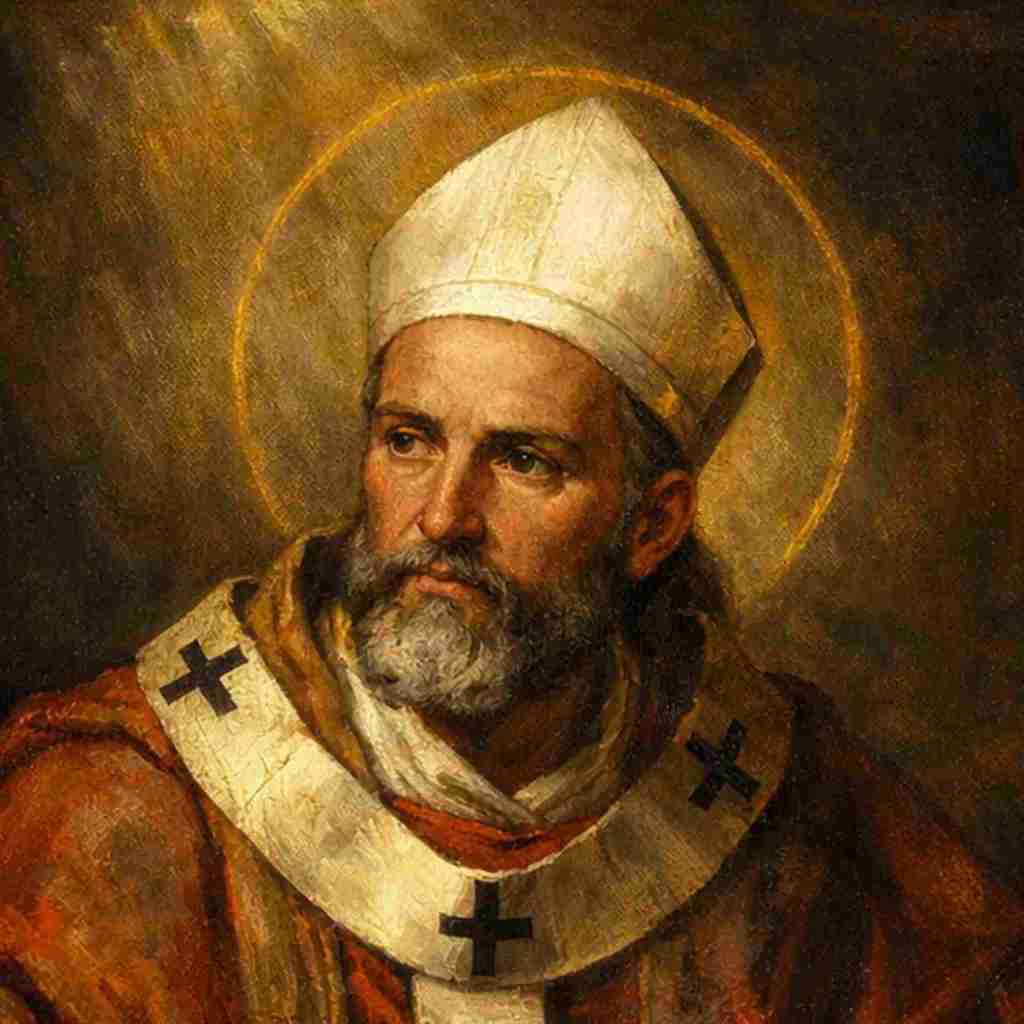
St. Irenaeus of Lyons and the Defense of Apostolic Tradition
Guarding the Faith Handed Down from the Apostles
Introduction: A Defender of the True Faith
In the second century, when Christianity was still young yet already facing serious internal challenges, God raised up a powerful defender of the faith—St. Irenaeus of Lyons. At a time when competing interpretations of Christianity threatened to distort the Gospel, Irenaeus stood firmly rooted in what he called the “rule of faith”—the authentic teaching handed down from the Apostles.
His mission was clear: to safeguard the integrity of Christian belief against false teachings, especially Gnosticism, which claimed secret knowledge and offered alternative versions of Christ and salvation. Through his writings, particularly his monumental work Against Heresies, Irenaeus articulated one of the earliest and most compelling defenses of Apostolic Tradition—a concept that remains foundational in Catholic theology.
This article explores the life, context, and theological contributions of Irenaeus, focusing especially on how he defended and explained Apostolic Tradition as the sure guide to truth.
1. The Life and Formation of Irenaeus
Smyrna (modern-day İzmir in Turkey) was the birthplace of Irenaeus, around the year 130 AD. This location is significant, for it places him within the living memory of the Apostles.
As a young man, Irenaeus was a disciple of St. Polycarp, who himself had been a disciple of St. John the Apostle. This chain of discipleship is crucial—it means that Irenaeus did not receive the faith secondhand or through speculation, but through a direct line of transmission reaching back to the Apostles themselves.
Later, Irenaeus moved to Gaul (modern-day France) and became bishop of Lyons. His leadership came during a time of persecution and doctrinal confusion. He was not only a theologian but also a pastor deeply concerned for the unity and fidelity of the Church.
2. The Crisis of Gnosticism
To understand Irenaeus’ defense of Apostolic Tradition, we must first understand the challenge he faced.
Gnosticism was not a single unified movement but a collection of sects that claimed to possess secret knowledge (gnosis) about divine realities. These groups often:
- Reinterpreted Scripture in highly symbolic or distorted ways
- Denied the goodness of the material world
- Rejected the true humanity of Jesus Christ
- Claimed access to hidden teachings not available to ordinary believers
Gnostics often presented themselves as more enlightened than the Church. They suggested that the Apostles had passed down secret teachings to a select few—teachings that were supposedly superior to the public preaching of the Church.
This posed a serious problem:
How could ordinary Christians know what was true?
How could the Church distinguish authentic teaching from distortion?
Irenaeus’ answer was both simple and profound:
Look to Apostolic Tradition.
3. What Is Apostolic Tradition?
For Irenaeus, Apostolic Tradition is not merely a collection of customs or practices. It is the living transmission of the faith entrusted by Christ to the Apostles and handed down through the Church.
This includes:
- The teachings of the Apostles
- The interpretation of Scripture
- The structure and authority of the Church
- The continuity of belief across generations
Irenaeus insists that this tradition is:
- Public, not secret
- Universal, not limited to a select group
- Consistent, the same across different churches
In contrast to the hidden teachings of the Gnostics, Apostolic Tradition is open, visible, and verifiable.
4. The Rule of Faith
One of Irenaeus’ key contributions is his articulation of the “Rule of Faith” (regula fidei).
This rule is essentially a summary of Christian belief, including:
- Belief in one God, the Father Almighty
- Faith in Jesus Christ, truly incarnate, crucified, and risen
- The work of the Holy Spirit
- The unity of salvation history
This rule was not written as a formal creed at the time, but it functioned as a standard against which all teachings could be measured.
For Irenaeus:
- True teaching aligns with the Rule of Faith
- False teaching contradicts it
This provided a clear and accessible way for Christians to discern truth.
5. Apostolic Succession: The Guarantee of Authentic Teaching
Perhaps the most powerful element of Irenaeus’ argument is his emphasis on Apostolic Succession.
He argues that the true teaching of the Apostles has been preserved through an unbroken line of bishops. These bishops, appointed by their predecessors, stand in continuity with the Apostles.
This means:
- The Church’s teaching authority is not self-invented
- It is rooted in historical continuity
- It can be traced and verified
Irenaeus famously points to the Church of Rome as a primary example, noting its connection to St. Peter and St. Paul.
He writes that all churches must agree with the Church of Rome because of its “preeminent authority.”
This is not about power—it is about preservation of truth.
6. Scripture and Tradition: Not Opposed but United
One of the most important aspects of Irenaeus’ teaching is his understanding of the relationship between Scripture and Tradition.
For him:
- Scripture is the Word of God
- Tradition is the authentic interpretation of that Word
The two are not in conflict. Rather, they belong together.
The Gnostics often misused Scripture, twisting its meaning to fit their ideas. Irenaeus responds by insisting that Scripture must be read within the Church, guided by Apostolic Tradition.
He uses a powerful analogy:
Heretics rearrange the pieces of a mosaic to create a false image, while the Church preserves the true image of the King.
This image captures his insight beautifully:
Truth is not just about having the right pieces—it is about arranging them correctly.
7. The Unity of the Church
For Irenaeus, Apostolic Tradition is inseparable from the unity of the Church.
He emphasizes that:
- The same faith is proclaimed in every part of the world
- The Church, though spread across many nations, speaks with one voice
- This unity is a sign of truth
He writes that even though the Church is dispersed throughout the world, it carefully preserves the same faith as if living in one house.
This universality is a powerful argument against Gnosticism, which was fragmented and inconsistent.
8. The Goodness of Creation and the Incarnation
Another key aspect of Irenaeus’ defense is his affirmation of the goodness of creation.
Against Gnostic claims that the material world is evil, Irenaeus insists that:
- God created the world and called it good
- Jesus Christ truly became flesh
- Salvation involves the redemption of the whole person
This has important implications for Apostolic Tradition:
- The faith is rooted in real history
- It is not abstract or purely spiritual
- It affirms the unity of body and soul
9. Recapitulation: Christ as the New Adam
One of Irenaeus’ most profound theological ideas is the concept of recapitulation.
He teaches that Christ “recapitulates” or sums up all of humanity:
- Where Adam failed, Christ succeeds
- Where humanity fell, Christ restores
- Salvation is the renewal of creation
This vision is deeply connected to Apostolic Tradition because it reflects the unified message of Scripture and the Church.
It shows that the Christian faith is not fragmented—it is a coherent and beautiful whole.
10. Relevance for the Church Today
The teaching of St. Irenaeus of Lyons is not only historically important—it is deeply relevant for our time.
a. Truth in a Confused World
Just as in the second century, today’s world is filled with competing interpretations of truth. Irenaeus reminds us that truth is not hidden—it is preserved in the Church.
b. The Importance of Tradition
In an age that often values novelty over continuity, Irenaeus calls us back to the wisdom of what has been handed down.
c. Unity of Faith
His vision of a unified Church challenges divisions and encourages deeper communion.
d. Faith as a Living Reality
Apostolic Tradition is not static—it is a living transmission of faith that continues to guide the Church.
Conclusion: A Guardian of the Apostolic Faith
St. Irenaeus of Lyons stands as one of the great defenders of Christian truth.
In the face of confusion and error, he did not invent new ideas. Instead, he pointed back—to the Apostles, to the Church, and to the living tradition that preserves the Gospel.
His message is clear:
- Truth is not secret—it is proclaimed
- Faith is not invented—it is received
- The Church is not divided—it is one
Through his life and writings, Irenaeus shows us that Apostolic Tradition is not a burden from the past, but a gift that safeguards the future.
And in remaining faithful to that tradition, the Church remains faithful to Christ Himself.
 Nelson MCBS
Leave a comment