
Beatitude: From promise to fulfillment | (Matthew 5:1-12a)
The Gospel begins by saying, “When Jesus saw the crowds, he went up the mountain … He began to teach them.”
Jesus chooses to teach not in the marketplace or in the bustling streets, but on the mountain away from distraction, away from display. He draws us upward. To hear of heaven, we must step away from the noise of the valley, from the endless chatter of the world. The mountain is a place of encounter, clarity, and conversion. It is where we meet God.
What Jesus teaches here, the Sermon on the Mount, is not a list of lofty ideals for a select few but, as Augustine says, “a perfect code of Christian life.”
And where does Jesus begin? Not with power, not with wealth, not with success, but with the heart:
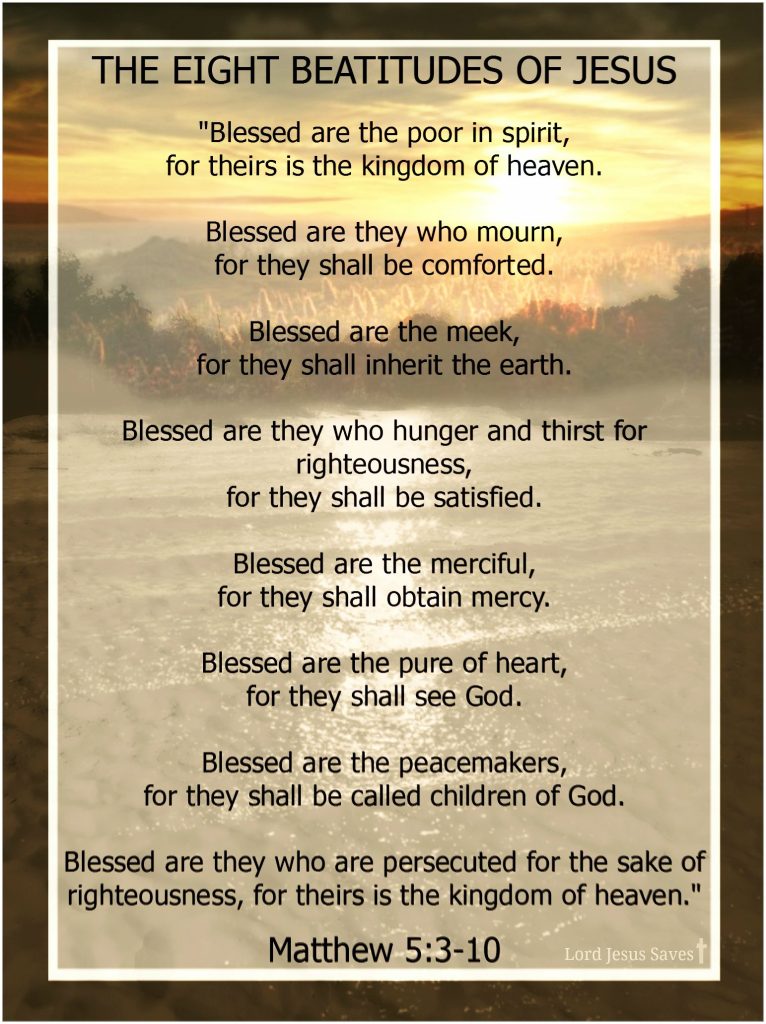
“Blessed are the poor in spirit, for theirs is the Kingdom of Heaven.”
The world tells us that blessed are those who are confident, full, and in control. Jesus tells us something different: blessed are those who recognize their need, who are humble enough to kneel before God, who admit that without Him, we can do nothing.
This is why the promise is so great: theirs is the Kingdom of Heaven. St. Augustine says, the proud seek kingdoms they can control. The humble receive a Kingdom they could never earn.
From there, Jesus moves to the next step of discipleship:
“Blessed are the meek, for they shall inherit the earth.”
As St. Ambrose wisely notes, once we have learned happiness in poverty, the next lesson is mastery of the heart. Poverty of spirit cleanses our hands; meekness purifies our hearts.
Meekness is often misunderstood. The world thinks it means weakness, silence, passivity. But as St. Augustine explains, the meek are not those who are defeated by evil, but those who refuse to let evil make them evil. They do not resist wrong with revenge; they conquer it with goodness. It is the strength of Christ Himself, who said, “Learn from me, for I am meek and humble of heart.”
And the promise is profound: they will inherit the earth not just land or possessions, but the eternal inheritance, the land of the living, (Ps. 142:5.) the place where the soul finds rest in God.
The meek possess their inheritance, because it is rooted in God, not in circumstance.
The Beatitudes move with a deep inner logic. After poverty of spirit and meekness comes a third, more painful grace:
“Blessed are they that mourn, for they shall be comforted.”
Once we have learned humility before God and gentleness toward others, we must finally turn inward and face the truth about ourselves: we are sinners. True discipleship does not stop at self-emptying or self-control; it leads to repentance.
St. Augustine says, when we turn to God, we lose our taste for worldly pleasures that once satisfied us. There is real sorrow in that loss. But that sorrow is not healed by returning to the world, it is healed only when a new love is formed within us: love for eternal things. And this comfort is the work of the Holy Spirit, rightly called the Paraclete, the Comforter.
Christian mourning is not despair. It is not sadness without hope. It is sorrow that looks toward mercy, tears that prepare the heart for joy. Only those who dare to mourn their sins can truly rejoice in forgiveness.
The Beatitudes continue their steady, interior ascent. After humility, meekness, and mourning for sin, the soul does not remain empty. Something new awakens within it: desire. So, Jesus declares
“Blessed are they who hunger and thirst for righteousness, for they shall be filled.”
St. Ambrose captures this movement beautifully. Once a person has truly wept for sin, a holy appetite is born. Just as a seriously ill person has no hunger, so a soul sick with sin has no desire for righteousness. But when healing begins through repentance, hunger returns. We begin to crave what is good, just, and holy. And Christ feeds that hunger. Our pursuit of righteousness becomes our nourishment, a spring welling up to eternal life.
From the heart, the Beatitudes now turn outward:
“Blessed are the merciful, for they shall obtain mercy.”
Mercy is not simply giving alms. It includes every way we carry one another’s burden patience with weakness, forgiveness of sin, gentleness with failure, silence instead of harsh judgment. To be merciful is to refuse to abandon a brother or sister to their misery, whether physical, moral, or spiritual.
The merciful receive more than they deserve. The merciful are granted a glory greater than all the Beatitudes that have gone before. Mercy opens the widest space in the heart for God Himself.
Human mercy and divine mercy are not comparable. Human mercy is limited, but God’s mercy is infinite. The more we give in love; the more God pours out His grace. What we give in drops, He returns as an ocean.
With this Beatitude, the Lord brings us very close to the summit:
“Blessed are the pure in heart, for they shall see God.”
St. Ambrose reminds even mercy can lose its reward if it is not rooted in purity. Mercy must flow from a heart that is undivided, focused on God, not on praise or recognition. Purity is the temple of God in our hearts. Those who are pure begin to see God now, and one day, they will see Him face to face.
St. Anselm observes that purity of heart comes sixth, recalling the sixth day of creation, when humanity was made in the image of God. That image was disfigured by sin, but it is re-formed by grace in the pure heart. And it cannot be formed in isolation. Poverty of spirit, meekness, repentance, hunger for righteousness, and mercy all prepare the heart for this final refinement. Without them, purity becomes a false ideal.
Purity is the temple of God in our hearts. The temple of God cannot be impure. If God dwells within us, the heart must become a sanctuary.
The promise reaches beyond this life. Those who are pure begin to see God now, “as in a mirror, and one day, they will see Him face to face.
With this Beatitude, Jesus draws us to the threshold of divine likeness:
“Blessed are the peacemakers, for they shall be called the children of God.”
True peace always begins not in society, not in the family, not even in the Church, but within the heart. St. Jerome sharpens the teaching. Peacemakers are those who make peace first within their own hearts, then between brethren at variance.
We cannot reconcile others if our own hearts are battlefields of pride, lust, anger, and resentment. Inner disorder always sabotages outer peace. And true peace is not merely spoken it is lodged in the heart.
True peacemakers forgive, reconcile, and bring the love of God into every broken relationship. In this, they resemble Christ Himself and are called His children.
The Beatitudes now reach their crown and their cost.
“Blessed are they who are persecuted for righteousness’ sake, for theirs is the kingdom of heaven.”
Christ places this Beatitude immediately after “Blessed are the peacemakers” to teach us that peace must never be sought at the expense of truth.
Peace and goodness may bring opposition. Yet faithfulness, even in suffering, is a sign of closeness to God.
The Christian is called to be a peacemaker, but not a compromiser. When peace demands silence in the face of injustice, fidelity to righteousness may bring opposition and persecution. Such suffering is not a failure, but a sign of faithfulness.
As St. Augustine teaches, when peace is firmly established within the heart, when the soul is rightly ordered under God, external persecution loses its power to disturb. On the contrary, such suffering endured with interior peace becomes a testimony of faith, a refinement of virtue, and a participation in Christ’s own suffering.
St. Augustine notes the structure: the eighth Beatitude returns to the first, framing the path of holiness. The seven preceding Beatitudes form the “perfect man,” cultivating virtues step by step: the eighth manifests the completion of this perfection.
The Beatitudes lead us step by step, from humility to meekness, from mourning to hunger for righteousness, from mercy to purity, peace, and faithful endurance. They do not start with what we must do, but with who we must become.
What begins in hope and spiritual growth is brought to completion in eternal joy, the reward of those who follow Christ in all things. And at every step, God’s promise is clear: He is with us, and He will bring us to His Kingdom.
So, let us go up the mountain, not with noise or pride, but with reverence and trust. Let us sit at the feet of the Master, open our hearts to His teaching, and begin the journey of becoming poor in spirit, meek, merciful, pure, and steadfast in love. In this way, we may receive the only wealth that lasts forever: the Kingdom of Heaven.
✍ Fr James Abraham
 Nelson MCBS
Leave a comment